

B2B Sourcing Guides
Buy Kit Kat 1.5 oz (36 Count) Wholesale: Bulk Buying Guide

09
Jul
Jul
The 1.5 oz (36 Count) WHOLESALE unit is not merely a product selection. It’s a logistical standard that defines retail efficiency and B2B profitability in the confectionery sector. You’ve likely dealt with the operational headaches of fluctuating shipping costs for heavy bulk boxes or the financial risk of receiving near-expiry inventory. Managing these variables is essential for maintaining a healthy bottom line. We understand that a reliable supply chain is the difference between a stocked shelf and a lost sale.
This guide provides a professional framework to optimize your procurement of these specific 36-count units. You’ll learn how to lower your landed cost per unit while ensuring a consistent supply of global brands like Kit Kat and Hershey’s. We’ll cover essential 2026 FDA import regulations, including the Foreign Supplier Verification Program (FSVP) and facility registration requirements. This overview details strategies for managing international transit risks and securing shelf-ready packaging that meets your operational standards.
Key Takeaways
- Identify why the 1.5 oz (36 Count) WHOLESALE unit serves as the logistical benchmark for retail display efficiency and inventory auditing.
- Learn how to optimize per-unit shipping costs by leveraging standard 36-count case dimensions for international procurement.
- Understand strategic placement techniques for display-ready boxes to maximize impulse sales in high-traffic retail zones.
- Implement rigorous quality control standards to manage temperature-sensitive stock and ensure “Best By” date transparency.
- Discover the advantages of a systematic supply chain partner to maintain a consistent inventory of top-tier brands like Kit Kat and Hershey’s.
Understanding the 1.5 oz (36 Count) Wholesale Standard
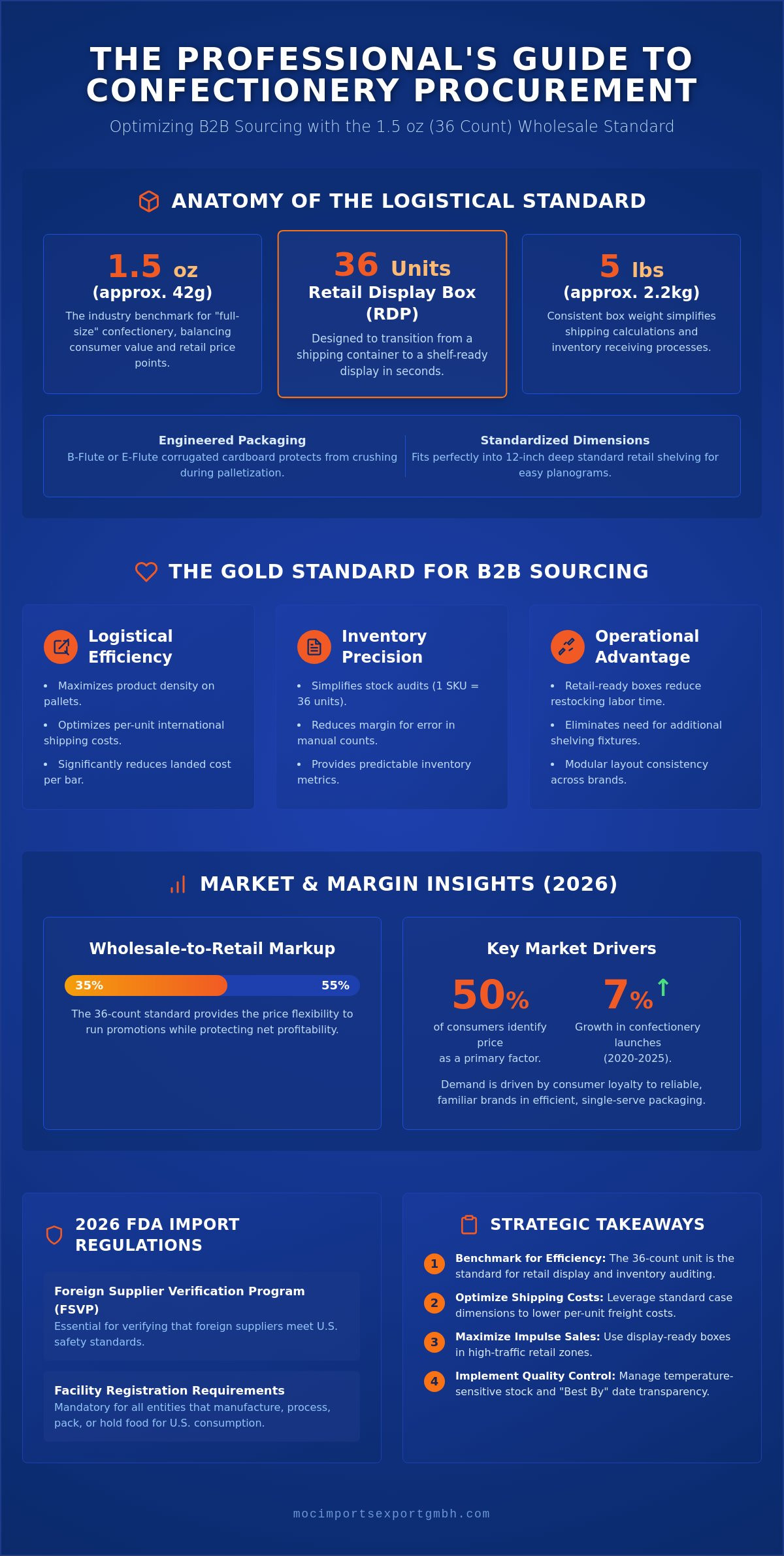
The 1.5 oz (36 Count) WHOLESALE unit is the foundational logistics block for the global confectionery trade. This format is officially recognized as a Retail Display Box (RDP). It’s designed to transition from a shipping container to a shelf-ready display in seconds. A 1.5 oz bar, weighing approximately 42g, remains the industry benchmark for “full-size” confectionery across the United States and European markets. This size offers the ideal balance between consumer value and retail price points.
Major manufacturers, specifically The Hershey Company, utilize this 36-unit configuration to maximize pallet density and retail visibility. The individually wrapped packaging is critical. It maintains the structural integrity of the wafer and chocolate while ensuring food safety standards are met during transit. Reviewing the History of Kit Kat shows how this specific portion size became a global standard for convenience and resale value. For professional buyers, this unit represents a predictable inventory metric that simplifies the procurement process.
The Anatomy of a Wholesale Candy Box
The structural integrity of a 36-count cardboard display tray is engineered for the rigors of international shipping. These trays are typically made from B-flute or E-flute corrugated cardboard. This material protects the bars from crushing during palletization. Standardized dimensions allow for precise shelf-space planning. Most 36-count boxes fit perfectly into the 12-inch depth of standard convenience store shelving. Weight is another critical factor. A single 1.5 oz (36 Count) WHOLESALE box weighs roughly 4.5 to 5 pounds. This consistency simplifies shipping calculations and labor requirements for inventory teams during the receiving process.
Market Demand for Full-Size Bars in 2026
Consumer behavior in 2026 continues to favor the single-serve, portion-controlled format. While variety packs exist, the 36-count single-SKU box outperforms them in commercial settings due to brand loyalty and display efficiency. Statistics show that 50% of global consumers identify price as the primary factor in chocolate purchases. Buying in the 36-count format allows retailers to offer competitive pricing while maintaining healthy margins. There is also a significant shift toward bulk purchasing for office breakrooms and home pantries. Global confectionery launches grew by 7% between 2020 and 2025, driven by the demand for reliable, familiar brands in efficient packaging. This format minimizes waste and ensures that every unit is shelf-ready upon arrival.
Why the 36-Count Unit is the Gold Standard for B2B Sourcing
Professional buyers prioritize the 36-count format because it perfectly balances shipping volume with inventory turnover. In high-volume retail environments, the 1.5 oz (36 Count) WHOLESALE unit acts as a logistical anchor. It allows for the optimization of per-unit shipping costs in a way that smaller 12 or 24-count packs cannot match. By maximizing the product density within each master case, businesses can significantly reduce their landed cost per bar. This efficiency is critical for maintaining competitiveness against larger big-box retailers that leverage massive economies of scale.
Inventory tracking also becomes more precise with this format. A single SKU represents exactly 36 units, which simplifies stock audits and reduces the margin for error during manual counts. The retail-ready design of these boxes is another operational advantage. Most Hershey’s and Kit Kat wholesale units feature perforated lids that convert the shipping container into a countertop display in seconds. This eliminates the need for additional shelving fixtures and reduces the labor time required for restocking. Standardized dimensions across major brands allow for modular shelf layouts, ensuring that your planograms remain consistent even when rotating different product lines.
Unit Pricing and Margin Protection
Protecting your margins requires a clear understanding of the break-even point for each shipment. When sourcing the 1.5 oz (36 Count) WHOLESALE unit, the calculation must include freight, duties, and warehousing overhead. The average wholesale-to-retail markup for full-size confectionery bars in 2026 typically ranges between 35% and 55% depending on the specific retail channel. By purchasing in the 36-count standard, you gain the price flexibility needed to run promotions or loyalty discounts without compromising your net profitability. This volume-based approach is the most reliable method for securing top-tier brands at a sustainable price point.
Logistical Efficiency in Warehousing
Warehousing efficiency is defined by stackability and pallet configuration. The 36-count master cases are engineered for high-density storage, allowing for stable stacking that prevents product crushing. Faster restocking of 36-unit blocks reduces labor costs and ensures that high-traffic zones remain stocked during peak hours. Compliance with FDA requirements for food importers is also easier to manage with standardized units, as labeling and lot tracking are uniform across the shipment. This systematic approach minimizes packaging waste per unit sold, aligning your operations with modern sustainability goals. For specific inquiries regarding pallet quantities and lead times, you can request a logistics consultation with our procurement team.
Maximizing ROI: Resale and Distribution Strategies
Turning bulk inventory into liquid capital requires a disciplined distribution strategy. The 1.5 oz (36 Count) WHOLESALE unit is uniquely positioned for high-velocity turnover in retail environments. Strategic placement at the point of sale is the primary driver of impulse purchases. Countertop displays utilizing the original 36-count tray typically outperform aisle-end placements for single-unit bars. This occurs because the visual cues of a full, branded box signal freshness and availability to the consumer at the exact moment of transaction.
Pairing these units with existing beverage programs increases the average transaction value. For example, positioning Kit Kat bars adjacent to coffee stations creates a logical cross-merchandising opportunity. Consumers often seek a sweet accompaniment to hot drinks, particularly in office environments and travel hubs. Seasonal peaks like Halloween and Easter also offer opportunities for accelerated turnover. During these periods, increasing stock levels for the 1.5 oz (36 Count) WHOLESALE units ensures your business captures high-volume demand without the risk of stockouts.
C-Store and Retail Display Optimization
Retailers must treat the 36-count box as a silent salesman. Its design is intended to grab attention without requiring additional signage or expensive fixtures. Managing inventory through the FIFO (First-In, First-Out) method is essential for maintaining product quality in the food and beverages snacks category. Rotating older stock to the front of the display prevents stale inventory and protects your brand reputation. This systematic approach ensures that every unit sold meets consumer expectations for texture and flavor.
Vending and Micro-Market Applications
In the vending sector, the 1.5 oz bar is the universal slot standard. Its dimensions are optimized for mechanical dispensing, which minimizes the risk of product jams and expensive service calls. Utilizing high-capacity 36-count boxes allows operators to reduce service frequency, effectively lowering operational overhead. Consumers show a clear preference for recognized brands like Kit Kat over generic alternatives in micro-market settings. Brand recognition reduces the friction of the purchase decision, leading to higher conversion rates per machine visit. Reliable dispensing and brand trust remain the two pillars of a profitable vending route.
Logistical Considerations: Freshness, Shipping, and Global Sourcing
Sourcing 1.5 oz (36 Count) WHOLESALE units internationally involves complex logistical variables that directly impact your bottom line. Confectionery is a delicate commodity. Unlike non-perishable consumer goods, chocolate requires a strictly controlled environment to maintain its structural integrity and flavor profile. Professional procurement teams must account for the specific challenges of global transit, including customs delays and climate variations. Managing these risks is the only way to ensure that your inventory arrives in shelf-ready condition.
Transparency regarding “Best By” dates is a critical component of any wholesale contract. Near-expiry stock represents a significant financial risk for retailers. We prioritize clear documentation that guarantees a minimum shelf-life for every 36-count box. This level of transparency allows you to plan your inventory turnover with confidence. Navigating global import and export regulations for branded goods requires expertise in FDA Prior Notice and Foreign Supplier Verification Programs (FSVP). Proper documentation ensures that shipments aren’t refused entry, preventing costly disruptions to your supply chain.
Temperature-Controlled Supply Chains
The use of reefer containers is the industry standard for long-haul international shipping. These refrigerated units maintain a constant temperature between 15°C and 18°C. For shorter transit or less extreme climates, insulated thermal blankets and gel packs provide a cost-effective alternative. Seasonal shipping windows are a critical planning tool. Smart retailers often increase their stock levels during cooler months to avoid the increased freight costs and spoilage risks associated with summer heatwaves. Chocolate bloom results in a white, powdery surface that significantly diminishes the aesthetic appeal and resale value of the product.
Verifying Authenticity in International Trade
Due diligence is non-negotiable when sourcing global brands like The Hershey Company. Counterfeit or gray-market goods often lack the proper temperature controls during their journey, leading to degraded quality. You should review our guide on Wholesale Consumer Goods Sourcing Strategies for US Retailers to understand the verification process for international suppliers. Working with an established German-based importer like MOC provides a layer of European regulatory oversight and systematic quality control. We ensure that all documentation is handled with precision, from facility registration to final delivery. If you’re ready to secure a reliable supply chain, you can contact our logistics department for a detailed quote.
Sourcing 1.5 oz (36 Count) Inventory with MOC Imports Export GmbH
MOC Imports Export GmbH acts as a systematic bridge between global manufacturers and professional buyers. Our confectionery portfolio is built around high-demand units from The Hershey Company. We maintain a consistent supply of the 1.5 oz (36 Count) WHOLESALE standard to ensure your retail operations remain uninterrupted. Specific inventory availability includes KIT KAT Milk Chocolate Wafer Candy Bars in the 1.5 oz 36-count box and HERSHEY’S SPECIAL DARK Mildly Sweet Chocolate Candy Bars in the 1.45 oz 36-count format. These products are stored and transported under strict environmental controls to preserve the quality standards required for professional resale.
Our professional B2B platform is designed for rapid decision-making and high-volume procurement. We manage the entire logistical chain from our German headquarters to national distribution points across the United States. This centralized control minimizes the risk of stock degradation and ensures all documentation complies with international trade laws. By utilizing a grounded and reliable supply chain, we provide the organized competence that business-to-business clients require for complex inventory management. Our focus remains on the ease of the transaction and the reliability of the landed product.
Streamlined Procurement for Business Clients
MOC facilitates bulk orders for food and beverages with a focus on logistical efficiency. We offer customized shipping solutions that cater to the scale of large retail chains and commercial distributors. Our platform also provides direct access to diversified inventory beyond confectionery. You can source professional dental products through our Oral-B guide or secure skincare lines like CeraVe. This multi-category approach allows you to consolidate your supply chain and reduce administrative overhead. Every order is processed with surgical precision to ensure timely delivery and accurate SKU counts.
Contact MOC for Professional Sourcing
Our online store provides real-time visibility into wholesale availability and current stock levels. The primary benefit of the MOC partnership is the reliability of a systematic logistical partner. We eliminate the ambiguity often found in international trade by providing structured information and efficient communication. Every word in our procurement process serves a specific purpose in moving 1.5 oz (36 Count) WHOLESALE goods from the manufacturer to your warehouse. This rhythmic efficiency ensures that critical data points are highlighted immediately for your procurement team. You can view our full range of wholesale snacks and confectionery to begin optimizing your inventory today.
Optimizing Your Confectionery Procurement Strategy
Mastering the logistics of the 1.5 oz (36 Count) WHOLESALE unit is a prerequisite for retail profitability. We’ve detailed how this industry standard optimizes shipping density, simplifies inventory audits, and ensures vending machine compatibility. Success in the global confectionery trade requires more than just product access. It demands a rigorous approach to temperature-controlled transit and strict compliance with current FDA import regulations to prevent inventory loss. Consistency in your supply chain is the primary driver of long-term margin protection.
MOC Imports Export GmbH provides the systematic framework necessary for high-volume B2B trade. Our German-based logistical expertise ensures every shipment of Kit Kat or Hershey’s meets high quality benchmarks. We’re specialists in bulk B2B import and export, offering free shipping on top-tier branded products. Secure your next inventory cycle with a partner that prioritizes procedural simplicity and transactional clarity. Browse 36-Count Wholesale Confectionery at MOC Imports Export GmbH to discuss your volume requirements. We look forward to facilitating your business growth through organized and dependable wholesale solutions.
Frequently Asked Questions
What is the shelf life of a 36-count box of chocolate bars?
The standard shelf life for milk chocolate is 12 months from the date of manufacture. Proper storage is essential to maintain this duration. Inventory should be kept in a climate-controlled environment with temperatures between 15°C and 18°C. Humidity levels must remain below 50% to prevent sugar bloom. We provide “Best By” date transparency on all wholesale contracts to ensure you receive stock with maximum remaining shelf life.
How much does a standard 36-count box of 1.5 oz candy bars weigh for shipping?
A standard 36-count box weighs approximately 4.5 to 5 pounds. This total includes the 54 ounces of product and the structural cardboard of the retail display tray. Accurate weight data is critical for calculating pallet density and freight costs. For large-scale procurement, these units are typically packed into master cases containing 12 boxes, which weigh roughly 60 pounds per case.
Can I order mixed brand 36-count boxes for wholesale?
Factory-sealed 1.5 oz (36 Count) WHOLESALE units contain only one specific SKU. Mixing different brands within a single 36-count box is not an industry standard. This restriction ensures inventory accuracy and prevents errors during retail scanning. For a diversified inventory, you should purchase individual 36-count boxes of each brand, such as Kit Kat and Hershey’s, to maintain organized stock levels and clear lot tracking.
What happens if my bulk chocolate order arrives melted?
Notify the carrier and our logistics team immediately if a shipment shows signs of heat damage upon arrival. We utilize temperature-controlled reefer containers to minimize this risk during international transit. You must document the damage with photographs and file a formal claim within 24 to 48 hours of delivery. Maintaining a strict chain of custody and using insulated packaging helps protect your investment during the final mile of distribution.
How do I verify the authenticity of branded wholesale candy?
Verification is achieved by sourcing exclusively through authorized manufacturer channels and reputable importers. Every 36-count box includes specific lot codes and production stamps that can be verified with the manufacturer. Authentic products like Kit Kat and Hershey’s feature high-quality printing on the packaging and consistent bar dimensions. Avoid gray-market suppliers that cannot provide a clear paper trail or proof of origin for their confectionery inventory.
Is the 1.5 oz (36 Count) format suitable for vending machines?
The 1.5 oz bar is the universal size standard for modern vending machine coils. Its dimensions ensure reliable mechanical dispensing without the risk of product jams. Using the 36-count box format allows operators to restock machines efficiently by using standardized unit blocks. This consistency reduces service frequency and operational overhead for vending routes. It’s the most dependable format for high-traffic micro-market and automated retail applications.
What is the difference between 1.5 oz and 1.55 oz bars in wholesale sizing?
The 0.05 oz difference is a brand-specific variation that does not affect the 1.5 oz (36 Count) WHOLESALE logistical footprint. Kit Kat bars are typically 1.5 oz, while Hershey’s Milk Chocolate bars are 1.55 oz. Both sizes utilize the same standard retail display box dimensions. This allows for modular shelf planning in convenience stores. Retailers can treat these sizes as interchangeable for the purpose of shelf-space allocation and inventory auditing.
Do wholesale 36-count boxes include individual barcodes for retail scanning?
Every individually wrapped bar in the 36-count box includes a unique UPC barcode for retail scanning. The outer display box also features a separate barcode for inventory management and wholesale transactions. This dual-layer barcoding simplifies the transition from bulk receiving to individual unit sales. It’s designed to integrate seamlessly with modern point-of-sale systems and automated warehouse management software, ensuring accurate tracking at every stage of the supply chain.
