

Uncategorized
KeHE Direct Alternatives for Independent Grocery: Comparing Packaged-Goods Suppliers

08
Oct
Oct
The right KeHE direct alternatives for independent grocery packaged goods depend on what your store needs to source. Another full-line distributor may not be the only answer: a mix of suppliers can cover different categories and purchasing requirements.
Before changing your sourcing setup, compare product range, ordering processes, and supply continuity. Full-line distributors, specialty wholesalers, and importers operate differently, so one supplier may not fit every part of your assortment. Use consistent procurement criteria to see where each model fits.
This article explains how to compare supplier types, assess products and operations, and build a sourcing mix around your store’s category priorities. It also covers MOC Import Export GmbH as a wholesale option for packaged-goods categories including coffee, snacks, drinks, sugar, milk powder, and refined sunflower oil.
Key Takeaways
- Assess alternatives by the categories and sourcing needs they can serve, rather than expecting every supplier to duplicate KeHE’s assortment.
- Compare broadline distributors, specialty wholesalers, importers, and category-focused suppliers according to the role each could play in your assortment.
- Evaluate product fit alongside ordering processes, account requirements, documentation, and supply continuity.
- Map category gaps and separate must-have requirements from preferences before shortlisting suppliers such as UNFI, C&S Wholesale Grocers, or Dot Foods.
- Consider MOC Imports Export GmbH for relevant packaged-goods categories as part of a sourcing mix.
What independent grocers should look for in KeHE Direct alternatives
A KeHE Direct alternative is a supplier that meets some or all of a store’s packaged-goods sourcing needs. It does not have to match KeHE’s assortment or operating model. The useful question is whether the supplier fits your categories, product formats, ordering workflow, and replenishment priorities.
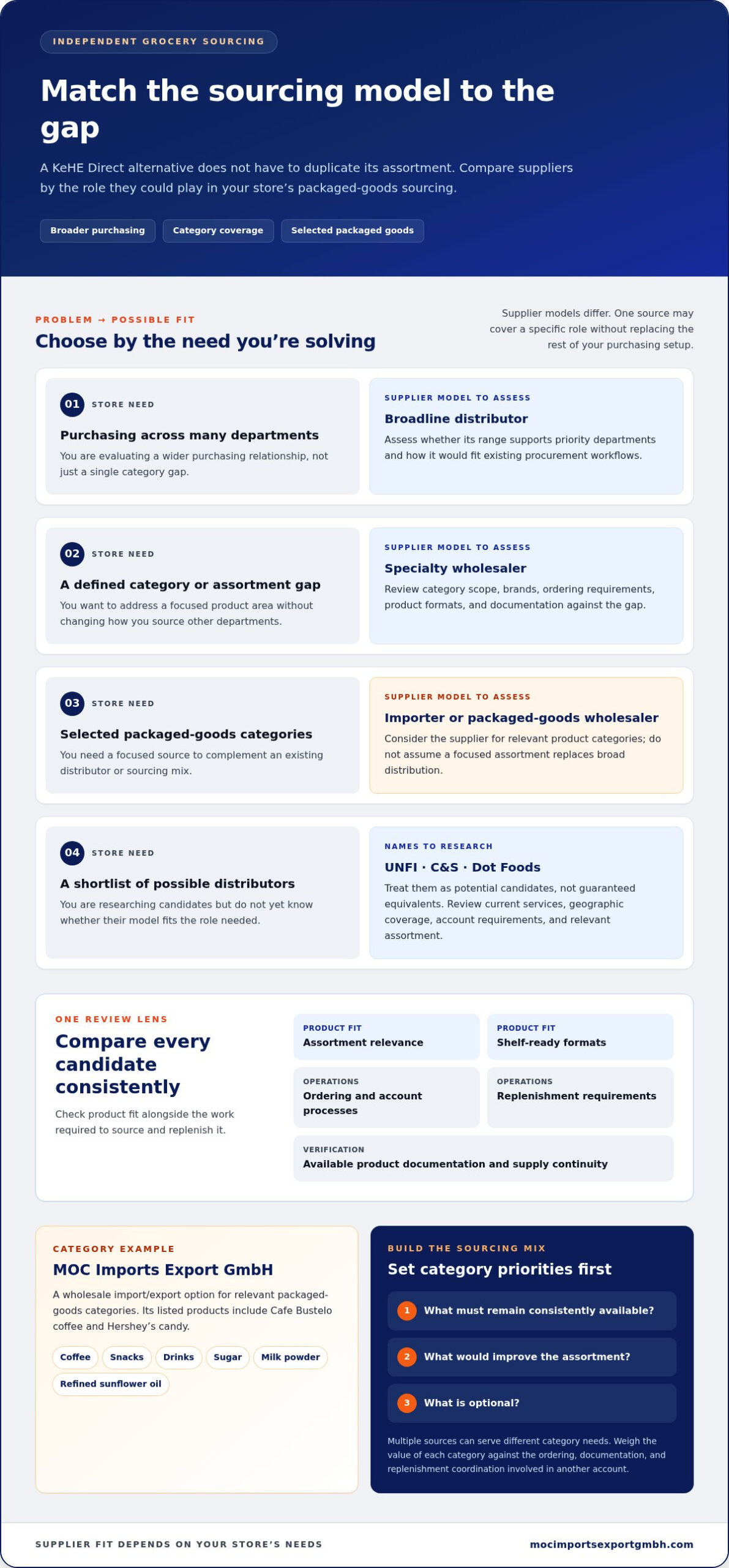
First, distinguish broad distribution from category-specific sourcing. A broadline distributor may support purchases across many departments. A specialty wholesaler or importer may focus on selected categories or product types. Your store might use a broad supplier for core inventory and another source to fill a defined assortment gap. Comparing every candidate as a one-for-one replacement can hide the different roles they could play.
When does an independent grocery need another sourcing option?
A new sourcing option can fill a product gap, support a category priority, or meet changing procurement requirements. For example, a store might want to expand its packaged coffee or snack assortment without changing how it buys other departments. That is different from replacing an existing distributor, which can affect a much larger part of purchasing and replenishment.
Multiple sources can make sense when their strengths match different category needs. The trade-off is operational: each account can involve its own ordering steps, documentation, and replenishment coordination. Weigh the expected value of the category against the work involved in managing another supplier.
What counts as an alternative to KeHE Direct?
A KeHE Direct alternative is a distributor, wholesaler, importer, or other supplier that can source packaged goods relevant to an independent grocer’s needs, across multiple categories or within a defined category. A broadline distributor generally serves a wider range of store needs; a specialty wholesaler focuses on selected product areas; an importer brings products through international sourcing; and a category-focused supplier concentrates on a narrower assortment. These labels describe general models, not a guarantee of fit.
Use the same review criteria for every candidate. Compare assortment relevance, shelf-ready formats, replenishment requirements, ordering and account processes, and available product documentation. A basic understanding of supply chain management can help frame how sourcing, movement, and product access connect.
Next, map your needs by category. Identify what must remain consistently available, what would improve the assortment, and what is optional. MOC Imports Export GmbH offers wholesale import/export sourcing for relevant packaged-goods categories, including coffee, snacks, drinks, sugar, milk powder, and refined sunflower oil. Its listed products include Cafe Bustelo coffee and Hershey’s candy. A grocer assessing coffee sourcing can review packaged coffee products as one part of that category review, while considering broader distribution needs separately.
KeHE Direct alternatives: compare distributor, wholesaler, and importer models
Supplier names alone do not show whether a business is a like-for-like replacement or a complementary source. Compare each candidate by the role it could play: broad assortment, focused category coverage, or access to selected packaged goods. This helps independent grocers assess KeHE direct alternatives for independent grocery packaged goods without assuming one supplier can meet every purchasing need.
How broadline and specialty distributors differ
A broadline distributor may be relevant when a store is evaluating a wider purchasing relationship. A specialty wholesaler focuses on a narrower range and may suit selected categories or assortment gaps. UNFI, C&S Wholesale Grocers, and Dot Foods are names to research as potential candidates, not guaranteed equivalents to KeHE Direct. Compare their current services, geographic coverage, account requirements, and product assortment against the role you need filled.
Where importers and packaged-goods wholesalers fit
Importers and packaged-goods wholesalers can complement an existing distributor when the need is narrower than full-line coverage. MOC Imports Export GmbH is a wholesale import/export option for relevant food and beverage categories, including snacks, coffee, and drinks. A grocer reviewing snack sourcing can consider packaged snack options as one category-specific input, rather than treating a focused assortment as a replacement for broad distribution.
The comparison below separates potential fit from the details to assess for each supplier type. Review the role, assortment, and operating requirements against your store’s needs.
| Supplier model or candidate | Potential fit | Comparison questions | Information to review |
|---|---|---|---|
| Broadline distributor | Evaluate for wider purchasing needs across store categories. | Does its range match priority departments? How would it fit existing procurement workflows? | Services, coverage, assortment, account processes, and replenishment details. |
| Specialty wholesaler | Consider for a defined category or assortment gap. | Does its product range support the store’s category priorities and formats? | Category scope, brands, ordering requirements, and product documentation. |
| UNFI, C&S Wholesale Grocers, or Dot Foods | Research as potential candidates for specific sourcing roles, not assumed equivalents. | Which role, if any, matches the store’s needs? | Business model, services, coverage, and relevant assortment. |
| Importer or packaged-goods wholesaler, including MOC Imports Export GmbH | Assess for selected packaged-goods categories such as coffee, snacks, and drinks. | Does the category fit justify adding a separate source? | Relevant products, ordering process, documentation, and applicable terms. |
For a practical comparison, record each candidate’s role beside the categories it may support. MOC’s wholesale sourcing can be evaluated within relevant packaged-goods categories, separately from broader distribution needs. Grocers reviewing a category-specific sourcing need can discuss relevant packaged-goods sourcing with MOC.
How to compare packaged-goods suppliers for an independent grocery
Use the same criteria for every candidate. A general category description is not enough; compare products and processes against your store’s assortment plan. A simple scorecard can show whether a candidate fills a shelf need, adds a useful brand or format, and fits the work your team can support. Base the comparison on current product and process information, and record any unanswered questions separately.
Which product and assortment criteria matter?
Start with priority shelf categories, then list the brands, formats, and product roles each requires. A coffee review, for example, might distinguish ground coffee from whole bean and everyday shelf items from products aimed at a narrower customer segment. Compare supplier catalogs against those requirements, not just the number of products shown. A store reviewing its coffee assortment can include relevant packaged coffee options as one reference point.
For each candidate, record whether the assortment matches the category, whether pack formats suit your shelves and inventory practices, and whether the brands support your plan. Note gaps as well as matches. A long catalog may have limited relevance if it misses the products or formats your store prioritizes.
Which operating criteria belong in the comparison?
Product fit is only part of the decision. Review ordering steps, account communication, available product information, and documentation. Consider how a new supplier would fit receiving routines, inventory records, and replenishment planning. Supply continuity matters too: assess what information is available about product access and how your store would manage a gap or change.
Supplier fit is the alignment of a supplier’s categories, product formats, and operating processes with a store’s assortment priorities and procurement workflow.
Use this checklist for each candidate:
- Category: Which priority shelf needs does the assortment address?
- Product: Do brands and formats match the store’s plan?
- Process: Are ordering, account communication, and documentation workable?
- Continuity: What information is available about product access and replenishment?
- Coordination: What additional receiving, inventory, or account-management work would another supplier add?
Mark each item as a match, a gap, or a detail to clarify. This prevents an attractive product range from obscuring operational demands and helps distinguish a supplier that fills a targeted category need from one that supports a broader purchasing role. Apply the same scorecard to KeHE direct alternatives for independent grocery packaged goods, then prioritize candidates by fit with your store’s requirements rather than by name recognition alone.
Build a practical sourcing plan without assuming one supplier replaces another
Begin a sourcing plan with store requirements, not a preferred supplier name. When considering KeHE direct alternatives for independent grocery packaged goods, decide which categories need another source and what role that source would serve. An existing distributor can remain responsible for core purchasing while a separate wholesaler or importer is considered for selected packaged goods.
Use a repeatable sequence:
- Map categories: List the departments and product groups the store needs to source.
- Identify gaps: Note missing brands, formats, or products that no longer match the assortment plan.
- Set requirements: Separate must-haves, such as category relevance or usable product information, from preferences.
- Shortlist models: Match each gap to broadline, specialty, importer, or category-focused options.
- Compare and review: Apply the same criteria to product information, account processes, terms, and operational fit.
Create a category-led sourcing shortlist
Group products by category before reviewing supplier options. Start with sales priorities, shelf needs, and known assortment gaps, then identify the product types and formats that could address them. This keeps a candidate’s broad catalog from distracting from your actual requirements. Use one comparison sheet for every supplier so differences in category fit, procurement processes, and available information are easy to see.
For example, a store could retain its current distributor for routine purchasing while evaluating a separate wholesale source for a targeted packaged-goods category. MOC Imports Export GmbH offers wholesale import/export sourcing for relevant categories such as coffee, snacks, and drinks. Focus the assessment on the category need and the supplier’s role in your sourcing mix.
Plan a manageable supplier mix
More suppliers can mean more account processes, orders, records, and receiving coordination. Before adding a relationship, define its purpose: which category it supports, what gap it addresses, and how your store will manage the added workflow. Keep requirements distinct from preferences and review product information and terms as part of the purchasing decision.
A mixed sourcing model may suit a store when broad distribution needs and category-specific product needs are better served by different supplier roles. Assign each source a clear scope, then review whether the arrangement remains useful as priorities and assortment needs change. This helps avoid overlap that adds administration without addressing a defined sourcing requirement.
Apply the same category-led approach to each consumer-goods requirement and keep supplier responsibilities clear. To discuss packaged-goods sourcing needs with MOC Imports Export GmbH, contact the wholesale team.
Assess MOC Imports Export GmbH for relevant packaged-goods sourcing
MOC Imports Export GmbH is a wholesale import/export company with food and beverage offerings for selected grocery categories. Independent grocers assessing KeHE direct alternatives for independent grocery packaged goods can consider MOC as a category-focused sourcing option. Its offerings are relevant when they align with a store’s assortment priorities.
Which MOC offerings may align with grocery packaged goods?
Relevant categories include coffee, snacks, drinks, sugar, milk powder, and refined sunflower oil. Examples include Cafe Bustelo coffee and packaged Hershey’s candy. These products can be considered when reviewing a shelf category or adding a wholesale source for selected packaged goods. Evaluate each product within your store’s assortment plan.
For a category-level review, compare coffee products with your existing beverage assortment. The Hershey brand page provides another reference for packaged candy. Consider how each category fits your shelf priorities, preferred product formats, and purchasing workflow. Do not infer assortment depth, stock levels, or delivery terms from a category name alone.
Start with a short category brief: identify the product group under review, its intended role in the store, and any brand or format requirements. Then compare relevant product information with your current sourcing arrangements. This keeps the evaluation focused on whether MOC can complement an existing distributor for selected categories.
What is the next step for grocery buyers?
Before discussing sourcing, summarize the categories you want to evaluate and the role you want a wholesale source to play. Note whether you want to supplement an existing supplier, address a specific assortment gap, or assess a source for relevant packaged goods. Clear priorities help focus the conversation on category fit and the procurement details that matter to your business.
- Category: Which packaged-goods group are you evaluating?
- Assortment: What brands, formats, or product roles matter to your store?
- Supplier role: Should the source complement current distribution or serve a specific category need?
For a focused discussion, discuss your packaged-goods sourcing needs with MOC Imports Export GmbH. Share your category priorities and preferred sourcing approach to assess fit.
Turn your sourcing review into a clear next step
A supplier decision does not have to begin with a full purchasing change. Start with one category, define what a useful outcome would look like, and document how a new source would fit your buying process. This gives you a focused basis for assessing KeHE direct alternatives for independent grocery packaged goods and keeps the next decision tied to your store’s priorities.
As your assortment or procurement requirements change, revisit the category brief. Record what is working, what remains a gap, and whether each supplier still has a clear role. A disciplined review can help you adjust the sourcing mix without changing parts of the business that continue to meet your needs.
MOC Imports Export GmbH supports wholesale and bulk import/export purchasing for retail and commercial buyers. If you are evaluating a category-specific packaged-goods source, share the categories and sourcing requirements your store is considering. Start a sourcing conversation with a focused plan.
Frequently Asked Questions
What are the best alternatives to KeHE Direct for independent grocery stores?
The right options depend on the categories and purchasing roles a store needs to cover. UNFI, C&S Wholesale Grocers, and Dot Foods can be research candidates, alongside specialty wholesalers and importers. Treat these as starting points, not a ranked list or guaranteed equivalents. For KeHE direct alternatives for independent grocery packaged goods, build a shortlist around specific category gaps and compare each candidate’s services and assortment with those needs.
Is UNFI a direct alternative to KeHE Direct?
UNFI may be a candidate for stores evaluating broad natural, organic, and specialty distribution, but it should not be assumed to match KeHE Direct in every respect. The businesses may differ in assortment, account processes, and coverage. Compare their offerings against the categories you need and decide whether you are replacing a broad relationship or sourcing a narrower group of products.
Can independent grocers use multiple packaged-goods wholesalers?
Yes. A store can source different categories through more than one wholesaler while retaining an existing distributor for other purchasing needs. For example, a grocer might use one supplier for routine department orders and another for a defined packaged-goods category. Weigh the category fit against the additional account administration, order tracking, receiving coordination, and inventory records involved.
How should a grocery buyer compare KeHE Direct alternatives?
Use a written comparison based on the store’s planned assortment and operating capacity. Record relevant product formats, brand fit, order steps, account communication, product documentation, and replenishment information. Separate details found in current supplier materials from assumptions. This creates a more useful decision record than choosing on name recognition alone and clarifies why a candidate suits a particular purchasing role.
What is the difference between a broadline distributor and a specialty wholesaler?
A broadline distributor generally serves purchasing needs across a wider set of product categories, while a specialty wholesaler concentrates on a narrower area or product type. For a store, that difference affects how a source might fit existing orders: broadline purchasing can address multiple departments, while specialty sourcing may suit a specific assortment need. Actual scope varies, so compare product catalogs and service information with your requirements.
Can an importer complement an independent grocery store’s existing distributor?
Yes. An importer can serve as an additional wholesale source for selected products or categories while the store continues using its existing distributor for other needs. This can be relevant when a buyer is assessing products tied to international sourcing or a specific packaged-goods assortment. Include product documentation, order coordination, receiving, and inventory processes in the decision.
What packaged-goods categories can MOC Imports Export GmbH supply?
MOC Imports Export GmbH offers wholesale and bulk import/export sourcing across food and beverage categories that include coffee, snacks, and drinks, as well as sugar, milk powder, and refined sunflower oil. Branded examples include Cafe Bustelo coffee and Hershey’s candy bars. These categories can suit buyers evaluating a focused packaged-goods source.
