

Uncategorized
McLane alternatives for candy and snack wholesale: compare supplier options

22
Oct
Oct
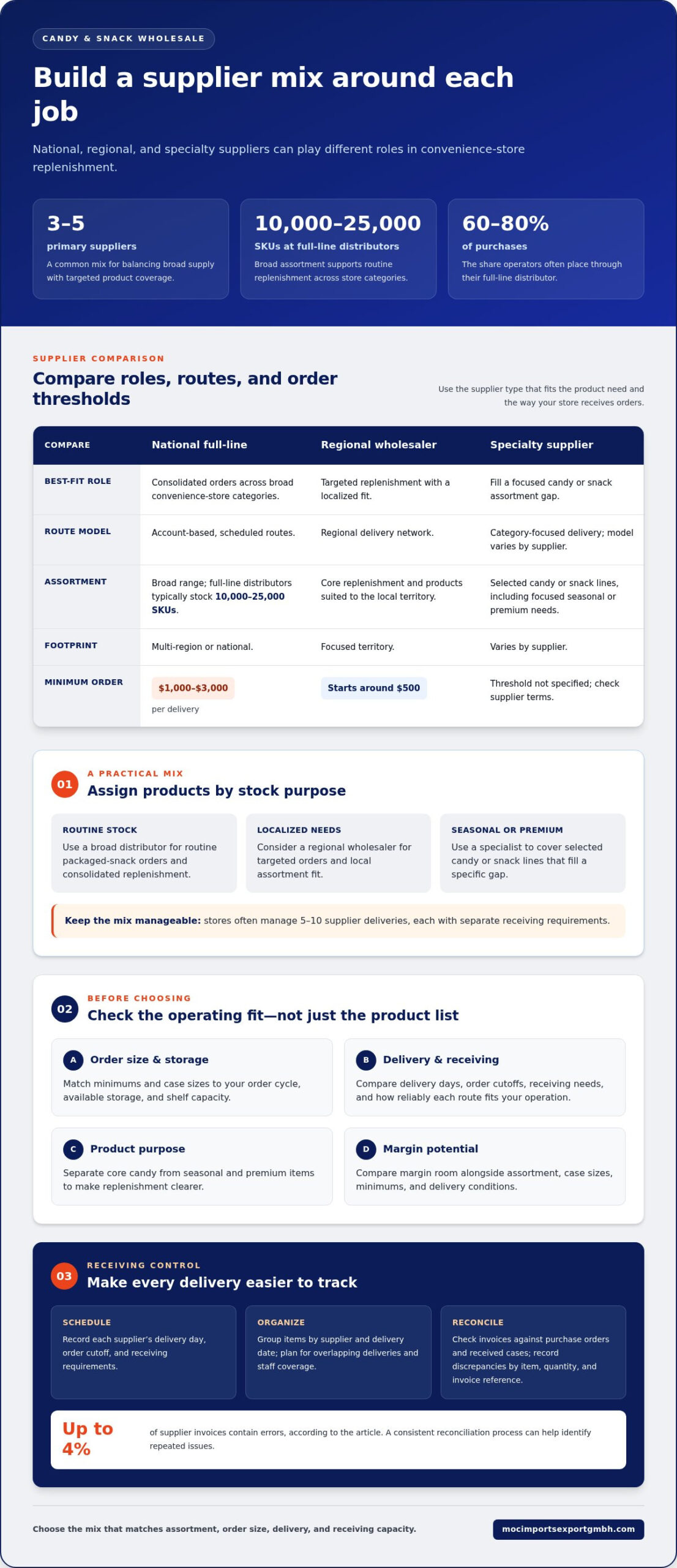
The best McLane alternatives for convenience store candy and snack wholesale may be a mix of suppliers, not one direct replacement. Convenience-store operators typically work with 3-5 primary suppliers, combining national, regional, and specialty options to balance broad restocking with focused candy selection.
McLane’s full-line model can simplify ordering, but another supplier setup may better match your store’s assortment, delivery needs, and order volume. Compare practical buying conditions, not just product lists. This guide explains how supplier types differ in candy and snack selection, order requirements, and restocking, so you can identify the right fit for your operation.
See how national distributors compare with regional wholesalers and specialty suppliers, what trade-offs to expect, and how to assess case sizes, minimums, delivery reliability, and margin potential. A comparison table and decision guide can help narrow your options and build a supplier mix around your store’s needs.
Key Takeaways
- National full-line distributors typically carry 10,000 to 25,000 SKUs, making them useful for broad store replenishment.
- Compare delivery schedules and receiving requirements alongside assortment; dependable restocking can matter more than small price differences.
- Regional wholesalers may suit targeted orders, while specialty suppliers can help fill gaps in seasonal or premium candy selections.
- Use a supplier mix that matches your store’s selling patterns, case-size needs, and available storage, rather than relying on assortment alone.
- Separate core candy from seasonal and premium items to make replenishment decisions clearer and reduce avoidable inventory complexity.
National convenience-store wholesale distributors
National distributors combine broad assortments with scheduled routes for convenience-store accounts. McLane’s full-line model illustrates how one distributor can support routine orders across multiple store categories.
Distributor Scale and Retail Locations
Scale affects warehouse coverage, assortment breadth, and the retail locations a distributor can serve. McLane generates $27.3 billion in annual sales and operates 80 grocery and food service distribution centers across the United States.
McLane employs 20,000 teammates and operates 6,100 multi-temperature trailers. Full-line convenience-store distributors typically stock between 10,000 and 25,000 SKUs. Convenience-store operators often use their full-line distributor for 60-80% of purchases, making assortment breadth a central consideration for routine ordering.
Compare each supplier’s role, not just its size. A national distributor may suit stores seeking consolidated orders across broad categories. A regional wholesaler may focus on a narrower territory, while a specialty supplier may carry selected candy or snack lines. These differences affect how many orders, deliveries, and receiving processes your store manages.
| Supplier option | Typical route model | Assortment role | Footprint |
|---|---|---|---|
| National full-line distributor | Account-based, scheduled routes | Broad convenience-store range | Multi-region or national |
| Regional wholesaler | Regional delivery network | Core replenishment and local fit | Focused territory |
| Specialty supplier | Category-focused delivery | Selected candy or snack lines | Varies by supplier |
Direct-Store Candy and Snack Delivery
Direct-store delivery for candy, chips, and packaged snacks varies by supplier and product category. McLane is described as using account-based distribution and scheduled delivery routes; that model alone does not establish brand-specific direct-store delivery.
Category-focused suppliers may deliver selected snack lines directly to stores, while full-line distributors combine products in broader orders. To distinguish a scheduled distributor route from a brand’s direct-store route, identify who supplies each item and how it reaches your store. Then compare delivery timing, order handling, and receiving needs for the products that matter most.
McLane’s national footprint and broad SKU range can suit operators seeking consolidated orders. Regional wholesalers may fit a localized assortment, while specialty suppliers can cover narrower candy or snack needs. Choose according to route coverage, warehouse assortment, and ordering model, and how well they match your store’s replenishment needs.
Historical company figures add another point of scale: McLane Company reported revenue of US$50 billion in 2017 and 20,545 employees. These figures provide context for evaluating the resources behind a national supplier, but operators should still assess route fit, order consolidation, and the service needs of their own stores.
Choosing a mix of national, regional, and specialty suppliers
Convenience stores typically work with 3-5 primary suppliers, balancing broad supply with targeted product coverage. Stores can buy candy and snacks from manufacturers or cash-and-carry wholesalers; the route, order size, and product range depend on the supplier.
Supplier Selection for Independent Stores
Independent stores can assign distinct roles to national, regional, and specialty distributors. A national supplier can consolidate broad orders, a regional wholesaler may suit localized replenishment, and a specialty supplier can fill a focused candy or snack gap.
Set the mix by listing core products, seasonal needs, and receiving capacity. Then compare case sizes, minimums, delivery days, and margin room. Convenience stores often manage 5-10 supplier deliveries, each with separate receiving requirements, so every added account creates coordination work.
Drug stores and food service operators may buy differently, but convenience retailers also benefit from matching supplier type to stock purpose. For example, source routine packaged snacks through a broad distributor and selected premium candy through a specialist. This keeps purchasing organized without expecting every supplier to cover the full assortment.
Minimum Orders and Delivery Frequency
Order thresholds differ by supplier type. National distributors’ minimum orders are $1,000 to $3,000 per delivery, while regional wholesalers’ minimum order quantities start around $500.
Compare each order threshold with your store’s order cycle and storage space. A higher minimum may work for consolidated replenishment, while a lower threshold can suit selective orders. Delivery frequency also affects inventory: frequent deliveries can support tighter stock levels, while less frequent deliveries require planning around case quantities and shelf capacity.
Build a receiving calendar that records each supplier’s delivery day, order cutoff, and receiving requirements. With 5-10 suppliers, staggered schedules can reduce dock congestion, but overlapping deliveries can complicate staff coverage. Group items by supplier and delivery date, then assign a receiving check for quantities and damaged cases.
Reconcile each invoice against the purchase order and received cases. Up to 4% of supplier invoices contain errors, so record discrepancies by item, quantity, and invoice reference. A consistent process helps identify repeated issues and keeps the store’s inventory records aligned with actual deliveries.
- Choose by role: Assign broad replenishment to full-line supply and targeted gaps to specialists.
- Schedule by capacity: Align delivery days with available receiving staff and storage space.
- Reconcile by case: Match invoice quantities with purchase orders and received stock.
For a practical purchasing discussion, use the wholesale contact page to outline your supply requirements.
Delivery reliability and restocking
Reliable restocking means matching order timing to your store’s sales pattern and receiving capacity. McLane Company uses account-based distribution and scheduled delivery routes, giving operators a defined structure for planning merchandise replenishment.
A route model is one comparison point, not a complete measure of service. Check whether the delivery schedule fits your receiving hours, shelf space, and inventory cycle. A candy order for a promotion needs a different receiving plan from routine packaged-snack replenishment.
McLane operates 6,100 multi-temperature trailers. The fleet figure illustrates the scale of its distribution operation, but store-level reliability is experienced through individual orders and deliveries. For any distributor, track the order against the delivery: were requested cases received, were substitutions recorded, and could staff put merchandise away promptly?
Use a simple receiving process for each shipment:
- Match: Compare delivered cases with the purchase order and invoice.
- Record: Note missing, damaged, or substituted items against the relevant order.
- Replenish: Move received candy and snacks to shelves using the store’s stock rotation practice.
- Adjust: Use sales and remaining inventory to shape the next order.
These steps can help distinguish a delivery issue from an ordering issue. If a fast-selling chocolate bar repeatedly sells out before the next scheduled route, review its sales pace, case quantity, and order timing together. If the shelf is still full after delivery, reduce the next order rather than adding more stock.
Delivery reliability can affect margin. A late or incomplete order may leave a promotion short of stock, while excess cases take up space and tie up working inventory. Compare suppliers on delivery consistency, order completeness, and the effort needed to receive each shipment. A small difference in item cost matters less if a route repeatedly disrupts store operations.
If your store uses separate grocery and foodservice supply channels, map each delivery against staff coverage and receiving space. Avoid overlapping arrivals when one team or receiving area handles both. A practical route calendar should list the supplier, expected delivery day, order cutoff, receiving contact, and merchandise categories due.
U.S. operators comparing McLane alternatives for convenience store candy and snack wholesale can use the same operating scorecard for national, regional, and specialty distributors. Record results from actual orders and compare performance alongside assortment and margin impact. Consistent records make restocking decisions more useful than relying on one unusually smooth or difficult delivery.
Minimum order quantities and account requirements
Order thresholds shape how an independent convenience store divides purchases across distributors. In the United States, regional wholesalers’ minimum order quantities start around $500, while national distributors’ minimum orders range from $1,000 to $3,000 per delivery.
These thresholds affect order planning, not just account access. A store with limited storage may find a national minimum difficult to use for slow-moving specialty candy. A regional order can support narrower replenishment, while a national grocery order may combine candy with other merchandise. McLane Company’s scale, including $27.3 billion in annual sales, illustrates the size of a national operator, not a required purchasing level for each account.
Convenience store wholesalers commonly use account-based purchasing. Credit, payment, and contract terms vary by distributor; standard wholesale-supplier payment terms range from net 15 to net 30 days, and some distributors offer a 2% early-payment discount.
Before opening an account, organize your business details and purchasing process. Prepare the store’s legal business name, billing and delivery information, resale documentation where applicable, and a designated ordering contact. The distributor’s application and account terms explain the documents and approvals required.
Compare Order Thresholds With Store Capacity
For each supplier, compare the minimum order with case sizes, shelf space, and expected sales before placing an order. A $1,000 minimum can be workable when fast-moving grocery items make up the order; it can create excess stock when the purchase consists mainly of specialty candy.
Use a simple order worksheet with four fields: minimum value, case quantity, delivery cadence, and storage capacity. For example, list core candy separately from seasonal cases. This makes it easier to see whether an order meets a threshold without adding merchandise your store cannot sell or store efficiently.
Review Payment and Contract Terms
Read payment timing, invoice procedures, order cutoffs, and delivery expectations as distinct account terms. Net 15 and net 30 describe payment timing; they do not establish a universal contract for every convenience store wholesaler. An early-payment discount can change the effective payment decision, so compare its terms with the store’s cash-flow process.
Document the outcome in an account summary. Record the approved payment period, discount conditions, minimum, and ordering contact. Reconcile invoices against received cases and tie any discrepancies to the order record. This process helps independent operators manage multiple grocery and specialty accounts with consistent controls.
Set order thresholds to fit your replenishment plan, receiving capacity, and cash-flow cycle. Avoid ordering extra cases solely to meet a minimum.
Core, seasonal, and premium candy stock
Group candy inventory into core, seasonal, and premium categories before comparing supplier assortments. This helps convenience-store operators assign each product a clear role: routine replenishment, a limited-time display, or a differentiated choice. It also makes purchasing decisions easier to review across national, regional, and specialty suppliers.
Protect Core Candy Availability
Core stock includes familiar everyday lines such as chocolate bars, gum, and mints. Track sales and remaining cases for each item, then set a reorder point that reflects your delivery cycle. If a core chocolate bar repeatedly sells out before the next order arrives, adjust its case quantity or ordering date.
Compare suppliers on their ability to supply your core assortment consistently. A broad distributor may combine candy with grocery merchandise in one order. A specialty supplier may offer a narrower range but fill a specific assortment gap. The largest catalog is not automatically the best fit if it adds cases your store cannot sell or store efficiently.
Plan Seasonal and Premium Items
Seasonal candy calls for a different inventory decision from core stock. Before ordering for a holiday display, identify the planned shelf space, promotion period, and date to review remaining stock. This gives staff a clear point to reduce replenishment or return display space to core items as the event ends.
Premium candy can distinguish your store’s selection, but track its role separately. Monitor each item’s sales, case balance, and display location. If it sells more slowly than core candy, order an amount that suits available storage and expected demand. A specialty supplier may help with a distinct product range; a full-line distributor may simplify ordering when those items fit a broader purchase.
Keep separate inventory records for these three groups. Use a practical review with the following steps:
- Core: Check shelf availability and reorder points during routine inventory review.
- Seasonal: Assign a promotion end date and review leftover cases after the event.
- Premium: Compare sales and storage use before repeating the order.
This approach connects candy selection with store operations, rather than treating assortment as a standalone measure of success. It also makes supplier comparisons more precise: assess case sizes, restocking fit, and the commitment each order creates for shelf and storage space. For help discussing wholesale candy requirements, contact the wholesale team.
MOC Import Export: Oral-B Pro Cross Action Electric Toothbrush Heads – Pack of 8 (White)
MOC Import Export GmbH is a next step for buyers sourcing wholesale goods beyond candy and snacks. Its Oral-B Pro Cross Action Electric Toothbrush Heads – Pack of 8 (White) can support oral-care inventory planning alongside convenience-store merchandise.
Use the same purchasing discipline from supplier comparisons: match case quantities to storage capacity, plan replenishment around demand, and keep account orders organized. MOC Import Export GmbH also offers Pampers ZZZ Overnight Diapers, Size 5 (27+ lbs), 88 Count, and Gain Original Liquid Laundry Detergent – 5 Gallon for buyers managing additional product categories.
For wholesale purchasing information, contact MOC Import Export GmbH.
Turn Supplier Comparisons Into Your Next Buying Decision
Your evaluation of McLane alternatives for convenience store candy and snack wholesale can guide decisions across more than one category. Use your purchasing priorities to determine which products belong in routine orders, which need a focused supplier, and where a separate wholesale relationship could support other store needs.
MOC Import Export offers Oral-B Pro Cross Action Electric Toothbrush Heads – Pack of 8 (White), Pampers ZZZ Overnight Diapers, Size 5 (27+ lbs), 88 Count, and Oral-B iO5 Electric Toothbrushes for Adults Black. These products may be relevant when you’re planning wholesale purchases beyond candy and snacks. Keep each category’s order requirements and inventory role clear as you build your purchasing plan.
For a next step, share your wholesale purchasing needs with MOC Import Export. Contact MOC Import Export to discuss your requirements and move forward with a clear buying plan.
Frequently Asked Questions
What are the best alternatives to McLane for convenience store candy and snack wholesale in the United States?
The right McLane alternatives for convenience store candy and snack wholesale depend on your store’s assortment and purchasing setup. National full-line distributors suit broad replenishment, regional wholesalers can fit territory-specific purchasing, and specialty suppliers focus on narrower candy or snack ranges. Compare each option by product selection, case configuration, ordering process, and fit with your shelves. You can use different supplier types for different inventory roles.
Which convenience store wholesalers distribute candy and snacks by state or region?
National distributors serve broad areas, regional wholesalers focus on defined territories, and specialty distributors concentrate on particular product categories. The right supplier type depends on where your store receives deliveries and which candy or snack lines it needs. For multiple stores, group locations by delivery territory to distinguish suppliers suited to a wider footprint from those that fit a localized assortment.
What are the minimum order quantities and delivery requirements for convenience store snack wholesalers?
Regional wholesalers’ minimum order quantities start around $500, while national distributors’ minimum orders range from $1,000 to $3,000 per delivery. Delivery requirements can include scheduled receiving days, case-level ordering, and designated receiving procedures. Before building an order, compare the minimum with the total planned purchase and available storage. Separate fast-moving snacks from slower items so a minimum does not lead to unnecessary stock.
How can a small convenience store open a wholesale account with a McLane alternative?
Before applying, a small store can prepare its business details, billing and delivery information, purchasing contact, and product needs. Review the application process and account terms, including payment timing, order minimums, and delivery procedures. For a first order, prioritize products that fit current shelf space and sales patterns. Keep the application, purchase order, invoice, and receiving record together to simplify account administration.
What should stores check when comparing distributor availability, product freshness, and delivery reliability?
Compare the specific items available, case condition, date coding, and whether received quantities match the order. Keep a receiving log of delivery dates, missing cases, damaged packaging, and substitutions. Rotate stock using your established inventory process, and review older cases before ordering replenishment. These records help distinguish product freshness concerns from ordering or receiving errors and show whether a distributor fits your store’s routine.
What are typical wholesale prices and fees for candy and snacks from convenience store distributors?
The article gives no typical wholesale prices or fees. It lists minimum orders of $1,000 to $3,000 per delivery for national distributors and around $500 starting minimums for regional wholesalers.
