

Uncategorized
5 ways to source subscription box products and compare costs

04
Nov
Nov
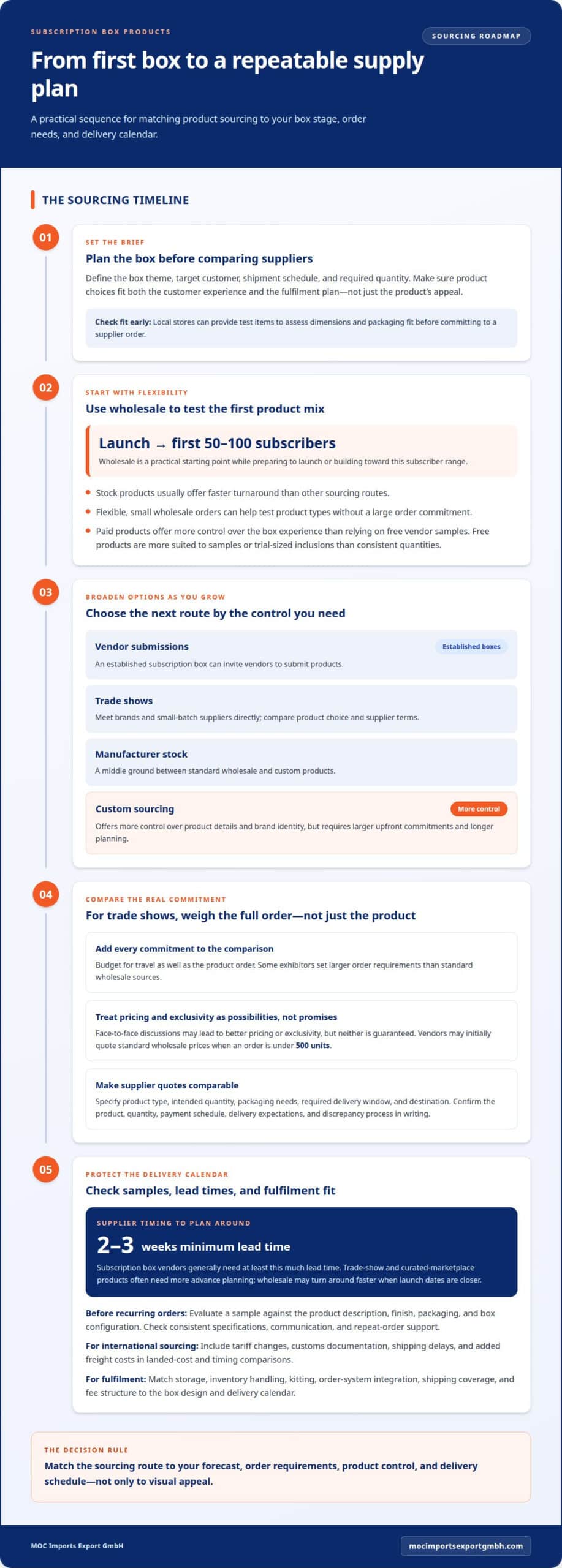
The most distinctive sourcing route isn’t always the best starting point. For a new box, sourcing products for a subscription box business often starts with wholesale, a practical option while preparing to launch or building toward 50–100 subscribers. As the business grows, trade shows, manufacturer stock and custom products can offer different balances of cost, product choice and brand control.
It’s easy to focus on a product’s appeal and overlook the order size, margin or delivery schedule behind it. A sourcing decision needs to work for the box concept and the fulfilment plan.
This guide compares five ways to find subscription box products: wholesale, vendor submissions, trade shows, manufacturer stock, and custom manufacturing. You’ll see how each route affects costs, order requirements, margins, distinctiveness, and supplier lead times, so you can match your sourcing approach to your business stage and box requirements.
Key Takeaways
- Match your sourcing route to your business stage, from flexible wholesale buying to more customized options as your box grows.
- Compare trade shows by factoring in travel, order requirements, and the extra planning needed for longer lead times.
- Build your margin calculations around paid products, and weigh wholesale’s limited branding options against its flexibility.
- Use niche ecommerce sites to identify boutique product leads, then approach the product companies directly.
- Set supplier timelines with shipping delays and recurring order needs in mind to reduce disruption to future boxes.
1. What’s the Best Way to Source Products for Your Subscription Box?
The right sourcing method depends on your business stage, order volume, and need for product control. Wholesale is a practical starting point for businesses preparing to launch or working toward their first 50–100 subscribers. It gives you access to stock products and usually offers faster turnaround than other sourcing routes. Paid products also give you more control over the box experience than relying on free vendor samples.
Start with a product plan. Define the box theme, target customer, shipment schedule, and required quantity before comparing suppliers. Wholesale can help test whether products fit the theme and packing configuration without a commitment to custom production. Local stores can also provide test items to assess dimensions and packaging fit. Free products are more likely to suit samples or trial-sized inclusions than a box that needs consistent quantities.
As subscriber numbers grow, consider vendor submissions, trade-show finds, or manufacturer stock. An established box can invite vendors to submit products, while manufacturer stock offers a middle ground between standard wholesale and custom products. Custom sourcing gives you more control over product details and brand identity, but requires larger upfront commitments and longer planning. Match each route to your forecast, not just its visual appeal.
U.S. regulations, labeling rules, and safety requirements depend on the product category and applicable federal or state requirements. A box containing cosmetics, food, or baby products, for example, needs category-specific attention to product labeling and safety information.
International sourcing can expose a subscription box to tariff changes, customs documentation requirements, shipping delays, and added freight costs. These factors affect landed cost and delivery timing, so include them in supplier comparisons before setting a recurring box schedule.
Choose a subscription box 3PL by matching its operating capabilities to your box design. Compare storage needs, inventory handling, kitting for multiple product types, order-system integration, shipping coverage, and fee structure. A box with a skincare item, a paper insert, and protective packaging needs different assembly steps from a single-product shipment. Map those steps before evaluating fulfillment options, and account for how receiving, storage, packing, and dispatch fit your delivery calendar.
Build a diverse product mix around the customer and theme, not an arbitrary number of categories. Pair products with complementary use cases, such as a personal-care item with a practical accessory, while keeping package size and weight manageable. A baby-focused box, for example, may draw from baby product categories, but each inclusion should suit the intended recipient and box format. Review the mix for variety, sourcing consistency, and packing compatibility before finalizing the next order.
2. Trade show costs, order requirements, and lead times
Trade shows can connect subscription box buyers directly with brands and small-batch suppliers. Budget for travel as well as the order, since attending adds costs before products reach your packing area. Some exhibitors also set larger order requirements than standard wholesale sources. Compare the total commitment with the quantity your box can use and the schedule your customers expect.
Face-to-face discussions may lead to better pricing or exclusivity, but neither is guaranteed. Use each meeting to clarify the product, available quantities, packaging, reorder process, and delivery timing. Record the terms in writing afterward. This gives you a clear basis for comparing suppliers without relying on a verbal summary.
Small wholesale orders can be more suitable for testing a product mix. Wholesale buying is flexible for trying product types without taking on a large order. Large international sourcing marketplaces may not suit every subscription-box order. Vendors may also initially quote standard wholesale prices when an order is under 500 units. Treat that as a starting point for comparing terms, not as evidence that a smaller order will receive bulk pricing.
Make a bulk-order inquiry specific. State the product type, intended quantity, packaging needs, required delivery window, and destination. Clearly identify where the order must go so suppliers can account for it when preparing their terms. Specific details make responses easier to compare because each quote addresses the same conditions.
Buyer protection starts with clear, documented terms. Before ordering, make sure the written agreement identifies the product and quantity, payment schedule, delivery expectations, and process for handling discrepancies. Keep the quote, order confirmation, and supplier correspondence together. These records help resolve misunderstandings by showing exactly what both parties agreed to.
Evaluate a sample before committing to a recurring box inclusion. Compare it with the product description, inspect its finish and packaging, and assess whether it fits your box configuration. Reliability also depends on consistent product specifications, clear communication, and the supplier’s ability to support repeat orders on your schedule. Keep your observations with the quote so your decision reflects both product fit and supply conditions.
Trade-show and curated-marketplace products often need more advance planning because their lead times can be longer. Subscription box vendors generally need at least 2-3 weeks of lead time, so build supplier timing into the box calendar. Wholesale may offer faster turnaround when launch dates are closer. For a bulk-order discussion related to your sourcing needs, share your order requirements.
3. Wholesale margins and branding limitations
Wholesale products from established brands can give a subscription box recognizable names and consistent product formats. The trade-off is that standard products may also appear in retail or competing boxes. Wholesale sourcing can mean smaller margins, less exclusivity, and limited branding options. Assess a product’s contribution to the box, not just its brand recognition. A familiar item makes financial sense only if its cost leaves room for packaging, assembly, shipping, and operating expenses.
Calculate the per-box margin using expected revenue and the costs tied to each shipment. Include product cost, packaging, assembly, and outbound shipping in the calculation. Subscription box businesses commonly aim for 30–60% per-box profit margins, but that target depends on the box’s price and cost structure. Compare the expected margin across the full product mix. One expensive inclusion can reduce the room available for other items.
Buying directly from an established brand can suit a box built around dependable, recognizable products. Before committing, compare wholesale sourcing with manufacturer stock. Stock products may offer better margins, faster turnaround, and opportunities for brand touches, although selection and exclusivity can remain limited. A branded insert or coordinated packaging can support a theme without changing the product itself. Include those presentation costs in your per-box calculation.
Before sourcing custom, private-label, or branded products, decide what level of differentiation matters. Wholesale keeps the product as supplied, while manufacturer stock may allow some added brand touches. Full custom manufacturing offers more product customization and brand control, but requires larger upfront commitments and longer timelines. Choose a route that fits your forecast and cash flow rather than treating customization as an automatic upgrade.
An email to a brand should make the business case clear. Identify your subscription box category, target audience, subscriber count, upcoming theme, proposed product, and why customers would value it. Include the expected order quantity and recurring schedule so the brand can assess the opportunity. A concise message with a specific request is easier to evaluate than a broad partnership pitch. If the box is established, explain its audience and product fit directly.
Plan costs to support healthy margins without relying on free products. Once a product has proved its fit, negotiate with partners you expect to buy from over the long term. Discuss recurring order conditions, product continuity, and any permitted branding or packaging options. Record agreed terms and use them to plan future boxes. This ties your margin calculation to actual purchasing decisions while keeping standard wholesale distinct from a differentiated product strategy.
4. Finding distinctive boutique products
A distinctive product can make a subscription box feel tailored to its theme. Start with niche ecommerce sites serving the same audience, then identify the brands and makers behind suitable products. Contact each company directly about wholesale supply. For example, a specialty tea shop can help you discover tea brands for a tasting box, while each brand can discuss its own products and ordering terms.
Use the same screening steps for every product lead. Record its fit with the box theme and target customer, packaging dimensions, order requirements, and potential for repeat supply. A handmade item may suit a self-care box but need different packing from a compact accessory. Check each product against the box layout before including it in your launch plan.
Trade shows and curated wholesale marketplaces can reveal small-batch and boutique products that general searches may miss. Sort leads by category and theme, such as home goods, snacks, or personal care. Then compare product fit, supplier terms, and timing with your box plan. This keeps a memorable conversation from outweighing the practical requirements of the next release.
To find local or small-business suppliers, search regional maker directories, niche ecommerce sites, and relevant trade-show exhibitor lists. Contact makers directly with the box theme, audience, expected order pattern, and product requirements. For sustainable sourcing, define the attributes that matter to your customers, then request product and sourcing details that address those priorities.
Assess samples before planning a full box inclusion. Inspect the finish, packaging, dimensions, and fit with the box’s intended use. For a boutique candle, for example, consider how its container fits beside other items and whether its presentation supports the theme. Keep these observations with supplier details so your selection accounts for customer appeal and packing needs.
Distinctiveness also depends on how products work together. Pair an unusual item with complementary products that clarify the theme, rather than filling the box with unrelated discoveries. A coffee-themed box could combine a distinctive roast with a brewing accessory and a tasting note. Check that each component has a clear role and contributes to a coherent customer experience.
Once you identify a strong lead, explain its relevance to your audience and an upcoming theme. A focused proposal helps the supplier understand the product’s potential fit. Record responses and product details, then compare suitable leads before choosing items for the next box cycle.
5. Supplier agreements and lead times
A recurring subscription depends on more than the first delivery. The supplier agreement should define the product, order quantity, pricing, payment terms, delivery schedule, and process for handling shortages or damaged goods. For a coffee box, for example, specify the product format and quantity required for each shipment. Clear terms make repeat orders easier to plan and compare.
Set a replenishment calendar based on when each box must be packed. Work backward from packing and dispatch to determine when the purchase order, supplier preparation, and transport need to happen. Record planned quantities and expected delivery dates in one inventory schedule. This shows whether incoming stock supports the next box cycle before you commit to another promotion.
Ask suppliers how they handle changes in order volume, product substitutions, and backorders. Put approved alternatives in writing instead of accepting an unplanned replacement. A change in product size or packaging can affect the box layout and customer experience. For recurring orders, define how the supplier communicates delays and who approves changes before goods ship.
Supplier capacity matters. According to the National Institute of Standards and Technology, a supplier operating above 80% capacity may cause delays or run out of stock, risking recurring subscription-box orders. Ask about production availability for your planned schedule and align order quantities with the supplier’s capacity. A supplier’s ability to support the first purchase does not alone establish continuity for later cycles.
Transport choices can also change the delivered cost. The National Institute of Standards and Technology (NIST) describes one manufacturer switching from ocean freight to air freight after shipping delays, raising costs from a total of $5,000 per roll for material and shipping from China to $7,500 for shipping alone. This example shows why a supplier agreement should make delivery terms and responsibility for freight costs clear.
Review actual stock before confirming the next order cycle. Track units received, units allocated to boxes, and remaining inventory. If a product sells through faster than planned, update the next purchase quantity and delivery window. If stock is accumulating, adjust the order plan before the next shipment. This routine connects pricing and purchasing decisions to real demand.
Keep supplier records together, including the signed terms, purchase orders, delivery updates, and quality notes. When a shipment arrives, compare it with the agreed product and quantity, then record any discrepancy. These records give both parties a shared reference for resolving order issues and refining future schedules. For support with wholesale product sourcing, discuss your recurring order requirements.
MOC Import Export GmbH: Gillette products
MOC Import Export GmbH can support subscription box buyers sourcing established consumer products for a planned product mix. Its offerings include Oral-B Pro Cross Action Electric Toothbrush Heads – Pack of 8 (White), Pampers ZZZ Overnight Diapers, Size 5 (27+ lbs), 88 Count, Oral-B iO5 Electric Toothbrushes for Adults Black, and Gain Original Liquid Laundry Detergent – 5 Gallon. These products may suit boxes focused on oral care, baby needs, or household essentials.
Consider wholesale when recognizable products and bulk purchasing fit your order plan. Match each item to the theme, packing format, and recurring demand before adding it to a box. Contact MOC Import Export GmbH to discuss your product requirements.
Turn Your Sourcing Plan Into the Next Box
Make sourcing decisions part of a repeatable buying plan. Give each product a clear role, then align purchase timing and quantities with the box schedule. This keeps product selection connected to the customer experience and the operational decisions behind each shipment.
As you refine sourcing products for a subscription box business, consider which items need to stay consistent and where a new product can create interest. A stable core can make the box recognizable, while carefully chosen additions keep each release fresh. MOC Import Export offers products such as Oral-B toothbrush heads, Pampers diapers, and Oral-B electric toothbrushes for wholesale buyers considering established consumer goods.
Share your product needs and purchasing plans with MOC Import Export to discuss a suitable next step. Contact MOC Import Export and move your next box plan forward with a focused sourcing approach.
Frequently Asked Questions
What’s the Best Way to Source Products for Your Subscription Box?
For a new box, wholesale can be a practical starting point. Choose a route based on your forecast, product control, and the supplier’s ability to support repeat orders. Sourcing products for a subscription box business works best when your sourcing mix follows your box’s needs: start with stock products, then consider manufacturer stock or custom items when differentiation becomes a priority. Keep a backup option for core products so a supplier issue doesn’t disrupt the theme.
How do you choose products for a subscription box niche and target audience?
Choose products that meet a clear customer need and make sense together in the same box. For a coffee niche, for example, select items that support a tasting or brewing experience rather than unrelated products. Consider the recipient, product format, packaging fit, and distinct role of each inclusion. A simple product map can connect every item to the theme and intended customer, making it easier to remove anything that doesn’t strengthen the offer.
Where can subscription box businesses source wholesale products in the U.S.?
U.S. subscription box businesses can explore wholesale distributors, brand sales teams, trade shows, and curated wholesale marketplaces. Niche ecommerce sites can also help identify makers, but approach product companies directly about wholesale supply. Local stores are useful for testing product dimensions and packing fit before planning a box. Compare sources by product selection, order conditions, delivery schedule, and suitability for repeat purchasing.
What are the best wholesale marketplaces and trade shows for subscription box products?
The best option depends on your order size and whether you need broad selection or distinctive products. Curated wholesale marketplaces and relevant trade shows can surface boutique and small-batch goods. Some online marketplaces may be a poor fit for smaller subscription-box orders, so compare their minimums with your purchasing needs. Trade shows also involve travel and may have larger order requirements, so assess the total commitment against the quantity your box can use.
How do you contact brands and negotiate wholesale pricing, minimum order quantities, and payment terms?
Send a concise business inquiry that identifies your box category, audience, subscriber count, planned product, and expected order pattern. Ask about wholesale pricing, minimum order quantity, payment terms, and timing for repeat orders. Explain why the brand’s product fits your audience, then make a specific request. Written terms help you compare offers accurately. For long-term purchasing, discuss whether recurring orders can support different pricing or product presentation.
What are typical wholesale costs and profit margins for subscription box products?
Wholesale costs vary by product, order quantity, packaging, and shipping, so calculate the landed cost for each inclusion rather than relying on a general price. Subscription box businesses commonly aim for 30–60% per-box profit margins. To assess your own box, subtract product, packaging, assembly, and shipping costs from revenue, then divide the remaining profit by revenue. Review the calculation across the full mix, since one high-cost item can affect the box’s overall margin.
