

Uncategorized
How to Create a CPG Procurement Budget Around Production Needs

25
Oct
Oct
A workable CPG procurement budget starts with production needs, not last year’s spending. To create a CPG procurement budget for 2026, translate production plans and demand forecasts into purchasing requirements, then account for inventory, supplier costs, cash flow, and contingency. Review actual spending during the year and adjust the plan as conditions change.
This approach keeps purchasing aligned with operational needs while giving finance and procurement a clearer view of when funds will be required. A budget is more useful when teams share production, inventory, and cash-flow assumptions instead of managing separate targets.
This guide explains how to build the plan step by step. You’ll learn how to forecast requirements with internal teams, organize spending by category and timing, involve stakeholders, and review performance as demand or market conditions change. The result is a practical framework for planning purchases around production while maintaining visibility and flexibility.
Key Takeaways
- Translate production plans and demand forecasts into purchasing requirements, then account for inventory levels and cash flow.
- Use historical spend and live budget tracking to spot variances and improve purchasing decisions.
- Bring procurement, production, finance, and inventory stakeholders into budget planning and approval.
- Review performance regularly and revise forecasts, purchase timing, or spending priorities when conditions change.
- Plan category expenditures and contingency funds in advance to reduce reliance on costly last-minute buying.
Procurement’s relationship to production, inventory, demand forecasts, and cash flow
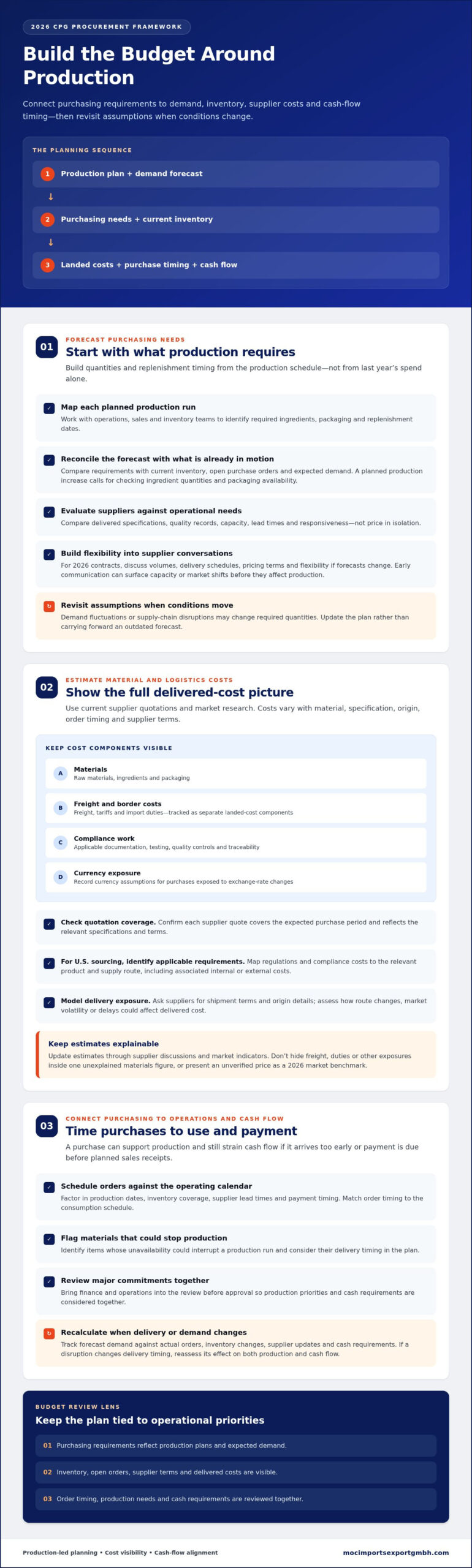
Build the purchasing plan around production requirements, then test it against inventory, demand, and cash-flow timing. Use the steps below to connect forecasts with supplier decisions and changing market conditions.
-
Forecast Purchasing Needs
Start with the production schedule and forecast purchasing requirements with operations, sales, and inventory teams. Map each planned production run to its ingredients, packaging, and replenishment dates. Compare the forecast with current inventory, open purchase orders, and expected demand. For example, a planned increase in production should prompt a review of ingredient quantities and packaging availability, not just a larger purchase request.
Compare suppliers using delivered specifications, quality records, capacity, lead times, and responsiveness. For 2026 contracts, use this analysis to negotiate volumes, delivery schedules, pricing terms, and flexibility around forecast changes. Early supplier communication strengthens supplier relationships and can surface capacity or market shifts before they affect production. Revisit assumptions when demand fluctuations or supply-chain disruptions change the required quantities.
-
Estimate Material and Logistics Costs
Estimate raw materials, ingredients, packaging, freight, tariffs, and import duties separately. Prices depend on the material, specification, origin, order timing, and supplier terms, so use current supplier quotations and market research rather than a generic CPG price estimate. Check that each quotation covers the expected purchase period, and record currency assumptions for purchases exposed to exchange-rate changes.
For U.S. sourcing, identify the regulations and compliance costs that apply to each product and supply route. Map required documentation, testing, quality controls, and traceability work to the relevant item and supplier, then include associated internal or external costs in that category’s budget. Keep freight, tariffs, and import duties as separate landed-cost components. Ask suppliers for shipment terms and origin details, then model how route changes, market volatility, or delays could affect delivered cost. Don’t hide these exposures in a single unexplained materials figure.
Use supplier meetings, communications, and market indicators to update estimates as conditions move. This makes the budget responsive without presenting an unverified price as a 2026 market benchmark.
-
Connect Purchasing to Operations and Cash Flow
Schedule purchases around production dates, inventory coverage, supplier lead times, and payment timing. A purchase may support production yet strain cash flow if it arrives well before use or must be paid for before planned sales receipts. Match order timing to the consumption schedule, and flag materials whose unavailability could stop a production run.
Review the plan with finance and operations before approving major commitments. Track forecast demand against actual orders, inventory changes, supplier updates, and cash requirements. When a disruption changes delivery timing, recalculate its effect on production and cash flow together. This keeps the budget tied to operational priorities rather than treating procurement as a standalone spending target.
Use procurement software for spend tracking and predictive analytics
Build software workflows around historical spend, active purchase orders, and budget categories. In 2025, 65% of procurement organizations cited digital transformation as their most important initiative.
- Start with a clean spend analysis. Export purchasing records and group transactions by category, supplier, product, and business unit. Reconcile duplicate supplier names, inconsistent item descriptions, and missing category codes before drawing conclusions. For example, separate packaging purchases from ingredients so price or volume changes appear in the right budget line.
Compare actual spending with the budget and prior purchasing patterns. Review recurring orders, off-contract purchases, fragmented buying, and categories with limited supplier visibility. Best-in-class organizations manage 91.7% of their total spend, making spend coverage a useful reference point. Use your own baseline to identify gaps and set a realistic improvement target.
- Configure procurement software to track commitments and actual spending in one view. Where practical, connect it with existing ERP, quality management, and warehouse management systems. Use predictive analytics to flag demand changes, unusual price movements, and likely budget variances before they affect production plans. Guided buying can direct staff to approved categories, suppliers, and purchasing processes.
Track supplier payment terms, discounts, and minimum order quantities separately. Payment timing affects cash flow; discounts matter only when their conditions fit the purchasing plan. Minimum order quantities may lower unit costs but increase inventory and the cash tied up in stock. Compare the total budget impact before accepting an offer.
Automated procurement efforts can achieve savings of 40% to 75%, while procurement upgrades can yield savings of 5% to 20% in subsequent value. Treat these as reported ranges, not guaranteed results for an individual business. Data quality and system integration affect whether analytics can support reliable decisions.
- Set measurable KPIs that connect software reports to operational and financial goals. Track budget variance, spend under management, purchase-order compliance, negotiated savings, and forecast accuracy. Review each measure by category and business unit, then assign an owner and review cadence. A clear dashboard helps managers distinguish genuine cost reductions from delayed purchases or lower production volume.
Choose a savings target from your baseline and define its timeframe. For example, the planning guidance offers an illustrative goal of reducing tail spend by 15% within 12 months. Use that example as a target-setting model, not a universal benchmark. Review results with finance and procurement, and adjust category actions when actual performance diverges.
To align bulk-order requirements with budget tracking, discuss your purchasing needs as you refine category plans.
Cross-functional stakeholder involvement
Build the budget with input from the teams that create demand, use materials, and manage funds. Assign each department a clear role before finalizing budget assumptions.
- Map contributors and decision rights before collecting figures. Procurement owns supplier and category data; production identifies material requirements; inventory teams report stock and replenishment needs. Finance assesses cash-flow limits, while sales provides demand assumptions. Quality and supply chain teams flag sourcing constraints that could affect production. Name one budget owner to consolidate the inputs and resolve conflicting assumptions.
- Request the same planning details from each department. Ask production for planned runs and material specifications, sales for demand changes, and inventory for current stock and open orders. Finance should provide spending limits and payment assumptions. For example, if production expects a schedule change, identify the affected ingredients and packaging rather than submitting only a revised total.
- Evaluate competing priorities in a cross-functional review. Compare each request with operational impact, customer commitments, strategic goals, and available funds. If production requests extra packaging while inventory reports usable stock, reconcile the quantities before approval. Record the decision, its owner, and the underlying assumption. This creates a traceable record and prevents teams from budgeting twice for the same need.
- Surface supply chain risks and opportunities with the departments closest to them. Procurement can present supplier capacity and contract information; quality can identify material or documentation constraints; production can explain the effect of a delayed input. Include growth, sustainability, and digitalization initiatives when they change purchasing requirements. For each proposal, state its expected operational benefit and affected budget category.
- Present the consolidated plan through a dashboard or concise report. Show category spending, forecast assumptions, department owners, approval status, and major risks. Ask managers to approve the budget and document exceptions. For example, an illustrative procurement policy could require manager approval for off-policy purchases above $500. Use clear approval rules so employees know which requests need escalation.
- Set a review cadence and keep responsibilities clear after approval. Procurement can report supplier and category changes; finance can compare commitments with available funds; production can flag schedule revisions. At each review, determine whether an assumption has changed and which team should update it. A shared record helps stakeholders distinguish a supply chain shift from a change in demand or timing.
Periodic budget reviews and adjustments
Treat the 2026 procurement budget as a living document. Compare actual results with approved category targets, then revise assumptions when demand, supplier conditions, or production plans change.
- Set a review schedule that matches purchasing cycles and production planning. At each review, compare actual spending, open commitments, and remaining budget by category. Record the date, owner, and reason for every material adjustment. For example, a packaging delay may shift a planned purchase into another period without changing total demand.
Separate timing variances from genuine cost or volume changes. This prevents an enterprise budget from misclassifying delayed invoices as savings or treating a temporary shift in orders as a lasting reduction in demand.
- Track a focused set of procurement KPIs: budget variance, forecast accuracy, supplier delivery performance, spend under management, and realized savings. Compare each measure with its baseline and target, then identify the category or process driving the difference.
Pair financial results with operational measures. Lower spending is not an improvement if it causes shortages or interrupts production. For example, review a lower packaging bill alongside inventory availability and schedule adherence before counting it as an effective saving.
- Investigate variances before changing allocations. Check purchase orders, invoice timing, demand changes, supplier updates, and inventory movements. If a raw material forecast rises, determine whether production volume changed or a supplier revised delivery terms. Document the cause and the owner of the next action.
Use the findings to improve the next purchasing decision. Procurement may consolidate orders, renegotiate contract terms, or evaluate an alternative supplier. Compare each option with quality requirements, delivery needs, and total operational impact.
- Update forecasts when market conditions or supply chain disruptions change costs. Review supplier communications, market indicators, and internal demand signals together. If a disruption threatens an input, estimate its effect on production and funding before moving budget between categories.
Maintain a clear audit trail. Record the original target, revised amount, reason, approver, and effective date. This helps finance distinguish an approved response from unplanned spending and enables procurement to work with operations on corrective actions.
- Use each review to improve procedures as well as spending. Identify repeated exceptions, fragmented buying, slow approvals, or categories with limited visibility. Assign an owner to each improvement and track progress at the next review. For instance, recurring off-policy purchases may point to unclear buying guidance rather than an isolated error.
Close the review by publishing updated targets and responsibilities. Share a concise dashboard with finance, procurement, and production so everyone works from the same budget version. Carry unresolved risks and decisions into the next review rather than letting them disappear from the enterprise plan.
Planning expenditures and purchase timelines
Build a procurement spreadsheet with cost categories, formulas, and planned purchase dates. Link each budget line to a production need, supplier contract, or contingency so spending has clear operational context.
-
Organize Budget Cost Categories
Create separate rows for ingredients, raw materials, packaging, freight, import duties, and other relevant purchasing categories. Add columns for supplier, item description, planned quantity, unit cost, purchase period, owner, and approval status. This makes category spending visible and helps distinguish a materials change from a delivery or timing change.
List contract commitments and a contingency separately. Record the assumptions behind each estimate, such as forecast volume or supplier terms. Don’t combine unlike costs in one row; keep a packaging estimate distinct from freight so later changes can be traced to the right budget area.
-
Add Spreadsheet Formulas
Calculate each planned line by multiplying quantity by unit cost, then use a sum formula to total spending by category and period. For example, a row formula can multiply planned quantity by quoted unit cost. A category total can sum the relevant items, while a remaining-budget formula subtracts actual and committed spending from the approved allocation.
Use consistent formulas throughout the workbook and lock formula cells to prevent accidental edits. Add fields for forecast, actual, and variance, with variance calculated as actual spending minus the approved amount. Use conditional formatting to flag overspending or missing inputs. Check that totals include every category and that changes to quantities update the correct period.
Keep assumptions visible beside the formulas. Calculations are useful only when buyers can identify the quantity, unit, supplier basis, and applicable contract terms. Avoid hard-coding adjustments into totals, which obscures the reason for a change.
-
Map Expenditures to Purchase Timelines
Assign each expected purchase to a period based on production demand, inventory position, supplier lead times, and payment terms. Show the expected order date, delivery window, and planned payment period separately. This lets finance see when funds are committed and operations confirm that inputs will arrive before scheduled production.
Prioritize purchases by operational impact and strategic value. Schedule recurring requirements early, then identify purchases that depend on changing demand or supplier updates. Set aside contingency funding for unforeseen expenses and specify the risks it covers. Planning ahead can reduce reliance on costly emergency procurement, while clear contracts and dates improve purchasing visibility.
Use the spreadsheet to review category allocations, purchase timing, and approval needs with your team. For bulk purchasing requirements, discuss your procurement needs as you develop the plan.
MOC Import Export GmbH: Oral-B Pro Cross Action Electric Toothbrush Heads – Pack of 8 (White)
MOC Import Export GmbH supports business purchasing plans with consumer goods available for bulk orders. For oral-care budgeting, include Oral-B Pro Cross Action Electric Toothbrush Heads – Pack of 8 (White) as a defined item in the relevant category.
Before placing an order, compare the pack format with expected demand, inventory, and the purchasing schedule. This helps your team assess the item within its own budget line and keep oral-care requirements separate from unrelated categories. It also gives procurement and finance a clear product reference for internal planning.
If this product fits your business purchasing needs, contact MOC Import Export GmbH to discuss the next step.
Put the Budget to Work in Your Next Buying Cycle
The next step in how to create a CPG procurement budget for 2026 is to turn its approved categories into clear purchasing decisions. Set priorities for the next buying cycle, assign owners, and document the assumptions behind each order. That gives your team a consistent basis for deciding what to purchase, when to commit, and how each order supports business needs.
For businesses sourcing consumer goods, the Oral-B Pro Cross Action Electric Toothbrush Heads – Pack of 8 (White), Oral-B iO5 Electric Toothbrushes for Adults Black, and Pampers ZZZ Overnight Diapers, Size 5 (27+ lbs), 88 Count can each be planned as distinct items in the relevant category. Their inclusion in a budget depends on your business’s purchasing requirements and demand.
As you prepare your next order plan, contact MOC Import Export GmbH to discuss your purchasing needs. Use the conversation to identify the product requirements that belong in your next buying cycle and move forward with a clear plan.
Frequently Asked Questions
What is Procurement Budgeting?
Procurement budgeting is the process of allocating funds for the goods and services a business expects to purchase. It connects purchasing plans with operational priorities and financial limits. Teams asking how to create a CPG procurement budget for 2026 should identify who owns each spending category and how approvals work. For example, a company can assign separate owners for ingredient purchases and packaging, making accountability clearer when requests change.
What is a CPG procurement budget and what costs should it include?
A CPG procurement budget estimates the spending needed to source products and materials for consumer goods operations. Include relevant ingredients, raw materials, packaging, supplier charges, freight, tariffs, and import duties. Also account for costs related to quality checks, storage, or purchase administration when they apply to your process. Keep costs identifiable so a change in freight or packaging doesn’t obscure the underlying material spend.
How do you forecast 2026 CPG demand and purchasing volumes?
Forecast demand by combining sales expectations with current orders, planned promotions, production capacity, and inventory movements. Teams planning how to create a CPG procurement budget for 2026 can separate stable repeat demand from items affected by seasonal patterns or launches. Translate forecast sales into required purchase volumes, accounting for existing stock and open orders. Review assumptions with sales and operations; a promotion change may alter packaging needs as well as ingredient quantities.
How can CPG companies estimate supplier price increases and inflation for 2026?
Build category estimates from supplier quotations, recent purchasing records, market research, economic indicators, and supplier communications. Ask suppliers to explain proposed changes by cost driver, such as material inputs, currency shifts, or delivery terms. Compare those explanations with your purchasing history, then model alternative scenarios for uncertain categories. Keep assumptions and quotation dates alongside each estimate so teams can distinguish new evidence from earlier planning assumptions.
How should CPG procurement budgets account for inventory, safety stock, and working capital?
Budget inventory by connecting planned purchases with expected usage, existing stock, open orders, and replenishment timing. Set safety stock according to demand variability and the consequences of a delayed supply, rather than applying the same buffer to every item. Then map payment timing against expected inventory use and cash availability. This helps show when a large order could tie up working capital or create excess stock before production needs it.
What supply chain risks should be included in a 2026 CPG procurement budget?
Include risks that could affect supply, cost, timing, or product usability. Examples include supplier capacity constraints, transport delays, market volatility, currency changes, quality problems, and reliance on a limited source for a critical input. For each risk, record the affected category, operational consequence, and response option. A disruption plan might identify an alternative material or revised production sequence, with the funding impact assessed before action.
