

Uncategorized
US Foods chemical supplies and wholesale distributor pricing
24
Oct
Oct
The lowest unit quote isn’t always the most useful comparison. The US Foods chemical supplies vs. wholesale distributor pricing comparison depends on matching the product, pack size, order volume, and delivery terms across supplier channels. There’s no single price that applies to every buyer or order.
A distributor quote should make costs easier to compare, but the supply channel and its fit for your operation matter as much as the listed unit price. This guide explains how distributor channels affect chemical supply pricing, what to compare in wholesale quotes, and how to assess suppliers against your product range and purchasing needs. It also shows how broadline and specialist suppliers can fit, and how to compare offers without treating different products or order terms as equivalent.
Key Takeaways
- Compare distributors by product fit, order requirements, and delivery terms, not by channel name alone.
- Assess wholesale suppliers by the range they carry, how they serve business buyers, and whether their offer suits your purchasing needs.
- Separate foodservice distribution from janitorial supply needs to identify which channel best matches the products your operation uses.
- Compare chemical quotes on equivalent products, pack sizes, and order terms; the unit price alone may not show the full purchasing value.
- Use product category and order format to frame price comparisons for degreasers, floor cleaners, and disinfectants without treating unlike products as equivalent.
Distributor comparison by channel and supplier fit
US Foods chemical supplies vs. wholesale distributor pricing is best assessed by comparing equivalent products and purchasing terms. Restaurants should distinguish a broadline foodservice channel from a janitorial-focused wholesaler before weighing quotes. Each serves different inventory needs, so the lowest unit price alone may not be the best fit.
Channel scale provides context, not a chemical price. U.S. food wholesalers sold $327.3 billion to food-service operators in 2022, while sales to retail food stores totaled $550.7 billion that year. These figures describe food wholesale activity, not cleaning-chemical sales. Restaurants, corporate buyers, and retail stores should therefore compare suppliers by the products and order terms relevant to their own operations.
How do chemical brands, concentrations, and dilution costs compare between US Foods and wholesalers? Compare each product’s label, active ingredient or concentration, dilution directions, and container size. Then calculate the ready-to-use solution each container yields. A lower container price can cost more per usable volume if the dilution differs.
How can a restaurant compare total chemical costs across suppliers? Compare the same product specifications and order quantity, then account for item price, delivery charges, order requirements, and usable solution volume. Include storage and dispensing needs too: a bulk container that does not suit the restaurant’s workflow can make inventory harder to manage.
- Match product purpose and label details.
- Compare concentration and dilution yield.
- Include delivery and order terms.
- Assess fit with storage and daily use.
Does US Foods require a minimum order or food purchase for chemical supplies? Minimums and food-purchase conditions depend on the applicable account and delivery terms. Compare those terms directly rather than assuming chemical items are always sold separately or bundled with food orders.
Are US Foods chemical prices available online, or do customers need a sales quote? Use the applicable customer quote as the basis for a purchase comparison. An online product description may help identify an item, but it does not establish the transaction price or order terms for a particular buyer.
Supplier fit also depends on the wider supply chain. A broadline distributor can align food and related purchasing, while a specialist wholesaler can focus on janitorial categories. For buyers managing different inventory groups, a separate shave and hair-removal supply category illustrates why product purpose matters when organizing purchasing.
Use the same comparison sheet for each channel. Record the product name, label concentration, container size, dilution yield, quote terms, delivery conditions, and intended use. This gives restaurant managers a practical way to assess supplier fit without treating food wholesale sales, chemical specifications, and buyer-specific pricing as interchangeable.
Finding and evaluating wholesale suppliers
Start with the products your operation uses, then identify suppliers that serve those categories. A restaurant may prioritize degreasers and dishwashing products, while a grocery store may need broader janitorial coverage. A healthcare facility has different purchasing and handling priorities. Matching supplier specialization to actual demand helps prevent decisions based on price alone.
Wholesale distributors buy products in bulk from manufacturers and resell them to businesses. Some also offer services such as financing, promotion, or marketing. Those services can affect overall supplier fit, but they do not replace a product-level comparison. When comparing US Foods chemical supplies with wholesale distributor pricing, separate food purchasing from chemical procurement needs before reviewing offers.
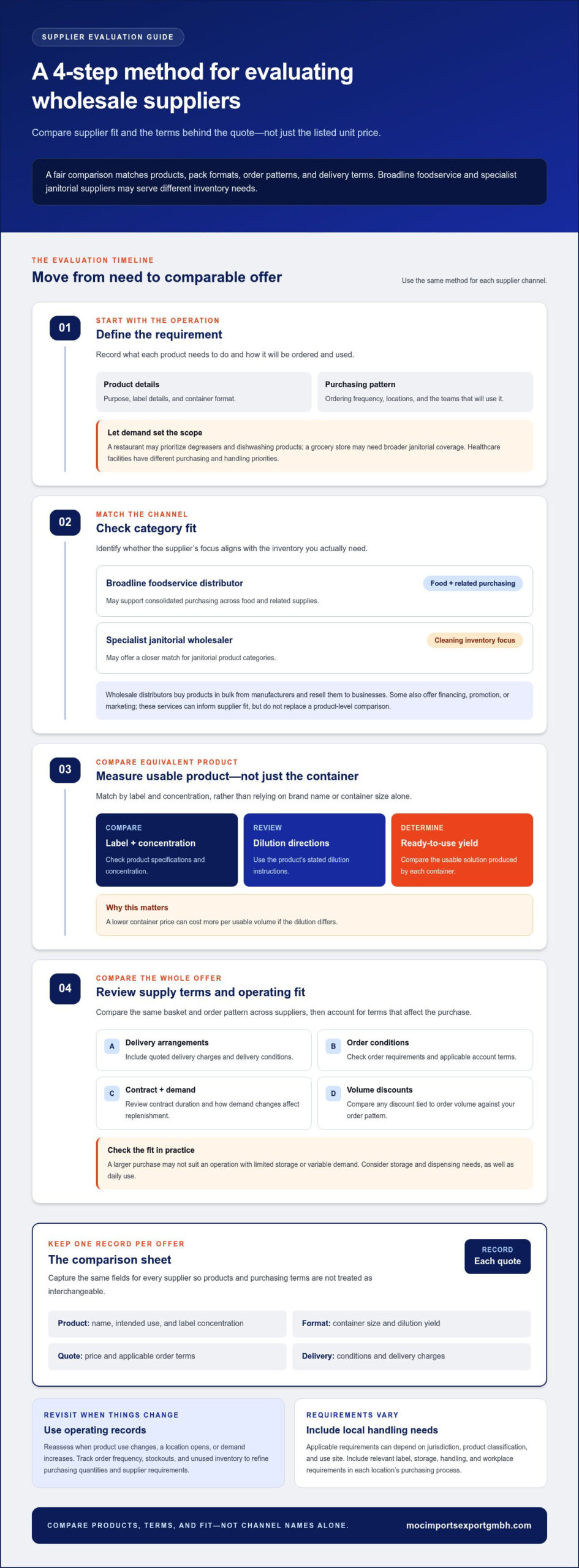
Use a consistent supplier evaluation process:
- Define the requirement. Record each product’s purpose, label details, container format, and ordering frequency. Include the locations and teams that will use it.
- Check category fit. Determine whether the supplier focuses on broadline grocery and foodservice distribution or specialty janitorial products. A broadline relationship may support consolidated purchasing; a specialist may offer a closer match for cleaning inventory.
- Compare usable product. Match products by label and concentration, not just brand or container size. Review dilution directions and the amount of ready-to-use solution produced.
- Review supply terms. Compare delivery arrangements, order conditions, contract duration, and how changes in demand affect replenishment.
Are commercial cleaning chemicals subject to local or state purchasing and safety requirements? Requirements can depend on jurisdiction, product classification, and use site. Include applicable product-label, storage, handling, and workplace requirements in each location’s purchasing process.
What delivery fees, contract terms, or volume discounts affect chemical supply pricing? The total depends on quoted delivery terms, contract conditions, and any discount tied to order volume. Compare the same basket and order pattern across suppliers. A discount on a larger purchase may not suit operations with limited storage or variable demand.
Revisit the comparison when product use changes, a location opens, or demand increases. A supplier that suits one restaurant may not fit a multi-site operation with different delivery points. Track order frequency, stockouts, and unused inventory, then use those records to refine purchasing quantities and supplier requirements.
For businesses aligning bulk purchasing with specific product needs, the wholesale inquiry page provides a route to discuss requirements.
Does US Foods sell cleaning chemicals and janitorial supplies to restaurants?
US Foods is a foodservice distribution channel for restaurants, but food purchasing alone does not establish which cleaning chemicals are available. Treat janitorial products as a separate purchasing category. Before including them in a comparison, identify the specific items in the relevant catalog and quote.
That distinction matters because food orders and sanitation inventory serve different operational needs. A kitchen may need dishwashing detergent, surface cleaner, degreaser, floor care products, and restroom supplies. Each has a distinct purpose, container format, label, and use procedure. A supplier carrying one category does not automatically provide the full janitorial range a restaurant needs.
Foodservice distribution is a substantial channel: U.S. food wholesalers sold $327.3 billion to food-service operators in 2022. That industry figure describes food wholesale sales, not cleaning chemical sales or US Foods’ chemical assortment. Use it as context for the foodservice channel, not as evidence that a particular restaurant can source every janitorial item through its food distributor.
For a practical purchasing review, divide the restaurant’s supply list into three groups:
- Kitchen cleaning: dish detergent, degreaser, and food-contact surface products.
- Facility care: floor cleaner, restroom cleaner, and other general janitorial items.
- Operating supplies: products used alongside cleaning, such as dispensers or wiping materials.
Then compare each item by intended use, label directions, concentration, container size, and ordering terms. For example, two degreasers with different dilution instructions are not equivalent just because both clean kitchen equipment. Compare the amount of usable solution and how well each product fits staff routines.
US Foods may be convenient for restaurant purchasing when the required chemical products are available with the buyer’s applicable foodservice order. A specialist janitorial wholesaler may better suit a restaurant seeking a wider range of facility-care products. The right channel depends on the actual assortment, delivery terms, and purchasing workflow, not the distributor’s general category name.
Keep a written comparison for each location. Record the product, intended area, order format, and purchasing terms. A single-site café may prioritize straightforward replenishment of kitchen cleaners, while a multi-location restaurant group may need consistent product specifications across sites. Separate those requirements from food inventory to avoid an incomplete price comparison.
In short, assess US Foods as a possible source for specific chemical items rather than assuming foodservice access means full janitorial coverage. Compare listed products with the restaurant’s cleaning schedule and supply requirements. This gives you a useful basis for deciding whether one distribution channel or a combination better supports the operation.
How do US Foods chemical supply prices compare with janitorial wholesalers?
There is no single price ranking for every chemical purchase. US Foods and janitorial wholesalers may quote different brands, concentrations, package formats, and order terms. Start with the exact cleaning task, then compare equivalent products under equivalent purchasing conditions.
For example, when comparing kitchen degreasers, match intended use, label directions, concentration, and container size. A janitorial wholesaler’s concentrated product may require dilution, while another product may be ready to use. Comparing container prices alone can make unlike products appear interchangeable.
Build a quote comparison with these fields:
- Product identity: Record the product name, use area, and label details for each quote.
- Concentration and yield: Compare dilution directions and the ready-to-use amount from each container.
- Order conditions: Include delivery terms, order requirements, and any volume discount conditions.
- Operating fit: Note dispensing, storage, and staff-use requirements for the restaurant.
Next, compare the cost of the usable solution, not just the container. If a floor cleaner is concentrated, calculate the amount prepared according to its label directions. For a ready-to-use product, use the supplied volume as the usable amount. Apply the same method to US Foods and specialist quotes.
Delivery and ordering terms can change the total purchase cost, even when product quotes are close. A restaurant receiving food and supplies together may value consolidated purchasing differently from a site ordering janitorial products separately. Compare applicable order terms side by side and include only costs for the same order scope.
Check usage before considering volume discounts. A lower quoted unit cost for a larger purchase may not suit a restaurant with limited storage or changing demand. Compare the quantity with actual replenishment needs and available shelf space. A discount matters only when the order volume fits the operation’s purchasing cycle.
To make the comparison actionable, choose a small basket of regularly purchased products, such as a degreaser, dish detergent, and floor cleaner. Request equivalent specifications and order conditions for each. Record quoted price, package size, dilution yield, and delivery terms in one worksheet. This helps identify whether differences stem from the product, order structure, or supply channel.
Review the worksheet when a product changes, the restaurant adds a location, or purchasing patterns shift. US Foods may suit a buyer who prioritizes foodservice ordering, while a janitorial wholesaler may better fit a specialized cleaning assortment. Base the decision on matched products and the restaurant’s supply workflow, not an assumed price advantage for either channel.
Broader supplier context can inform sourcing questions, but it does not replace like-for-like quotes. Since 2022, overseas food manufacturers must register with China’s General Administration of Customs to export food to China. At the close of the C&S Wholesale Grocers and SpartanNash acquisition, the combined company reported almost 60 distribution centers and close to 10,000 independent retail locations. Those figures describe registration context and distribution scale, not chemical prices; buyers still need comparable product, yield, and order terms for a purchasing decision.
What are typical wholesale prices for degreasers, floor cleaners, and disinfectants?
Wholesale prices depend on product specifications and purchasing terms, so a single benchmark can mislead. A degreaser’s price reflects its intended use, concentration, container format, and order conditions. Floor cleaners and disinfectants also vary by formulation and application. Compare equivalent products, not category names alone.
For degreasers, first distinguish ready-to-use products from concentrates. Assess a concentrate’s container price against its labeled dilution directions and usable solution yield. A ready-to-use degreaser needs no dilution calculation, but its container size and intended surfaces still matter. Compare products designed for the same cleaning task.
Floor cleaner comparisons need the same care. Products can differ in intended floor type, cleaning purpose, and dilution. Record the label instructions and the volume of solution prepared from each container. Then compare the quote against that usable amount, not just the package price.
Compare disinfectants product by product, based on intended use and label directions. Do not assume two products are equivalent just because both are described as disinfectants. Match the product specification and package format first, then include the quoted order terms. This keeps the comparison focused on comparable purchasing options.
A practical quote worksheet should capture:
- Product details: name, purpose, concentration, and container size.
- Use yield: dilution directions and usable solution produced.
- Order terms: quantity, delivery conditions, and volume discounts.
- Operational fit: storage space, dispensing method, and replenishment pattern.
Next, compare the total purchase with the restaurant’s actual use. A larger container changes the unit calculation, while a volume discount may require ordering more product. Consider how quickly inventory will be used and whether the package fits available storage. This prevents a low quoted unit price from obscuring an unsuitable order size.
Request comparable quotes for a defined basket, such as one degreaser, one floor cleaner, and one disinfectant. Keep product specifications and order quantities consistent across suppliers. If a quote changes the brand, concentration, or package format, record that difference instead of treating it as a direct price match.
For wholesale purchasing inquiries across household and consumer goods, contact MOC Import Export GmbH with your product requirements. A clear list of categories, quantities, and purchasing needs helps structure the discussion.
Price comparisons should also account for whether delivery arrangements suit the operation’s handling needs. For orders shipped with food, clarify the applicable transport practices and available documentation rather than assuming a low quote covers every requirement. The US Sanitary Transportation Rule requires food shippers and carriers to follow practices including proper refrigeration, sanitary trailers, and records of cleaning and temperature controls.
Keep this transport review separate from the product price calculation, while noting any delivery conditions that affect the purchasing decision. Ask suppliers how shipments are handled and what records they can provide, then compare those details alongside matched product specifications and order terms. This practical check helps assess whether an offer suits the restaurant’s purchasing needs. A clear record of commercial terms and relevant handling information makes the review easier.
MOC Import Export GmbH: Oral-B Pro Cross Action Electric Toothbrush Heads – Pack of 8 (White)
MOC Import Export GmbH supports business buyers seeking wholesale quantities of established consumer brands. The Oral-B Pro Cross Action Electric Toothbrush Heads – Pack of 8 (White) is one example for buyers sourcing oral-care products alongside other inventory. For household purchasing, the range also includes Gain Original Liquid Laundry Detergent – 5 Gallon and Dawn Original Manual Pot & Pan Liquid Dish Soap – 5 Gallon.
If your purchasing needs extend beyond restaurant chemicals to household and consumer goods, compare products by category and pack format, then plan orders around your business requirements. MOC Import Export GmbH serves wholesale and bulk import/export buyers, not retail single-unit purchases.
Contact MOC Import Export GmbH to discuss your wholesale purchasing requirements.
Turn your comparison into a practical purchasing plan
Make your next step a purchasing plan that separates sanitation requirements from other wholesale categories. Your US Foods chemical supplies versus wholesale distributor pricing comparison can guide cleaning-product decisions, while a separate order plan can cover other consumer goods your business buys. Keeping these requirements distinct makes supplier fit easier to assess without treating unrelated products as substitutes.
MOC Import Export GmbH offers business buyers products such as Oral-B Pro Cross Action Electric Toothbrush Heads – Pack of 8 (White), Oral-B iO5 Electric Toothbrushes for Adults Black, and Pampers ZZZ Overnight Diapers, Size 5 (27+ lbs), 88 Count. These examples show where its wholesale assortment may fit alongside a broader procurement plan. Set out the product categories and purchasing needs your business wants to address, then use that list to guide the discussion.
Contact MOC Import Export GmbH to discuss your wholesale supply needs and take the next step with a clear purchasing plan.
