

Uncategorized
Costco vs Wholesale Distributor for Cleaning Supplies

26
Oct
Oct
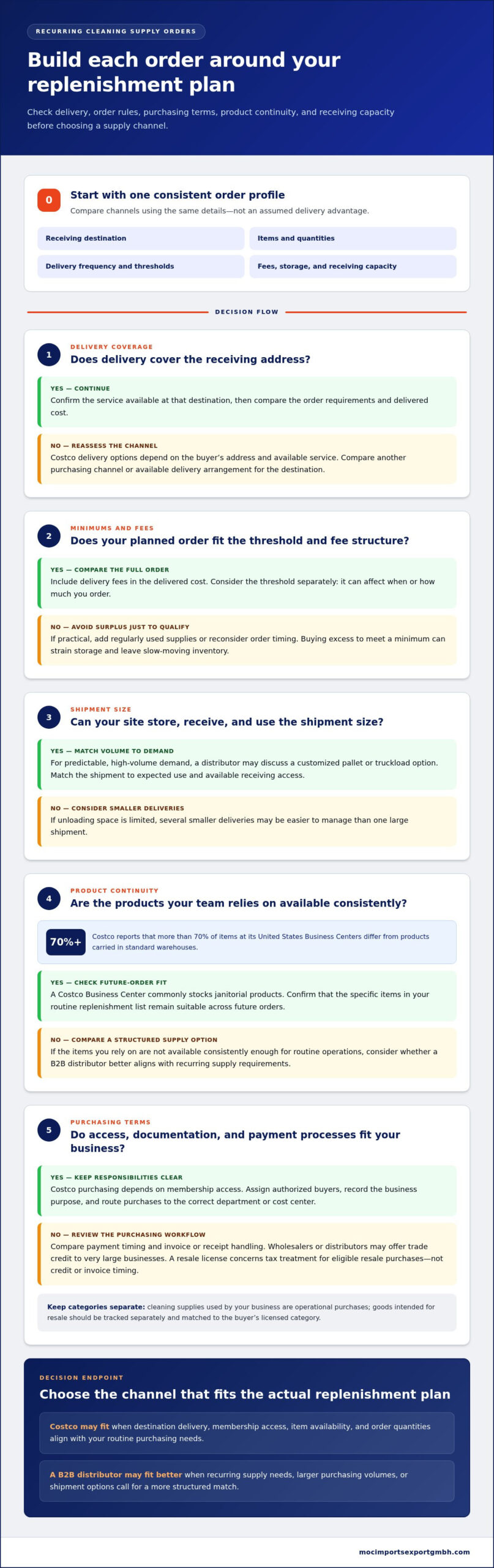
The most convenient source isn’t automatically the best fit for recurring cleaning orders. In a Costco business delivery vs. B2B wholesale distributor for cleaning supplies decision, compare delivery availability and minimum-order requirements with the membership model, product range, and quantities your business uses. Costco Business Centers commonly stock janitorial products, but the right option depends on how well its purchasing terms fit your replenishment needs.
It’s reasonable to weigh more than the unit size when choosing a supply channel. A bulk purchase can simplify procurement, but it also needs to match storage capacity, usage rates, and the products your team relies on.
This comparison explains how delivery, minimum orders, membership, product availability, and bulk purchasing affect recurring business cleaning needs. You’ll see where Costco can suit a buying plan and when a B2B distributor may better align with regular supply requirements.
Key Takeaways
- Compare delivery coverage and minimum-order rules against your replenishment schedule before choosing a purchasing channel.
- Factor membership and resale purchasing requirements into the total procurement process, not just the product selection.
- Assess whether the items you rely on are available consistently enough to support routine cleaning operations.
- Match bulk quantities to usage rates and storage capacity to avoid tying up space in excess inventory.
- Consider a wholesale distributor when your operation needs a more structured fit for recurring supply and larger purchasing volumes.
Delivery availability and minimum order requirements
Delivery can change the practical value of a cleaning-supply order. Costco Business Centers stock janitorial products, but delivery options and order requirements depend on the buyer’s address and the service available there. A business near a warehouse may have different options from one outside its delivery area. Start the comparison with the delivery destination, not just the catalogue.
Online ordering can save time when you know the items and quantities you need. First confirm that delivery covers the receiving address, then compare any order threshold with your planned replenishment list. A small cleaning team may need only a limited range of detergents and paper goods, while a larger facility may consolidate those items into one order.
Delivery fees and order thresholds can affect the final purchasing decision, even when the product selection fits. Consider them separately: a fee changes the delivered cost, while a threshold may affect when or how much you order. If your order is below a minimum, adding regularly used supplies may be practical. Buying surplus just to meet a threshold can put pressure on storage and leave you with slow-moving inventory.
Pallet and truckload orders suit a different purchasing pattern from routine online baskets. For businesses with predictable, high-volume demand, a distributor may be able to discuss these options. A customized pallet can consolidate selected items, while a truckload may fit a larger replenishment plan. Match shipment size to available storage, receiving access, and expected use. If unloading space is limited, several smaller deliveries may be easier to manage than one large shipment.
Compare each channel using the same order profile. Include the destination, item mix, quantity, delivery frequency, thresholds, fees, and receiving capacity. In the Costco business delivery versus B2B wholesale distributor comparison, the strongest fit is the one that serves the actual replenishment plan, rather than an assumed delivery advantage. Keep adjacent inventory categories separate; for example, shave and hair removal supplies belong on a different purchasing list from janitorial stock. This prevents unrelated products from distorting a cleaning order’s minimum or pallet plan.
Business membership and resale purchasing
Costco purchasing depends on membership access, while resale purchasing depends on the buyer’s licensed category. Payment and invoicing terms also determine how each channel fits your purchasing process and cash-flow controls.
Membership Access
Membership determines who can shop through a Costco warehouse or Costco Business Center. Assign purchasing access clearly, particularly when employees order supplies for different departments. For example, a facilities manager can handle cleaning orders while an office administrator manages other workplace purchases. Clear responsibilities support consistent records and help prevent duplicate orders.
Resale purchases involve a separate consideration. A resale license may allow tax-exempt purchases in the category for which the buyer is licensed. Keep goods intended for resale separate from cleaning supplies consumed by the business. This helps purchasing and accounting teams apply the license appropriately and organize records by transaction purpose.
Payment and Invoicing Terms
Costco is a wholesale purchasing channel, not a complete B2B credit or accounts-receivable solution. Businesses should consider when payment is due and how receipts or invoices move through their approval process. A company that reconciles orders by department, for instance, benefits from assigning each purchase to the correct cost center when placing it.
Wholesalers or distributors may offer trade credit to very large businesses. Compare payment timing with your cash-flow cycle and the documentation needed for reconciliation. A resale license is not a payment term: it concerns tax treatment for eligible purchases, not credit or invoice timing.
Build a purchasing procedure around these distinctions. Identify authorized buyers, set an approval process, and separate operational supplies from resale inventory. Decide how each order will be documented and assigned in your accounts. Clear categories help teams review spending without mixing purchases for different purposes, whether you buy cleaning materials for your own facilities or goods for resale.
For example, record cleaning supplies bought for your premises as operational purchases. If you purchase goods for resale, keep the relevant license and category documentation with your records. This gives accounting staff a clearer basis for reviewing transactions and helps purchasing teams avoid applying resale treatment to items used internally.
When setting up the workflow, document the buyer responsible for each order, the business purpose, and the records accounting needs. That simple sequence can prevent duplicate approvals and reduce follow-up work at reconciliation. For wholesale purchasing requirements, contact MOC Import Export GmbH.
Product availability and consistent commercial supply
Compare total cost by considering product fit, order consistency, and the effort needed to replenish stock. Costco reports that more than 70% of items at its United States Business Centers differ from products carried in standard warehouses. For recurring cleaning needs, assess whether the specific products your team uses remain available across future orders, not only whether a first purchase offers savings.
A Costco Business Center commonly stocks janitorial products alongside office supplies and commercial food-service products. Its range also includes hundreds of items not found at Costco warehouses, giving businesses more options than a typical warehouse assortment. For example, Business Centers carry 22-quart buckets. That broader mix can help buyers combine selected operational supplies, but it does not by itself establish consistent availability for every cleaning item.
Assess product availability separately from commercial suitability. A warehouse assortment may cover routine maintenance, while a specialized facility may need particular formats or quantities. A broader catalogue can also simplify procurement for commercial kitchens that buy food-service supplies. For commercial appliances, compare the equipment requirement with the products available; janitorial and kitchen supplies do not automatically meet every equipment need.
Make a shortlist of essential items and compare it with each channel. Record the product, pack format, usage rate, and acceptable substitute. Check whether you can reorder the same specifications without changing staff procedures. A different container size or formulation can affect storage, dispensing, and routines, even when the product has a similar purpose.
When comparing a wholesale distributor, consider delivery schedules, product consistency, and payment terms. These factors matter when a business needs predictable replenishment across locations or departments. A distributor may suit a very large operation seeking a structured supply arrangement. Costco can work for buyers whose needs fit its stocked selection and purchasing model. The key is how well the supply approach matches recurring demand.
After choosing a channel, track a few operational measures: stockouts, substitute purchases, delivery timing, and unused inventory. A hotel, for example, can compare housekeeping essentials over successive order cycles. If product changes create extra work, a lower purchase cost may not mean better overall value. Review the list when usage patterns change, and keep core specifications consistent for each reorder.
More than 60% of Costco Business Center items differ from those found at a typical Costco. That broad distinction is useful when screening an assortment, but it should not be treated as proof that a needed item will remain available. Confirm exact specifications and acceptable replacements with the channel before relying on a product for routine work.
Once purchasing begins, base reorders on actual use rather than catalogue breadth. Identify essential items, those that can be substituted without changing work practices, and those that need review if unavailable. If a replacement affects storage, dispensing, or handling, account for the adjustment before switching. The best source for your operation is the one that supports its required products and replenishment routines with minimal disruption.
Bulk janitorial and cleaning supplies
Bulk purchasing works best when quantities reflect how a facility uses each product. Group items by task, such as restroom cleaning, floor care, kitchen cleanup, and general surfaces. A restaurant may use dishwashing products daily but replenish floor-care supplies on a different cycle. Separating these categories helps make orders more precise and avoids treating every item as equally urgent.
Next, estimate consumption from internal purchasing records and assign each item a preferred pack format. Keep products with different purposes in separate inventory lines, even when they arrive in the same order. This gives the person receiving the shipment a clear way to record stock and helps staff request the right item. The Costco business delivery vs B2B wholesale distributor for cleaning supplies decision should account for this handling work, not only the initial purchase.
Storage capacity also shapes a workable bulk order. Identify where containers will be kept, how staff will access them, and whether the space can accommodate the planned shipment. A convenience store with limited back-room capacity may need a different order pattern from a facility with dedicated storage. Store cleaning products separately from beverages and snacks, and keep the inventory records distinct.
Review replenishment needs before repeating an order. Note which products remain unused, which need replacing sooner, and whether staff have had to use substitutes. If a restaurant regularly runs short of a kitchen cleaner but has excess stock of another product, adjust each quantity separately. Base repeat orders on actual consumption rather than copying the previous basket unchanged.
Costco Business Centers commonly stock janitorial products. Distributors may offer better scale pricing, trade credit, or logistics solutions for very large businesses. Compare the channels using the same item list and order pattern. In a Costco business delivery vs B2B wholesale distributor for cleaning supplies comparison, assess whether each option supports the facility’s required products, preferred order size, and inventory process. The best operational fit depends on those requirements, not on bulk volume alone.
Use a purchasing worksheet to make decisions repeatable. Record each product’s task, preferred specification, pack format, storage location, and reorder trigger. Assign someone to update the worksheet after each shipment. It provides a consistent reference for future orders and helps distinguish a lasting change in demand from a temporary fluctuation. Review it when cleaning routines or operating needs change.
For a restaurant or office, this approach makes bulk purchasing a controlled replenishment process. It gives staff a clear basis for setting quantities, organizing storage, and comparing supply channels. Focus the list on items used regularly, then assess whether the ordering method meets those needs without adding avoidable handling or inventory work.
Bulk purchasing cleaning supplies and recurring business needs
Bulk purchasing can reduce repeat orders, but the right quantity depends on consumption, storage, and reorder timing. Costco says buying regularly used products in bulk can provide enough supplies to last six months or a year. That may suit a business with steady use and space for reserve stock. It can also create excess inventory if demand changes or products expire before use.
Start with usage records. Review recent orders, note how quickly each cleaner is used, and separate essential products from occasional-use items. A restaurant might track dishwashing liquid, floor cleaner, and restroom supplies separately because each serves a different task. Set a reorder point for each item based on actual use instead of applying one bulk quantity to the entire list.
Storage capacity sets a practical limit. Measure the area allocated to cleaning stock and consider container size, safe access, and separation from food and beverages. A convenience store with limited back-room space may prefer smaller replenishments, while a larger facility with dedicated storage can plan fewer, higher-volume orders. In either case, keep snacks and beverages separate from janitorial products.
Compare order quantities with the cost and effort of replenishment. A larger purchase may reduce ordering frequency, but it also uses storage space and working capital. For very large businesses, a distributor may offer scale pricing, trade credit, or logistics solutions. Costco may suit a business whose needs fit its bulk quantities and purchasing model without creating unnecessary stock.
Review inventory before each recurring order. Record on-hand quantities, expected usage, storage limits, and the next planned replenishment. Remove items that are no longer needed and adjust quantities when operating hours or occupancy change. For example, if a facility adds a shift, update its cleaning-use estimate before repeating the previous order.
Choose a purchasing channel that supports the full replenishment cycle, not just the initial bulk buy. Compare how each option handles your usual product mix, volume, delivery pattern, and payment needs. If demand is predictable and storage is available, a larger order can simplify procurement. If use varies, smaller, more frequent orders can preserve space and reduce unused stock.
For help aligning recurring wholesale purchasing with your business requirements, discuss your bulk order needs.
Costco says bulk purchases of regularly used products can provide enough supplies to last 6 months; assess whether that reserve fits your own consumption pattern before adopting it. Keep a brief record of what remains after each replenishment and note products that are slow to move. This can help distinguish a useful reserve from stock that is taking up space without serving a current need.
Before placing a recurring order, confirm that products still suit your cleaning routines and that staff can identify and access them easily. Tell the person responsible for purchasing about changes in use or storage so quantities can be adjusted before excess accumulates. A consistent review process supports dependable supplies while keeping purchasing decisions responsive to actual business needs.
MOC Import Export GmbH: Oral-B Pro Cross Action Electric Toothbrush Heads – Pack of 8 (White)
MOC Import Export GmbH offers the Oral-B Pro Cross Action Electric Toothbrush Heads – Pack of 8 (White) for businesses sourcing this branded consumer product in bulk. It also offers Gain Original Liquid Laundry Detergent – 5 Gallon, which may suit businesses managing laundry alongside other purchasing needs. These products serve different purposes, so assess them as separate parts of your order.
Consider MOC Import Export GmbH when your purchasing plan includes these products and you want to discuss business orders. For specialized commercial cleaning requirements, use the supply criteria covered above to assess the right channel. Contact MOC Import Export GmbH to discuss your purchasing needs.
Set Your Next Purchasing Plan in Motion
Use your next procurement cycle to define which cleaning items must remain consistent and which purchasing needs can be grouped with other business goods. The Costco business delivery vs. B2B wholesale distributor for cleaning supplies decision should support that plan, rather than dictate it. A clear purchasing list helps keep janitorial requirements distinct while identifying other products your business may source through wholesale channels.
For businesses sourcing consumer products as well, MOC Import Export GmbH offers items such as Oral-B iO5 Electric Toothbrushes for Adults Black and Pampers ZZZ Overnight Diapers, Size 5 (27+ lbs), 88 Count. These are separate from cleaning supplies, but may be relevant to a broader purchasing plan.
Define your priorities, then choose the supply approach that fits your operation. Contact MOC Import Export GmbH to discuss your business purchasing needs and take the next step with a clear plan.
Frequently Asked Questions
How do delivery coverage, lead times, and delivery schedules compare by location?
Costco delivery depends on the destination and the options serving that address. Distributor schedules depend on delivery coverage and ordering arrangements. A business near a Costco Business Center may have different delivery choices from one outside its service area. For a distributor, distance, route planning, order composition, and receiving access affect scheduling. If your business has multiple locations, compare delivery arrangements for each receiving address separately.
