

Uncategorized
Find Bulk Shelf Stable CPG Suppliers Beyond UNFI

31
Oct
Oct
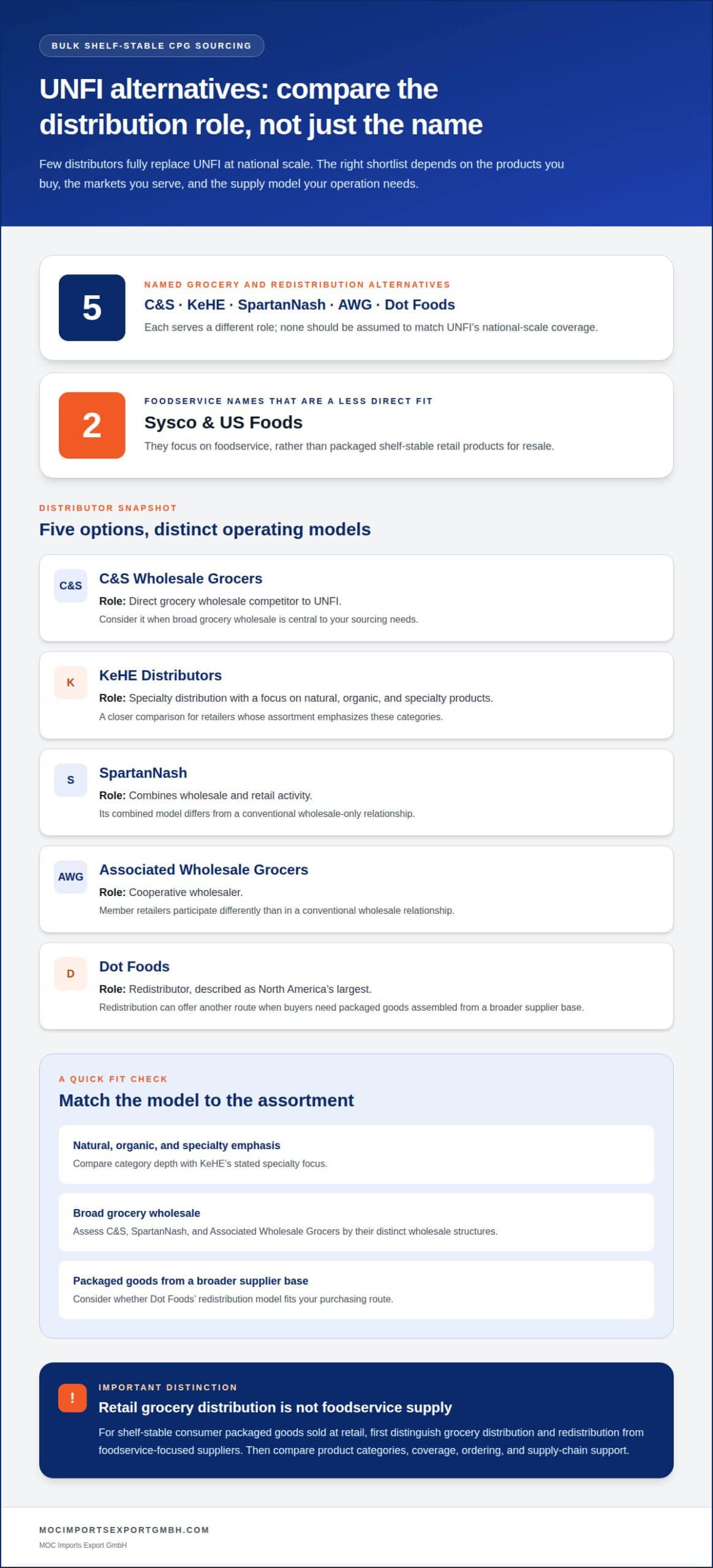
Few distributors fully replace UNFI at national scale. UNFI alternatives for bulk shelf stable consumer packaged goods include C&S Wholesale Grocers, KeHE Distributors, SpartanNash, Associated Wholesale Grocers, and Dot Foods. Their roles differ, while Sysco and US Foods focus on foodservice rather than packaged shelf-stable retail products.
Choosing an alternative means more than finding another supplier. The right fit depends on the products you buy, the markets you serve, and the distribution capabilities your operation needs. A national grocery wholesaler, a regional distributor, and a redistributor can each support a different purchasing model.
This overview explains how these distributor types compare and what to assess across product range, geographic coverage, ordering, and supply-chain support. You’ll also see how B2B marketplaces differ from traditional distributors, so you can focus your shortlist on the capabilities that matter for your bulk purchasing needs.
Key Takeaways
- Compare national and regional distributors by their role in grocery supply, not just by how closely they resemble UNFI.
- Understand when a B2B marketplace may suit your purchasing model and how it differs from a traditional distributor.
- Assess product selection across natural, organic, and conventional CPG categories to find a fit for your assortment.
- Use order requirements, pricing structure, fees, and payment terms to evaluate the full purchasing relationship.
- See how MOC Import Export’s bulk offerings, including Oral-B Pro Cross Action Electric Toothbrush Heads, may fit a buyer’s product needs.
National and regional food distributor alternatives to UNFI
Few alternatives fully replace UNFI at national scale. The right shortlist depends on whether you need broad grocery wholesale, specialty distribution, or redistribution.
C&S Wholesale Grocers is a direct grocery wholesale competitor to UNFI. Associated Wholesale Grocers operates as a cooperative wholesaler, while SpartanNash combines wholesale and retail activity. These models suit different purchasing structures. For example, a cooperative differs from a conventional wholesale relationship in how member retailers participate.
KeHE Distributors competes directly in natural, organic, and specialty distribution, making it a closer comparison for retailers whose assortment emphasizes those categories. Dot Foods is described as North America’s largest redistributor. Redistributors offer another purchasing route when buyers need packaged goods assembled from a broader supplier base.
Sysco and US Foods focus on foodservice, not packaged shelf-stable retail products. That makes them a less direct fit for grocery stores sourcing consumer packaged goods for resale. When comparing UNFI alternatives for bulk shelf stable consumer packaged goods, distinguish retail grocery distribution from foodservice supply before assessing coverage or order fit.
Product Selection Across Distributors
Product selection means the mix of natural, organic, specialty, and conventional brands a distributor makes available to business buyers. It matters because an assortment built around specialty grocery requires a different distribution fit from one centered on conventional packaged goods.
KeHE’s stated focus includes natural, organic, and specialty distribution. C&S, SpartanNash, and Associated Wholesale Grocers are grocery wholesale alternatives, while Dot Foods follows a redistribution model. Compare each option by category depth and supply-chain role rather than assuming every distributor carries an equivalent assortment.
Retailer and Business Customer Fit
Customer fit describes the types of buyers a distributor’s operating model is designed to serve. It matters because independent retailers, ecommerce sellers, foodservice operators, and large chains have different purchasing and delivery needs.
UNFI’s listed competitors span grocery wholesale, cooperative wholesale, specialty distribution, and redistribution. Alternatives are therefore not limited to large chains, but that does not make every option suitable for every buyer. Foodservice distributors such as Sysco and US Foods are not designed for packaged shelf-stable retail products. Ecommerce sellers should assess whether a distributor’s model supports their product flow.
Do UNFI competitors serve independent retailers, ecommerce sellers, foodservice businesses, or only large chains? They are not limited to large chains: the alternatives include grocery wholesalers, a cooperative wholesaler, specialty distribution, and redistribution. Foodservice businesses can use distributors such as Sysco and US Foods, but those companies are not designed for packaged shelf-stable retail products.
How can a retailer open a wholesale account with KeHE, C&S, or a regional wholesaler? First, identify the distributor that matches your assortment and operating model. Prepare a concise business profile covering store format, product categories, purchasing needs, and delivery locations. Then submit the information through the distributor’s account or sales process and discuss account fit, ordering, and delivery arrangements.
Faire Wholesale and other B2B marketplaces
Faire Wholesale uses a marketplace model, unlike sourcing through a grocery distributor such as UNFI. A marketplace connects business buyers and sellers through a shared purchasing interface. Buyers can evaluate individual seller listings, whereas a distributor typically presents an assortment through its own wholesale relationship. This distinction affects how you compare products, orders, and supply arrangements.
For shelf-stable consumer packaged goods, start by identifying the exact category and brand you need. A marketplace search for packaged coffee, for example, may show sellers with different assortments and order conditions. It can help you explore products across sellers, but it is not a direct substitute for every distributor function. The purchase relationship may depend on the seller and the terms listed.
Use a consistent comparison for Faire Wholesale and any other B2B marketplace you consider. Record the product, seller, pack configuration, order minimum, shipping terms, and reorder process. Then compare those details with the requirements of a distributor account. Keep the comparison at the product and order level. A marketplace’s broad range of listings doesn’t guarantee that one seller can meet every category or replenishment need.
- Assortment: Compare the specific shelf-stable categories and brands available from each seller.
- Order structure: Note whether the order combines products from one seller or several.
- Replenishment: Review how the seller handles repeat purchasing and product continuity.
- Delivery terms: Compare the stated shipping arrangements with your receiving process.
These checks help distinguish product discovery from ongoing supply. A retailer testing a new packaged snack, for example, may value a marketplace listing from one seller. A grocery operator replenishing established shelf-stable lines may prioritize a distributor relationship built around regular ordering. Neither model fits every purchasing task. The right option depends on assortment breadth, ordering workflow, and how consistently the buyer needs the same products.
Distinguish marketplace visibility from the responsibilities attached to an order. Faire Wholesale is the platform, while the individual seller’s listing provides the product and transaction details. Review those details as part of the purchase decision. For a distributor, focus on the account relationship and the range of products available through that channel. This helps clarify whether a marketplace supplements a distributor or serves a different sourcing purpose.
Use marketplaces to compare seller-level options, then map the results against your wholesale purchasing needs. If your next step is discussing bulk sourcing requirements, share your purchasing requirements.
How do UNFI alternatives compare on product selection, including natural, organic, and conventional CPG brands?
Compare distributors by category depth, not company name alone. KeHE is identified as a direct competitor in natural, organic, and specialty distribution. C&S Wholesale Grocers, SpartanNash, and Associated Wholesale Grocers represent other grocery wholesale models, while Dot Foods is a redistributor. These roles frame the comparison, but do not establish that the assortments are identical.
Divide your target list into natural, organic, specialty, and conventional CPG products. Then record each required brand and item under its category. A retailer carrying conventional packaged coffee alongside natural snacks, for example, can assess whether one distributor’s range meets both needs. KeHE’s stated focus makes it relevant to the natural, organic, and specialty part of the list.
Use a product-level matrix rather than a broad claim such as “full grocery range.” Include the brand, product name, pack format, category, and whether the item is essential or optional. Add a column for each distributor being assessed. This makes gaps visible without assuming C&S, SpartanNash, Associated Wholesale Grocers, or Dot Foods carries a particular item.
- Natural and organic: Mark the products that define your assortment, then compare their listing status across distributors.
- Specialty: Identify niche or regional brands separately from core grocery items.
- Conventional CPG: List routine packaged goods and note which items drive repeat purchasing.
- Assortment fit: Distinguish must-stock products from items that can be sourced through another channel.
Category labels alone do not show whether an assortment meets a store’s needs. A natural-focused retailer may prioritize category depth, while a conventional grocery operation may need broad coverage across everyday packaged goods. A mixed-format store should compare both groups separately. KeHE’s specialty focus is a useful comparison point, not proof that it meets every natural or organic product requirement.
Compare the same product list across distributors, distinguishing confirmed product matches from category-level alignment. C&S, SpartanNash, and Associated Wholesale Grocers can be assessed as grocery wholesale alternatives; Dot Foods can be assessed by its redistribution role. The key question is whether the relevant channel aligns with your product categories and purchasing plan, not whether its profile sounds similar.
Identify assortment gaps before making a sourcing decision. If one channel aligns with natural and organic products but leaves conventional items uncovered, record the difference rather than treating the ranges as interchangeable. This gives buyers a practical basis for comparing UNFI alternatives for bulk shelf stable consumer packaged goods and deciding which supplier relationships should support each category.
What are the minimum order quantities and purchase requirements for major grocery distributors?
Major grocery distributors do not share one standard minimum order quantity. The practical threshold depends on the account, product assortment, pack configuration, and delivery arrangement. For UNFI, KeHE, C&S Wholesale Grocers, SpartanNash, Associated Wholesale Grocers, and Dot Foods, assess both item-level and total-order requirements. A low minimum for one item may still come with a larger order or delivery requirement.
Separate purchase requirements into three parts: account eligibility, order composition, and delivery conditions. Account eligibility defines which business buyers can open an account. Order composition covers cases, product combinations, and any minimum value or volume. Delivery conditions affect how an order is assembled and received. These factors help you compare operating requirements without treating every channel as equivalent.
A retailer considering KeHE for specialty items, for example, should first list the required products and pack formats. A buyer comparing C&S or SpartanNash can use the same list, then record each distributor’s applicable order terms. For Dot Foods, consider whether its redistribution model fits the intended assortment. This keeps the comparison specific to your business.
- Account requirements: Record business details and the buyer type each distributor serves.
- Item minimums: Note case quantities or pack formats attached to each product.
- Order thresholds: Separate item requirements from any total-order conditions.
- Delivery terms: Include receiving location and delivery arrangement in the comparison.
Order scale also affects whether a minimum is workable. A small independent retailer may need a narrow assortment and manageable case quantities. A large chain may plan orders across several locations and a wider product range. Ecommerce sellers may prioritize products that fit their online assortment and fulfillment workflow. These examples show why buyer type and order design belong in the same assessment.
Build a comparison sheet with one row per distributor and one column per requirement. Use the same product list for UNFI, KeHE, C&S, SpartanNash, Associated Wholesale Grocers, and Dot Foods. Record account criteria, case configuration, order thresholds, delivery terms, and the reorder process. Note requirements by product category, since a condition for specialty items may not apply to conventional packaged goods.
Compare the full purchasing pattern, not just the opening order. Repeat orders, assortment changes, and receiving capacity can affect whether a distributor’s minimum remains workable. A retailer weighing UNFI alternatives for bulk shelf stable consumer packaged goods can use this framework to identify the channel whose purchasing requirements best match its inventory plan.
How do distributor pricing, fees, and payment terms compare with UNFI?
Compare the full purchase arrangement, not just the listed case price. UNFI does not typically charge slotting fees. However, prime promotional or catalog placement may involve unofficial costs, such as commitments to higher-volume orders. A promotion can affect purchasing commitments without appearing as a standard fee, so include that distinction when comparing distributor terms.
For UNFI, KeHE, C&S Wholesale Grocers, SpartanNash, Associated Wholesale Grocers, and Dot Foods, compare the same planned order basket. Record product cost, case configuration, freight terms, discounts, promotional commitments, and payment conditions separately. A lower listed product cost may not suit your operation if the overall arrangement requires a larger order or different purchase terms.
Assess promotional support separately. UNFI promotional funding may not cover the full cost of agreed promotions, leaving brands to pay unexpected expenses. Identify the funding, commitments, and associated costs before assessing a promotion’s effect on margins. This matters when a brand plans catalog placement or a temporary retail promotion.
Payment terms shape cash-flow planning. Compare when payment is due, what event starts the payment period, and how credits or promotional allowances appear on invoices. Apply the same criteria to each account. This gives buyers a consistent basis for comparing UNFI with other distributors without assuming companies use identical payment arrangements.
- Product pricing: Compare the same brand, item, and pack configuration.
- Order commitments: Record volume expectations tied to promotions or placement.
- Fees and allowances: Separate standard charges from promotional funding and credits.
- Payment conditions: Review due dates, invoice handling, and applicable credits.
Consider a brand evaluating a UNFI catalog promotion. Assess the order commitment separately from product cost and promotional funding, then apply the same comparison points to a KeHE or C&S proposal. This prevents a promotion’s volume requirement from being mistaken for an ordinary account fee.
A comparison of UNFI alternatives for bulk shelf stable consumer packaged goods should include the total purchasing obligation for the planned assortment and promotion. Assess it alongside the payment schedule and expected sales. Buyers can then compare equivalent products, order conditions, promotional arrangements, and payment terms, rather than relying on one headline price.
To discuss bulk sourcing requirements and product purchasing, contact MOC Import Export.
UNFI acquired Tony’s Fine Foods in 2014, expanding its specialty and perishables distribution, particularly in the western United States. UNFI sets delivery and packaging standards that vendors must follow for efficient warehousing and distribution.
MOC Import Export: Oral-B Pro Cross Action Electric Toothbrush Heads – Pack of 8 (White)
MOC Import Export can support buyers sourcing branded consumer goods in bulk, including Oral-B Pro Cross Action Electric Toothbrush Heads – Pack of 8 (White). This product is relevant when your purchasing plan includes oral-care goods alongside grocery and other shelf-stable packaged categories.
Use the distributor comparison above to assess assortment fit, order structure, and commercial terms. Then consider whether adding a wholesale source for established consumer brands suits your inventory plan. MOC Import Export also offers Pampers ZZZ Overnight Diapers, Size 5 (27+ lbs), 88 Count, Oral-B iO5 Electric Toothbrushes for Adults Black, and Gain Original Liquid Laundry Detergent – 5 Gallon.
For details on bulk purchasing, contact MOC Import Export or visit mocimportsexportgmbh.com.
Turn Your Supplier Shortlist Into a Sourcing Plan
Choosing among UNFI alternatives for bulk shelf stable consumer packaged goods is an opportunity to build a sourcing plan around your inventory priorities. Separate core products from secondary categories, then decide which purchasing relationships best support each part of your assortment. This keeps supplier decisions tied to operational needs rather than broad company profiles.
For buyers also sourcing branded consumer goods, MOC Import Export offers products such as Oral-B Pro Cross Action Electric Toothbrush Heads – Pack of 8 (White), Pampers ZZZ Overnight Diapers, Size 5 (27+ lbs), 88 Count, and Oral-B iO5 Electric Toothbrushes for Adults Black. These examples can help assess whether a wholesale assortment aligns with your broader purchasing plan.
Use your product priorities to guide the next sourcing conversation. Discuss your wholesale purchasing needs with MOC Import Export and take the next step toward a more focused supply plan.
Frequently Asked Questions
Which distributors compete with UNFI for bulk shelf-stable consumer packaged goods in the United States?
Named alternatives include C&S Wholesale Grocers, KeHE Distributors, SpartanNash, Associated Wholesale Grocers, and Dot Foods. Their business models differ: C&S is a grocery wholesale competitor, KeHE focuses on natural, organic, and specialty distribution, and Associated Wholesale Grocers operates as a cooperative wholesaler. SpartanNash combines wholesale and retail activity, while Dot Foods is a redistributor. These distinctions help buyers narrow their shortlist by purchasing model.
Which wholesalers specialize in bulk shelf-stable foods, snacks, beverages, and household CPG products?
KeHE Distributors is the clearest fit for buyers prioritizing natural, organic, and specialty products. Dot Foods offers redistribution, while C&S Wholesale Grocers, SpartanNash, and Associated Wholesale Grocers are grocery wholesale options. Sysco and US Foods are not designed to supply packaged shelf-stable retail products. Compare each supplier’s business model with the categories you need before treating the options as interchangeable.
Which U.S. regional grocery distributors are alternatives to UNFI for shelf-stable products?
For a grocery wholesale shortlist, consider C&S Wholesale Grocers, SpartanNash, and Associated Wholesale Grocers. C&S is a direct grocery wholesale competitor, SpartanNash combines wholesale and retail activity, and Associated Wholesale Grocers is a cooperative wholesaler. Compare these different wholesale structures with your business’s product assortment. Dot Foods may also be relevant when redistribution suits your purchasing approach.
What risks should retailers check when switching distributors, including fill rates, shelf life, and product availability?
Check whether the distributor can supply each required brand and item, and use a product-level matrix to identify assortment gaps. Review delivery arrangements, ordering requirements, and how consistently products can be reordered. Also compare any stated fill-rate or shelf-life criteria against your operation’s needs.
