

Uncategorized
Lavazza Whole Bean Coffee Wholesale: Business Guide

12
Oct
Oct
Is the best wholesale coffee choice the one with the broadest appeal, or the one your operation can use consistently? Business buyers should match Lavazza whole bean coffee wholesale to actual demand, storage capacity, and preparation routines, rather than relying on a familiar brand name alone. MOC Import Export GmbH offers Lavazza Top Class Filtro Whole Bean Coffee in a 2.2 lb / 1 kg format, giving businesses a specific product to evaluate.
This guide shows how to assess that format for your operation and plan purchases around observed usage. Use the checklists to estimate order quantities, organize replenishment, and establish receiving and storage routines. You’ll also find what to include in a focused wholesale inquiry, from the product name to your estimated requirement. The aim is to help you decide how the listed coffee fits your business and what information to bring to the next sourcing step.
Key Takeaways
- Plan Lavazza whole bean coffee wholesale purchases around actual use and your replenishment process.
- Identify the product accurately: Lavazza Top Class Filtro Whole Bean Coffee in a 2.2 lb / 1 kg format.
- Choose a purchasing workflow that fits your demand pattern and internal buying process.
- Use consistent receiving and stock records to support inventory control.
- Prepare a focused wholesale inquiry with the product name, intended business use, and estimated requirement.
What Lavazza Whole Bean Coffee Wholesale Means for Business Buyers
Lavazza whole bean coffee wholesale means assessing a specific whole bean product for your business’s use, product requirements, and purchasing workflow. Start by considering who will use the coffee, how it will be prepared or sold, and how your business will manage stock.
MOC Imports Export GmbH offers Lavazza Top Class Filtro Whole Bean Coffee in a 2.2 lb / 1 kg format. Use the full product name and package size when assessing the listing and recording your requirement. Then consider whether whole beans and the package format fit your preparation process, storage space, and purchasing routine.
Keep three decisions separate. First, establish the intended use, such as customer service, workplace consumption, or resale. Next, identify the product and package format. Finally, plan purchasing around your expected consumption, stock records, and internal ordering process. This makes the evaluation specific to your operation instead of relying on brand recognition alone.
For background on the company behind the brand, Lavazza’s history and global operations offers broader context. For procurement, focus on the product listing and how it fits your business requirements. The coffee product category provides a place to view the coffee range.
What whole bean format means in day-to-day operations
Whole beans require a grinding step before preparation. Consider where grinding will take place, which equipment your process uses, and who will handle the task. For a business serving coffee, include grinding in the preparation workflow; for workplace use or resale, consider the equipment or handling process relevant to that use.
Assess this workflow separately from the product name and package size. Check your equipment instructions and existing routine to determine how grinding would fit. This helps identify practical requirements without assuming a particular roast profile, tasting note, or brewing suitability.
Who may evaluate wholesale Lavazza coffee
Cafés and foodservice operators can estimate use in beverage service and consider how grinding fits their preparation routine. Workplace buyers can track internal consumption and decide how coffee will be replenished. Retailers can assess whether the product identity and package format fit their resale planning.
Start with the demand pattern specific to your business: service volume for foodservice, staff or visitor use in a workplace, and sales and stock records for retail. The key question is whether the listed product and a workable purchasing process suit the operation’s needs.
How to Evaluate Lavazza Whole Bean Coffee for Your Business
A useful evaluation starts with your operation, not a generic serving estimate. For Lavazza whole bean coffee wholesale, define the intended use and review how the coffee will be prepared, stored, and replenished. That gives you a practical basis for assessing the product format and purchasing workflow.
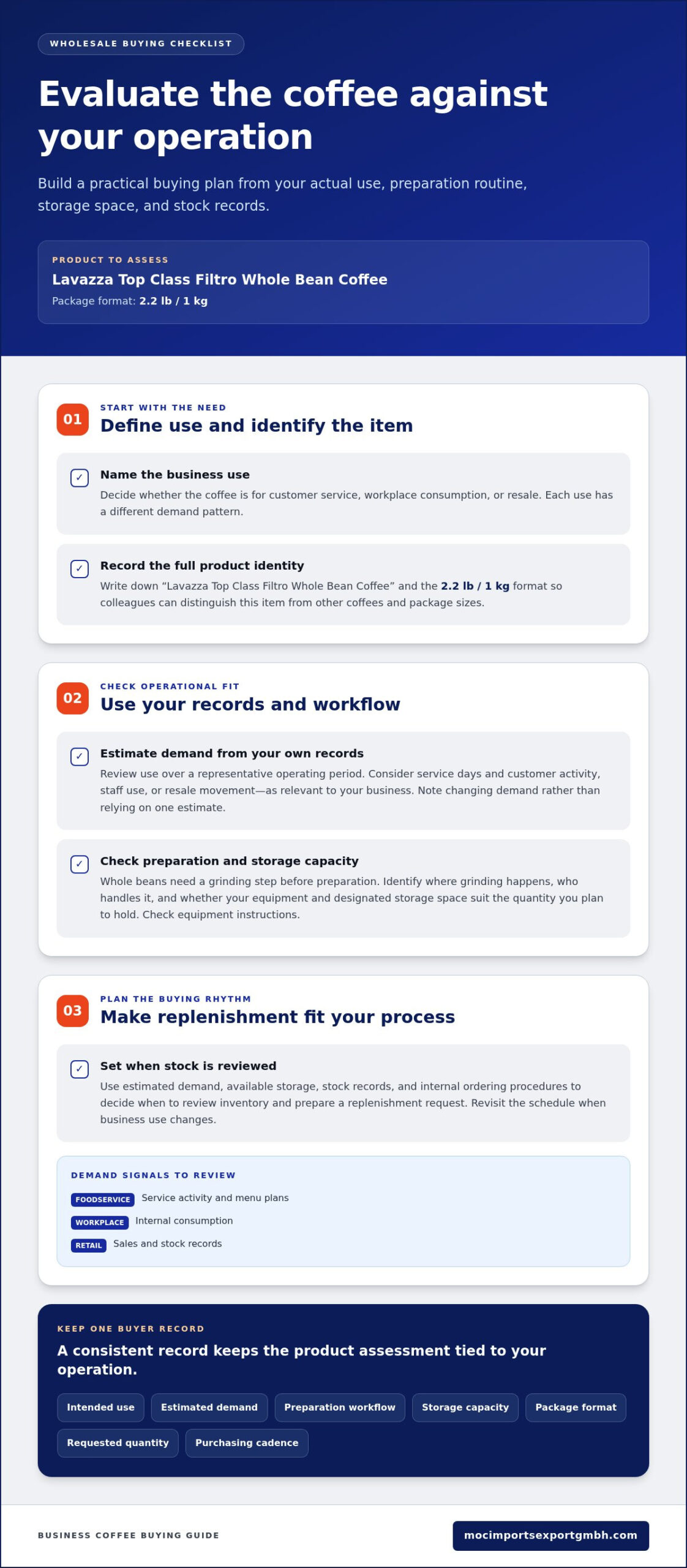
The listed product is Lavazza Top Class Filtro Whole Bean Coffee, packaged in a 2.2 lb / 1 kg format. Use those details to identify the item in your notes and inquiry. Then assess how many packages your business needs using its own records and operating requirements.
- Define the business use. Decide whether the coffee is for customer service, employee use, or resale inventory. Each use creates a different demand pattern. A café can review service activity and menu plans, a workplace can track internal consumption, and a retailer can use its sales and stock records.
- Match the product identity. Record the full name, Lavazza Top Class Filtro Whole Bean Coffee, along with the 2.2 lb / 1 kg package format. Clear identification helps colleagues distinguish the item from other coffee products and formats.
- Estimate demand from your own records. Review usage over a representative operating period, accounting for service days, customer activity, staff use, or resale movement as relevant. If demand changes over time, note the pattern and use it when planning purchases instead of relying on a single estimate.
- Check preparation and storage capacity. Compare expected use with the equipment and process already in place. Consider who will manage the grinding step and whether your designated storage space can accommodate the quantity you plan to hold. Review equipment instructions rather than assuming compatibility with a particular machine.
- Set a purchasing rhythm. Use estimated demand, available storage, and internal ordering procedures to decide when to review stock and prepare a replenishment request. Revisit the schedule when business use changes instead of treating one estimate as permanent.
Keep your assessment grounded in the product details and your own operational records. The product name and package format help identify the listing. Your demand records, equipment, and storage plan help determine whether it fits your business. Related items are available in the coffee product category.
For a practical buyer record, capture intended use, estimated demand, storage capacity, preparation workflow, package format, requested quantity, and planned purchasing cadence. This gives colleagues a consistent reference when reviewing inventory or preparing an inquiry. Once you have established your requirement, use the wholesale inquiry page to share the product name and estimated need.
Compare Coffee Purchasing Approaches Before Choosing a Wholesale Workflow
Your purchasing workflow should reflect how consistently your business uses coffee, how much stock it can store, and how orders are handled internally. Occasional purchasing may suit variable demand. Planned replenishment can make recurring needs easier to manage, while an inquiry-led approach lets your team communicate a defined product requirement. Choose the process that fits your records and purchasing routine.
Use the comparison below to identify which workflow best suits your business. Consider how much administration each approach involves and whether your demand records are clear enough to support recurring stock decisions.
| Buyer need | Useful planning question | Workflow consideration |
|---|---|---|
| Occasional or variable demand | Will usage remain unpredictable or change between ordering occasions? | Occasional purchasing may be easier to manage when needs are inconsistent, but each purchase still requires review and administration. |
| Recurring operational use | Do usage records show a repeatable pattern? | Planned replenishment can align stock reviews with observed demand and internal purchasing procedures. |
| A defined sourcing requirement | Can the business specify the product and estimated requirement? | An inquiry-led approach gives procurement teams a structured way to communicate their needs. |
One-time purchasing versus planned replenishment
A one-time purchase can suit a trial or a period when demand is uncertain. As you build usage records, compare consumption across operating periods and note changes in service schedules or business activity. A regular stock review can reduce ad hoc decisions, but holding inventory also takes storage space and requires oversight. Set a review cadence that reflects your records and procedures rather than assuming one interval works for every operation.
Whole bean purchasing versus other coffee formats
Whole bean purchasing includes grinding as part of preparation; pre-ground coffee does not require that step at the point of use. That difference affects equipment, staff routines, and preparation time. Consider who will grind the beans and whether the task fits your existing process. Neither format is automatically the better choice. Compare the workflow and equipment each requires with your operation’s practical capacity.
A simple comparison framework for procurement teams
Review four criteria before choosing a purchasing process: product fit, forecasted demand, storage readiness, and purchasing administration. Document the selected format, the reason for choosing it, the basis for your demand estimate, the storage plan, and who manages purchasing. This gives colleagues a clear reference for future stock reviews and sourcing decisions.
When your team has defined its product requirement and estimated need, it can share those details through a wholesale inquiry as the next sourcing step.
Plan Receiving, Storage, and Inventory for Wholesale Whole Beans
A dependable coffee workflow starts before a package reaches the preparation area. Assign responsibility for receiving, recording, storing, and reviewing stock. Use the same product name and package description in purchasing records and inventory so that staff can match what arrives to what was ordered. For Lavazza whole bean coffee wholesale, consistent records also help distinguish this item from other coffee in your operation.
Forecast, receive, record, store, and review. Use these steps as a simple control from purchase planning through the next inventory decision.
Prepare a basic coffee inventory routine
Assign a person to each task, even if one team member handles several of them. When stock arrives, compare it with the purchasing record and note any discrepancy for internal follow-up. Record the product identity, package count, and date received. Use the same product wording in purchase requests and stock records to reduce confusion.
Track usage and use that history to set an internal reorder trigger. Base the trigger on how quickly your business consumes stock and how its purchasing process works, not on a generic benchmark. Review it when operating demand changes.
Handle and store stock using product directions
Follow the handling and storage directions on the package. Keep stock in a clean, organized area that suits your operation, and make sure staff know where it is recorded and stored. Avoid relying on assumptions about shelf life, temperature, or handling after opening. Use the product directions for those details.
A consistent placement routine makes stock checks easier. Staff should be able to find the inventory record and locate the coffee in its designated storage area. This supports accurate counts while keeping product-specific handling aligned with package instructions.
Review purchasing performance over time
At each stock review, record usage, remaining packages, and the time since the previous order. Compare actual movement with the forecast used for purchasing. If demand was higher or lower than expected, look at operational factors such as a changed service schedule or a shift in business use before adjusting the plan.
Use the records to decide whether your reorder trigger or purchasing schedule needs to change. They can also show when inventory is accumulating faster than the operation uses it, helping buyers avoid holding more stock than their process requires.
Keep the workflow straightforward: forecast expected need, check and record received stock, store it according to package directions, then review usage and remaining inventory. Apply the same sequence to the listed Lavazza coffee to support clear handoffs between purchasing and daily operations. Businesses can send a coffee sourcing inquiry with their product requirement and estimated need.
Source Lavazza Whole Bean Coffee Wholesale Through MOC
MOC Imports Export GmbH offers Lavazza Top Class Filtro Whole Bean Coffee in a 2.2 lb / 1 kg format. Use the product name and package size as a clear reference when planning a wholesale purchase. Connect that product reference to your intended use and estimated requirement so your sourcing request reflects the needs of your business.
Prepare a useful wholesale inquiry
Start with the exact name, Lavazza Top Class Filtro Whole Bean Coffee, and include the 2.2 lb / 1 kg package format. Explain how your business plans to use it, such as for customer service, workplace consumption, or resale. This makes the request specific and helps distinguish an operational requirement from a general product question.
Include an estimated requirement based on your usage or inventory planning. If relevant, say whether the need is recurring or tied to a particular business activity. Label estimates clearly: they describe your requirement and help frame the sourcing request.
Use MOC’s coffee range for relevant product discovery
The listed whole bean option is Lavazza Top Class Filtro Whole Bean Coffee, 2.2 lb / 1 kg. Keep the product name and package format together in procurement notes so the item is easy to identify during internal review and inquiry preparation. The coffee product category offers a useful place to browse coffee listings alongside your product review.
Assess the listing alongside your operational needs, including expected use and inventory planning. Keeping those considerations together helps your team prepare a clear request and maintain a consistent record of the product under review.
Take the next sourcing step
Before submitting a request, bring together the information your purchasing team has established. A concise, organized inquiry can include:
- The exact product name and 2.2 lb / 1 kg package format.
- The intended business use, such as service, workplace consumption, or resale.
- Your estimated requirement and whether it reflects a one-time or recurring need.
- Relevant planning context, such as the basis for your estimate or inventory schedule.
This preparation keeps the inquiry specific and gives your team a record of the product considered and the reason for the request. It also supports consistent follow-up across purchasing and operations.
For Lavazza whole bean coffee wholesale, send MOC a focused business inquiry with the product name, intended use, and estimated requirement.
Turn Your Coffee Plan Into a Clear Sourcing Request
Turn your operating needs into a brief your purchasing team can use. Specify the intended business use and estimated requirement, then align the request with your internal stock and preparation plans. A clear brief gives the sourcing conversation a practical starting point.
MOC Imports Export GmbH serves business buyers through wholesale product sales and offers Lavazza Top Class Filtro Whole Bean Coffee in a 2.2 lb / 1 kg format. Use that product reference to frame your Lavazza whole bean coffee wholesale inquiry and explain what your operation needs.
Submit a wholesale coffee inquiry with the product name, intended use, and estimated requirement. This gives MOC a clear picture of your business request and gives your team a useful record of its sourcing plan.
Frequently Asked Questions
Is Lavazza whole bean coffee suitable for business use?
It can suit a business when the product and preparation workflow match its operational needs. MOC offers Lavazza Top Class Filtro Whole Bean Coffee for buyers to evaluate for customer service, workplace use, or resale planning. Consider who will prepare or handle the coffee, what equipment is available, and how the product fits existing purchasing procedures. Suitability depends on your use case, not the brand name alone.
How much whole bean coffee should a business stock?
Set stock levels using your own consumption records rather than a general estimate. A café can compare coffee used during similar service periods, while an office can track how quickly its supply is used during normal workdays. Note periods of higher or lower demand, then set an internal reorder point that reflects that pattern and your purchasing process. Review it when operating conditions change.
What does the 2.2 lb / 1 kg package size mean for inventory planning?
It identifies the amount of coffee in one listed package, giving your team a unit for counting stock and planning requests. Record inventory in packages, and include total weight if that helps your internal reporting. Package weight alone does not show how many servings it will provide, since preparation amounts and usage vary. Estimate expected use from your own operating method before deciding how many packages to plan for.
Can whole bean coffee be used with any coffee machine?
Do not assume every coffee machine can prepare whole beans directly. Check the equipment instructions to determine whether it accepts whole beans or requires ground coffee, and whether your workflow includes a separate grinder. Also consider who will operate the equipment and how grinding fits into preparation. Assess compatibility based on your equipment setup and its instructions.
How should a business store whole bean coffee?
Follow the handling and storage directions on the product package. Include those directions in your receiving routine so staff know how to manage stock after it arrives. Keep inventory records aligned with the physical product and use an organized storage area that fits your operation. Use the package guidance for product-specific instructions rather than relying on assumptions about shelf life, temperature, or handling after opening.
What information should I include in a wholesale coffee inquiry?
Include the product’s exact name, your intended business use, and an estimated requirement. State whether the coffee is intended for service, workplace consumption, or resale, and whether your estimate reflects a recurring need or a one-time request. Add relevant planning context, such as how you arrived at the estimate. Clear details help define the request.
Why choose whole beans instead of pre-ground coffee for a business?
Choose based on the preparation workflow your business can support. Whole beans require a grinding step, so consider equipment, staff responsibilities, and how that task fits service or workplace routines. Pre-ground coffee avoids grinding at the point of preparation, which may suit a different setup. Neither format is automatically the better choice for every business. Compare the steps and equipment each requires with your team’s established process.
