

Uncategorized
Zoro vs. a Commercial Wholesale Distributor for Facility Maintenance Chemicals

11
Oct
The biggest catalog isn’t automatically the best fit for your supply room. In the choice of Zoro vs commercial wholesale distributor for facility maintenance chemicals, the better source depends on what you buy repeatedly, which pack formats work for your operation, and how you replenish stock without tying up space in excess inventory. A supplier may be convenient for individual orders yet less aligned with recurring bulk needs.
Compare product range and ordering convenience, then look at whether the supplier’s categories and formats match your maintenance routine. This article compares Zoro’s online purchasing model with the broader commercial wholesale distributor model, focusing on product fit, order patterns, and replenishment planning. It also explains where MOC Import Export GmbH fits as a wholesale source for business customers, including cleaning and janitorial goods and related branded products. MOC offers Gain laundry detergent and Dawn dish soap in 5-gallon formats. These are bulk options for laundry and dishwashing, not specialized industrial chemicals. Use the comparison to identify a sourcing approach that supports routine facility needs without encouraging overbuying.
Key Takeaways
- Compare suppliers by recurring order needs, product categories, and purchasing effort, not catalog size alone.
- Use the Zoro vs commercial wholesale distributor for facility maintenance chemicals comparison to assess buying models alongside product fit and replenishment needs.
- Match each product’s identity and container format to its intended task, storage limits, and routine consumption.
- Set a clear purchasing process by assigning buyer roles, recording approval requirements, and defining an ordering cadence.
- Consider MOC as a wholesale source for cleaning and janitorial goods when sourcing related business products.
Zoro vs. a Wholesale Distributor: Start With Your Facility’s Supply Needs
Supply continuity, product fit, and purchasing effort all affect facility operations. A source that makes a one-off order simple may not suit recurring bulk needs, while a wholesale purchasing model may be useful when the facility buys across several related categories. Start by listing what staff use, how quickly supplies are consumed, and what can be stored safely and practically.
Zoro is the named online supplier in this comparison. A commercial wholesale distributor serves business customers through bulk sourcing across relevant product categories. These are different purchasing models, not automatic indicators of which supplier is better. In a Zoro vs commercial wholesale distributor for facility maintenance chemicals comparison, the decision depends on the facility’s order pattern, required products, and procurement workflow.
Which maintenance supplies does the facility actually use?
Separate supplies by task before comparing suppliers. Routine cleaners support recurring surface and floor care. Degreasers address specific soil or equipment needs. Laundry products and dishwashing supplies serve distinct workflows, so don’t group them with general-purpose cleaners simply because the same facility uses them. For a broader overview of cleaning-agent types and purposes, see Cleaning agent.
Create an inventory with each product’s name, intended use, container format, and typical consumption pattern. Add storage limits, such as available shelf or floor space, and note whether staff need a particular format for handling or dispensing. The cleaners and degreasers category can help buyers distinguish those supplies from laundry and dishwashing products when organizing purchasing needs.
Keep general cleaning needs separate from specialized chemical requirements. If a task calls for a product with a specific application or facility procedure, record that requirement clearly rather than treating any cleaner as interchangeable. This makes product comparisons more precise and helps prevent an unsuitable substitution.
When does a supplier comparison matter most?
Review your sourcing model when orders recur, replenishment is difficult to coordinate, or teams buy across multiple categories. A small, occasional order may call for a different process than planned purchasing for several departments. Urgent replenishment also deserves attention, but assess it as part of the facility’s normal workflow rather than assuming a supplier’s delivery performance.
Inconsistent products or formats can create extra work. A change in container format may affect storage or staff routines. A product substitution may need review before it is suitable for the task. Separate orders can also add steps for buyers coordinating cleaning, laundry, and dishwashing supplies.
Compare the full purchasing process: product identification, order scale, category coverage, internal approvals, storage, and the effort needed to maintain a usable reorder list. A single listing may look suitable on its own, but the broader workflow determines whether the source supports dependable replenishment. Start with actual consumption and constraints, then judge which model aligns with them.
How Zoro and Wholesale Distributors Differ in the Buying Process
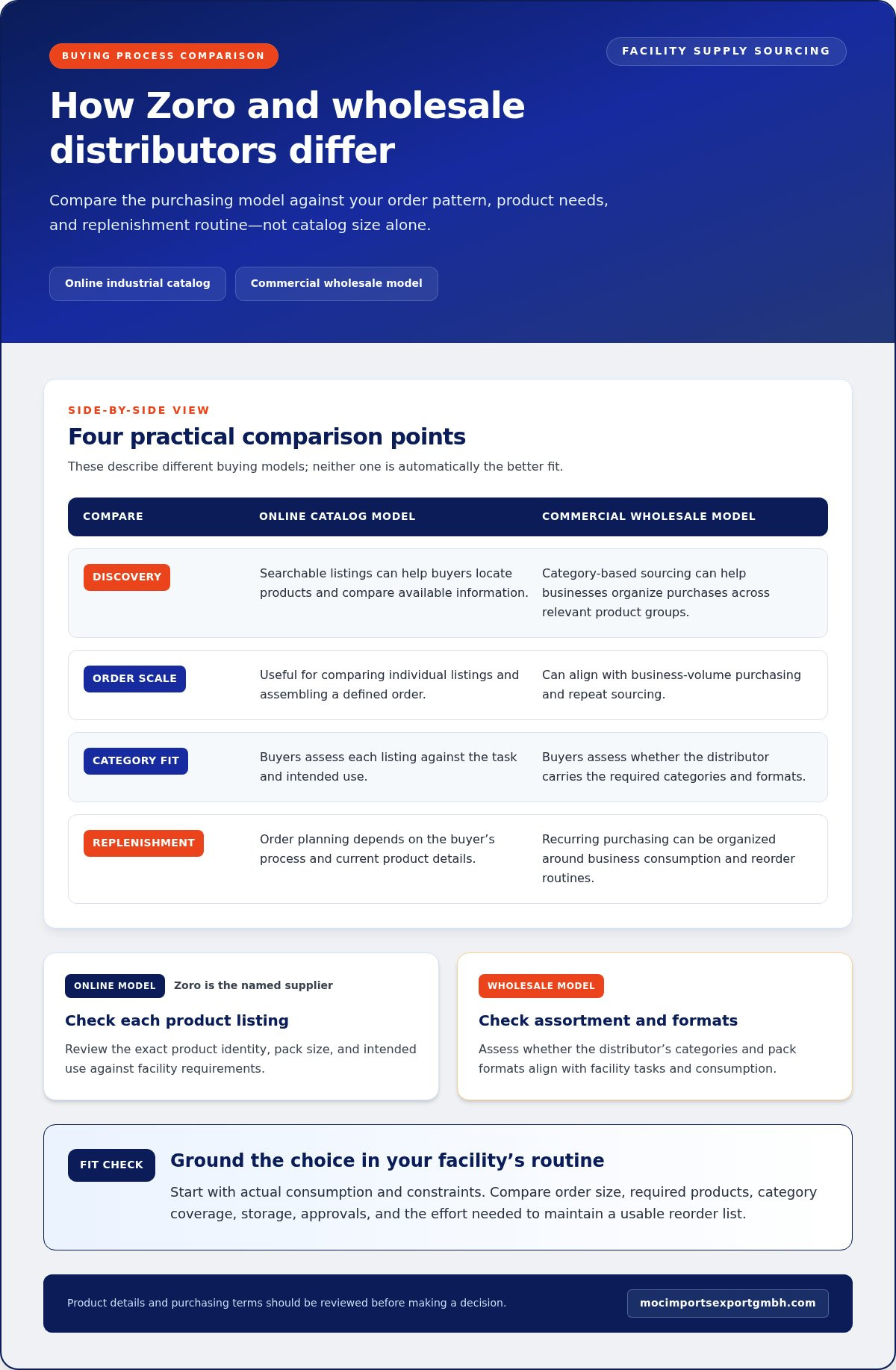
The buying process shapes how easily a facility can identify products, place orders, and maintain a consistent supply routine. An online industrial catalog and a commercial wholesale distributor represent different sourcing models. Neither model guarantees a better fit by itself. Compare how each supports your order size, product categories, and repeat purchasing needs. Review current product details and purchasing terms before making a decision.
| Comparison point | Online catalog model | Commercial wholesale model |
|---|---|---|
| Catalog discovery | Searchable listings can help buyers locate products and compare available information. | Category-based sourcing can help businesses organize purchases across relevant product groups. |
| Order scale | Useful for comparing individual listings and assembling a defined order. | Can align with business-volume purchasing and repeat sourcing. |
| Category fit | Buyers assess each listing against the task and intended use. | Buyers assess whether the distributor carries the required categories and formats. |
| Replenishment | Order planning depends on the buyer’s process and current product details. | Recurring purchasing can be organized around business consumption and reorder routines. |
What an online industrial catalog can support
An online catalog can make product discovery direct: buyers search by product type, review listing information, and compare options with facility requirements. These are general characteristics of the model, not a guarantee about any specific site function. Zoro is the online supplier being compared here. For every product, review the current listing for exact identity, pack size, and intended use.
What a commercial wholesale relationship can support
Wholesale sourcing can suit organizations that plan recurring business purchases or need to coordinate multiple supply categories. The practical test is whether the distributor’s assortment and pack formats align with the facility’s tasks and consumption. A buyer may need separate sourcing decisions for a general cleaner, a degreaser, and laundry supplies rather than assuming one category covers every need. Confirm product details before standardizing a recurring order.
Order-channel convenience helps buyers place an order; product suitability determines whether an item fits the facility’s task. Keep those decisions separate. A simple purchasing route cannot make a mismatched product appropriate, and a suitable product still needs a workable reorder process.
For a grounded comparison, document the required product and format, then consider how each purchasing model fits the facility’s routine. MOC Imports Export GmbH serves business customers through wholesale categories that include cleaning and janitorial goods, alongside related household products. Teams organizing recurring business sourcing can discuss their wholesale purchasing needs with MOC.
Compare Product Fit, Pack Formats, and Replenishment Before Choosing
Once the purchasing model is clear, compare candidate products against the actual task and facility usage. A matching category name isn’t enough. Confirm the exact product identity, intended application, container format, and how much the team uses during a normal ordering cycle. In the Zoro vs commercial wholesale distributor for facility maintenance chemicals comparison, this step separates a convenient listing from a product and pack size that fit daily operations.
Match product specifications to the task
Read label directions and intended applications for each candidate. Review the product’s safety documentation, including its Safety Data Sheet when available, and make sure staff procedures account for handling and use. Don’t assume a household cleaner can replace a specialized maintenance chemical. Product suitability starts with documented intended use. If a task requires a specific chemical function or facility procedure, treat that as a requirement, not a preference.
Use this worksheet to compare candidates from each source. Fill in the details from current product information and your facility’s records.
| Comparison field | Zoro candidate | Wholesale distributor candidate |
|---|---|---|
| Exact product name or identifier | Record the listing details | Record the listing details |
| Intended task and application | Match to facility procedure | Match to facility procedure |
| Container or pack format | Note size and unit format | Note size and unit format |
| Typical consumption | Use purchasing history | Use purchasing history |
| Storage and handling fit | Record space and routine limits | Record space and routine limits |
| Reorder trigger | Set from usage and lead-time data | Set from usage and lead-time data |
Plan pack sizes and repeat orders
Use purchasing history to estimate consumption. Review order dates, quantities, and how long each pack typically lasts. Avoid relying on industry averages that may not reflect your building, cleaning schedule, or staffing. A larger container may reduce how often the item is reordered, but it can also exceed available storage or complicate handling. Choose a format staff can store and use within established routines.
Set a reorder trigger using the data available to your team. For example, record the stock level at which a new order should be placed, then account for the supplier’s stated lead time where known. Set a separate trigger for each product, since consumption rates can differ. Review the trigger after changes in occupancy, cleaning frequency, or purchasing patterns.
Compare the completed worksheet across sources. A candidate that matches the task, fits storage, and supports a practical reorder rhythm is a stronger operational fit than one selected on pack size or listing convenience alone.
Use a Facility Purchasing Checklist to Make the Comparison
A consistent checklist turns supplier selection into a repeatable purchasing decision. It gives operations staff, procurement, and approvers a shared record of what each product must do, how it will be stored, and how it will be reordered. Use the same steps for every candidate in the Zoro vs commercial wholesale distributor for facility maintenance chemicals comparison so the result reflects documented needs rather than assumptions about supplier capabilities.
Create a repeatable procurement specification
For each recurring item, record its exact product name, use case, pack format, and any acceptable alternatives. Add storage and handling requirements from the product documentation, then assign a responsible buyer and review date. For relevant chemicals, review the Safety Data Sheet and applicable workplace procedures before adding the item to a standard order list.
- Define the task. Identify the cleaning or maintenance job, the area involved, and any procedure staff must follow. Keep routine cleaning tasks distinct from applications with specific chemical requirements.
- List required products. Record product names and intended uses. Note which items are essential and which alternatives are acceptable only if they meet the same documented requirements.
- Compare formats. Capture container size, units per order, storage capacity, and handling considerations. Include the people responsible for receiving, storing, approving, and using the product.
- Assess replenishment. Use purchasing history to set the expected ordering cadence. Identify the stock level that triggers a reorder and use available lead-time information when setting that point.
- Document the selection. Record the chosen source, decision rationale, required approvals, responsible buyer, and next review date. Update the record when the task, product, or facility storage conditions change.
Compare suppliers using the same scorecard
Apply one scorecard to each candidate. Rate each factor using evidence from current listings, product documentation, and account details. Don’t assume that an online catalog or wholesale relationship guarantees a particular pack format, ordering feature, or replenishment result. If a detail is unavailable, mark it for internal follow-up rather than treating it as a confirmed advantage.
- Product fit: Does the documented use match the facility task?
- Order workflow: Can the buyer complete the necessary identification and approval steps?
- Pack format: Does the stated container format fit consumption, storage, and handling needs?
- Replenishment predictability: Can the buyer plan repeat orders using documented purchasing and lead-time information?
Use the same discipline to organize wholesale cleaning supplies by task, format, and reorder routine. MOC’s wholesale cleaning and janitorial categories support business sourcing, including relevant branded household products. To discuss business purchasing needs, contact MOC Import Export GmbH.
Where MOC Fits for Wholesale Cleaning and Facility Supply Purchasing
MOC Imports Export GmbH is a wholesale and bulk sourcing option for business customers, with cleaning and janitorial goods among its product categories. For facility buyers, MOC is relevant when sourcing branded cleaning and household products alongside other business goods. Not every item is a specialized facility chemical. Match each product to its intended task and the procedures used at your site.
In a Zoro vs commercial wholesale distributor for facility maintenance chemicals comparison, MOC fits the wholesale side of the decision. Its relevant categories include cleaners and degreasers, laundry detergents, and other household products. Buyers evaluating related supplies can review the cleaners and degreasers category as part of their sourcing assessment.
Examples of relevant bulk cleaning products
Two examples show how pack format can matter in business purchasing. MOC offers Gain Original Liquid Laundry Detergent in a 5-gallon format and Dawn Original Manual Pot & Pan Liquid Dish Soap in a 5-gallon format. These products serve laundry and dishwashing tasks, respectively. They are not specialized industrial chemicals, so keep their intended uses distinct from other maintenance requirements.
For a useful comparison, record the product name, task, container format, and how the item fits your facility’s purchasing routine. MOC’s 5-gallon products provide a starting point for reviewing relevant large-format options. Compare each candidate against actual use and storage needs rather than assuming that a larger container will suit every operation.
Choose the next step for your purchasing workflow
Wholesale sourcing may align with buyers who purchase recurring business quantities, need cleaning and janitorial products, or coordinate related household supply categories. The fit still depends on the exact product required, its documented use, the pack format, and the facility’s replenishment plan. Keep specialized chemical requirements separate and assess them against applicable product documentation and workplace procedures.
MOC serves business customers nationally in the United States. Use the comparison to identify which items fit wholesale sourcing and which product details should guide the purchasing decision. For a focused discussion about your business requirements, contact MOC about wholesale sourcing.
Make Your Sourcing Decision Part of the Routine
Turn the supplier comparison into a working procurement standard. Keep selected product details, the approval path, and the reorder trigger in one shared record. Assign an owner to review it when facility tasks change, storage conditions shift, or purchasing history shows a different consumption pattern. This keeps the decision useful beyond the next order.
The Zoro vs commercial wholesale distributor for facility maintenance chemicals choice doesn’t need to be permanent for every item. A facility may use different sourcing approaches for different categories, provided product requirements and purchasing responsibilities remain clear. Record why each source fits, and revisit the decision when operational needs change.
For businesses considering wholesale sourcing, MOC Imports Export GmbH can be part of the evaluation. Bring your purchasing priorities into a focused discussion and identify a practical path for your business needs. Start a wholesale sourcing discussion and move forward with a clearer procurement process.
Frequently Asked Questions
Is Zoro a wholesale distributor for facility maintenance chemicals?
Zoro is an online supplier used by businesses to source maintenance and operational products. “Commercial wholesale distributor” describes a broader business purchasing model, often centered on bulk sourcing for organizations. These labels can overlap, so focus on how each source supports your facility’s ordering needs rather than relying on the label alone. Compare specific products, formats, and purchasing processes for the items your team needs.
How do I choose between Zoro and a commercial wholesale distributor?
Choose by matching the source to your purchase pattern and required products. For the Zoro vs commercial wholesale distributor for facility maintenance chemicals decision, compare how each handles your required categories, order quantities, approvals, and recurring orders. A buyer purchasing a few distinct items may prioritize a direct online process; a team coordinating routine business-volume orders may prioritize wholesale sourcing. Base the final choice on current product and ordering information.
Can I use household cleaners for facility maintenance?
Use a household cleaner only for tasks its label identifies as suitable. A product intended for dishwashing, for example, shouldn’t automatically be treated as a degreaser or floor-care chemical. Review the application directions and facility procedure before introducing a product to a new task. Don’t mix cleaning products unless their documentation specifically directs that use. Keep household products and specialized maintenance chemicals distinct in staff instructions and storage records.
What should a facility compare when buying chemicals in bulk?
Compare the exact product, intended application, container format, and quantity per order. Then consider whether staff can store and handle the amount safely, whether approvals are required, and how the order fits the purchasing calendar. A bulk quantity may suit a central supply room but create unnecessary handling steps for a small team. Record the reason for selecting each item so future buyers can follow the same criteria.
Are 5-gallon cleaning products suitable for every facility?
No. A 5-gallon format may fit a facility with steady use and adequate storage, but it may be impractical where consumption is low or storage and handling space is limited. Check the product’s directions and storage information, then compare the format with actual usage. Consider who will move and dispense the container as part of the decision. A larger pack isn’t useful if the facility can’t manage it efficiently.
What documents should buyers review before ordering a maintenance chemical?
Review the product label and Safety Data Sheet (SDS), along with the facility’s applicable handling and use procedures. These materials help staff understand the product’s intended applications and relevant handling information. Keep the current product identification and approval record with the purchasing file so receiving staff can match deliveries to the selected item. If a proposed substitute differs from the approved product, route it through the facility’s normal review process before use.
How can a facility avoid running out of routine cleaning supplies?
Track usage and on-hand quantities for routine items, then set a reorder point for each product. Use purchasing history and available lead-time information to decide when an order should be placed, rather than waiting until a container is empty. Assign someone to review stock on a consistent schedule and record unusual usage changes, such as added cleaning tasks. Keep approved product details accessible so a reorder doesn’t default to an unsuitable substitute.
