

Uncategorized
Uline Breakroom Coffee and Supply Pricing vs. a Wholesale Distributor

10
Oct
Oct
The lowest visible unit price doesn’t always make the best breakroom order. In a Uline breakroom coffee and supply pricing vs wholesale distributor comparison, pack size, product format, shipping, minimums, and the full order total can change the result.
Uline can appeal to business buyers who want one supplier for a broad range of breakroom needs. But comparing unlike products or overlooking order requirements can make a price check misleading. The better sourcing route is the one that fits your volume, storage capacity, and replenishment routine.
This guide explains how to compare equivalent products using consistent units, account for order terms and total cost, and decide which route suits your operation. It also outlines coffee and related breakroom categories available through MOC Import Export GmbH, including Café Bustelo ground coffee in a 12-count case, Lavazza whole-bean coffee in a 2.2 lb package, Coffee mate creamer in a two-pack, drinks, snacks, and disposable tableware. Use the steps to make a practical purchasing decision without assuming one supplier is always less expensive.
Key Takeaways
- Use the Uline breakroom coffee and supply pricing vs wholesale distributor comparison to assess sourcing fit, not assume one route always costs less.
- Build a comparable product basket by matching coffee format, brand where possible, package quantity, and specifications.
- Account for order requirements and related costs before deciding which supplier suits your purchasing workflow.
- Estimate consumption, storage capacity, and replenishment frequency to set a practical order plan.
- Explore wholesale options across coffee and adjacent breakroom categories, including ground coffee, whole beans, creamer, drinks, snacks, and disposable tableware.
Uline Breakroom Coffee and Supply Pricing: What Are You Comparing?
The Uline breakroom coffee and supply pricing vs wholesale distributor decision is a sourcing comparison, not a verdict that one supplier is always cheaper. The right result depends on the products your breakroom uses, the quantities you order, and the terms that apply to the complete purchase. A low listed price can mislead if the pack size, coffee format, or order conditions differ.
A fair breakroom procurement comparison measures equivalent products in consistent units and evaluates the full order under each supplier’s applicable purchasing terms. Match product specifications first, then compare how much your team needs to buy and the total cost to receive that order.
Which breakroom coffee and supplies belong in the comparison?
Separate coffee by format before comparing listings. Ground coffee and whole beans serve different preparation routines, so comparing a case of ground coffee with a bag of whole beans does not establish which is better value. Match brand where possible, along with package quantity and intended use. For example, MOC Imports Export GmbH offers Café Bustelo Espresso Ground Coffee in a 12-count case and Lavazza Top Class Filtro whole-bean coffee in a 2.2 lb package. These illustrate distinct formats, not equivalent products.
Include creamer and disposable tableware only if they are part of your actual purchasing basket. A supplier’s broader assortment may support consolidated ordering, but extra categories matter only when your breakroom regularly uses them. MOC’s coffee product range is one reference point for assessing wholesale coffee formats. For context, Wholesaling Explained describes the intermediary role wholesalers play in moving goods through the supply chain.
Why a listed unit price is not the full buying picture
Package size affects the comparison. A displayed price may apply to one bag, a multi-pack, or a case. Confirm how much product each listing contains, then calculate the comparable unit. Keep the measure consistent, such as price per ounce or per serving, and note meaningful differences in format or specification instead of treating unlike items as interchangeable.
Next, assess the complete order using current terms. Shipping, order thresholds, and applicable taxes can change the total, as can a required purchase quantity that exceeds routine demand. Don’t project savings from one line item if a minimum order or delivery cost applies to the full basket.
- Match product, format, quantity, and intended use.
- Normalize package contents to a consistent unit.
- Include applicable shipping, order requirements, and taxes in the total.
Once those details align, the comparison can support a sound purchasing decision. If you cannot establish equivalent products or current order terms, treat the price check as directional rather than proof of savings.
How to Compare Uline and Wholesale Distributor Costs Fairly
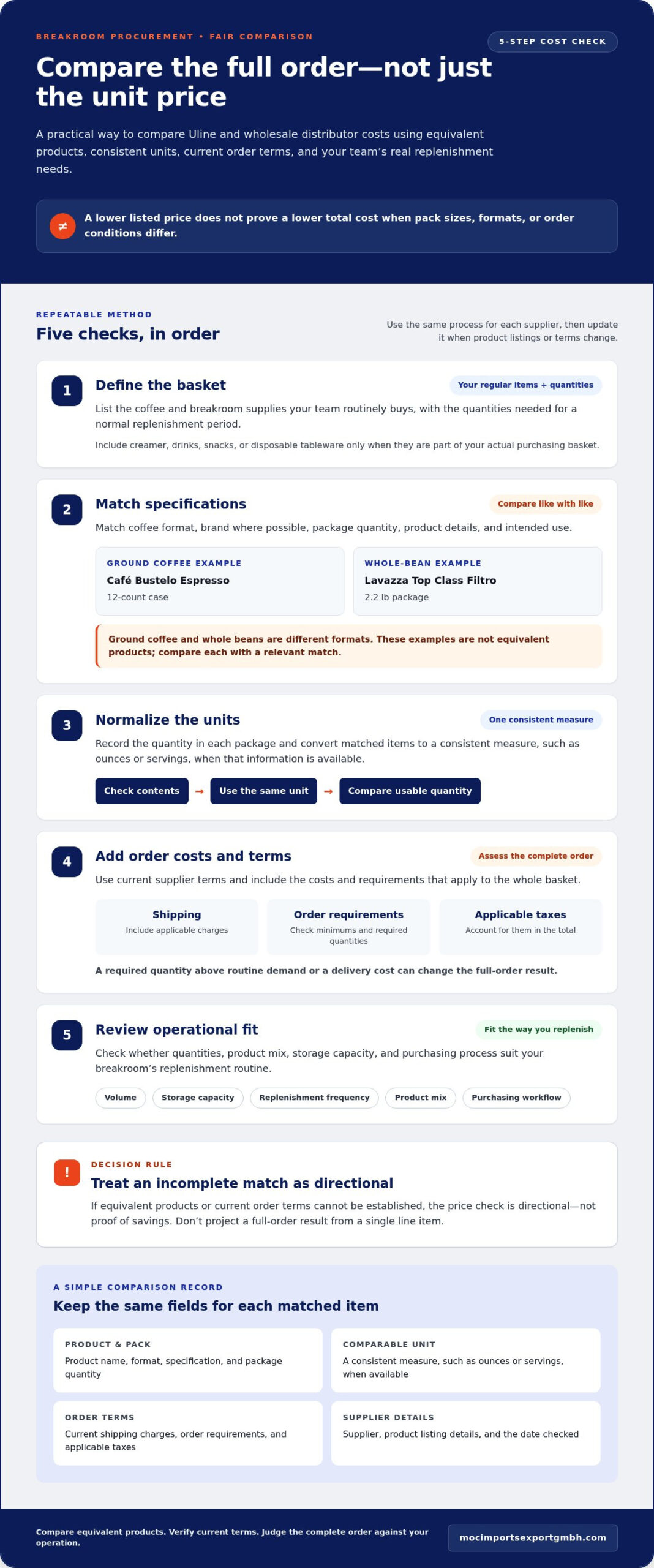
A useful cost review follows the same steps for each supplier. Record the product details and order terms so you can check and update the comparison when listings change. The method below turns the Uline breakroom coffee and supply pricing vs wholesale distributor decision into a repeatable procurement check, rather than a comparison of unrelated prices.
- Define the basket. List the coffee and breakroom items your team regularly purchases, with the quantities needed for a normal replenishment period.
- Match specifications. Compare the same coffee format, brand where possible, package quantity, and product details. Keep ground coffee, whole beans, and single-serve formats in separate comparisons unless they serve the same use.
- Normalize the units. Convert package contents to a consistent measure, such as ounces or servings, where that information is available. Divide the comparable total order cost by the usable quantity.
- Add order costs. Include current shipping charges, minimum-order requirements, and applicable taxes. Record the terms that apply to the complete order, not just one product.
- Review operational fit. Consider whether the order quantities, product mix, storage needs, and purchasing process suit your replenishment routine.
Normalize pack sizes into comparable units
Case labels and package sizes can make two listings look comparable when they contain different amounts. Record the package quantity first, then use one unit of measure across matched items. For example, MOC Imports Export GmbH offers Café Bustelo ground coffee in a 12-count case and Lavazza Top Class Filtro whole beans in a 2.2 lb package. These are different formats, so compare each only with a relevant equivalent.
Use a compact worksheet for each matched item. Fill in current supplier details before calculating:
Product: Ground coffee | Pack size: Case quantity and contents | Unit measure: Ounces or servings | Verified terms: Shipping and order requirements
Product: Whole-bean coffee | Pack size: Package quantity and contents | Unit measure: Ounces or servings | Verified terms: Shipping and order requirements
Record the supplier, listing date, and product specification in the worksheet too. Uline product details, shipping terms, and order requirements can change, so verify current information before relying on a direct comparison. The U.S. Department of Commerce’s supply chain sourcing resources offer broader context for evaluating sourcing decisions beyond the item price.
Include order-level costs and purchasing conditions
When coffee, creamer, and tableware come from separate sources, assess the combined order pattern. Separate purchases may mean separate shipping charges or different order thresholds. Add applicable taxes using current supplier information, and don’t assume one set of terms applies across the full basket.
Unit price alone cannot identify the better buy. Compare equivalent usable quantities along with the costs and conditions of the complete order. Once your worksheet reflects current terms, judge the options against your purchasing routine. Business buyers planning a bulk coffee basket can discuss wholesale coffee requirements with MOC Imports Export GmbH.
Uline or a Wholesale Distributor: Which Fits Your Breakroom?
Neither sourcing route is the automatic winner. A focused order may favor a supplier whose current listing matches a specific requirement. A broader breakroom basket may make a wholesale distributor worth assessing across several categories. In the Uline breakroom coffee and supply pricing vs wholesale distributor comparison, separate product price from operational fit. A route that doesn’t produce the lowest matched unit cost may still align better with how your team orders and replenishes supplies.
When a focused supplier or retailer may suit the order
A narrow, defined purchase can be straightforward to evaluate when one listing meets the required format, quantity, and specification. If the immediate need is a particular coffee format, compare the relevant current Uline listing with an equivalent option, then review the applicable order and shipping terms. Verify the live listing rather than assuming a particular brand, package size, or purchasing condition is available.
This route can also suit buyers who prioritize a specific catalog experience or want to source a limited set of items in one order. The deciding evidence is the buyer’s actual basket and current terms, not a general claim about supplier breadth or price.
When a wholesale distributor may better match a mixed basket
If your recurring order includes coffee alongside creamer, drinks, snacks, or tableware, assess those needs together. A wholesale assortment can bring several relevant categories into the same sourcing review. MOC Imports Export GmbH offers different coffee formats, including ground and whole-bean options, which buyers can consider against their breakroom preferences in its wholesale coffee products. Disposable tableware may also be relevant to a mixed breakroom basket.
Combining categories may simplify purchase planning, but it doesn’t guarantee a lower total cost. Consider supplier count, order frequency, storage, and the effort required to track separate replenishment cycles. For a broader view of supply continuity and risk planning, the Department of Homeland Security outlines supply chain security considerations.
Use a neutral comparison record. Enter verified evidence for each route rather than assigning scores before reviewing the basket:
Assortment: Uline evidence: relevant current listings | Distributor evidence: matching categories and formats
Product match: Uline evidence: verified specification and package | Distributor evidence: equivalent specification and package
Order consolidation: Uline evidence: items included in the order | Distributor evidence: items included in the order
Replenishment workflow: Uline evidence: applicable ordering terms | Distributor evidence: applicable ordering terms
Fill each field using current product, shipping, and order information. If a category is absent from the actual basket, leave it out. If the terms or product specifications don’t match, mark the comparison incomplete rather than treating it as proof of savings. The best fit is the route that meets the breakroom’s real requirements under verified conditions.
A Practical Checklist for Choosing a Breakroom Supply Route
The best sourcing plan starts with how your workplace actually uses its breakroom. For the Uline breakroom coffee and supply pricing vs wholesale distributor decision, product fit is only part of the review. Consumption, equipment, storage, receiving capacity, and the time spent managing orders all affect whether a purchasing route works in practice.
Build a basket around real consumption
Use recent purchase records, stock counts, or a short usage review to estimate demand. Note what runs out first and what remains unused between orders. This separates everyday requirements from occasional additions. Avoid ordering a bulk quantity based on a guess when your records can provide a more reliable starting point.
Match coffee formats to the equipment already in use and the preferences your workplace has established. Ground coffee, whole beans, and single-serve formats require different preparation routines. Add creamer, drinks, snacks, and tableware only when employees use them and the workplace needs to replenish them. The result is a focused basket that you can assess consistently across Uline and distributor options.
Review storage, order cadence, and total workload
Check shelf and cupboard space before selecting package sizes. Include receiving and handling in the decision: who accepts the order, where cases are stored, and how products are rotated so older stock is used first. A larger order may fit the purchasing plan but create a storage or handling burden if the breakroom has limited capacity.
Next, compare replenishment frequency and internal workload. Separate suppliers can mean distinct order dates, records, and receiving tasks. A combined purchasing workflow may reduce coordination effort, but it is not automatically less expensive or more suitable. Broader purchasing principles can also inform the review, including the consumer goods sourcing strategies discussed by MOC Imports Export GmbH.
Use this checklist for each sourcing route:
- Consumption: Does the planned quantity reflect recent use?
- Product format: Does the coffee match the available equipment and workplace preferences?
- Basket priority: Are essential items separated from optional products?
- Storage and rotation: Is there space to receive, store, and rotate the order?
- Replenishment: Does the order cadence fit the team’s routine?
- Purchasing workload: Who places orders, tracks stock, and receives supplies?
- Order terms: Are current supplier requirements and applicable costs included in the decision?
Review the answers with the people responsible for purchasing and breakroom inventory. A route that suits the basket on paper should also fit the workplace’s storage and receiving process. To discuss wholesale sourcing needs for a business order, contact MOC Imports Export GmbH.
Source Breakroom Coffee and Supplies Through MOC Imports Export GmbH
MOC Imports Export GmbH is a wholesale and bulk import/export company serving business buyers. For teams assessing coffee alongside related breakroom needs, its wholesale assortment offers another sourcing route to compare against a focused supplier. The decision still comes down to the actual basket, product formats, quantities, and applicable order terms. A broader assortment can support procurement planning, but it does not establish that one route will always cost less.
The Uline breakroom coffee and supply pricing vs wholesale distributor comparison is most useful when each option is assessed against the workplace’s real purchasing requirements. MOC’s catalog includes coffee, drinks, snacks, and disposable tableware categories. Consider the categories relevant to your operation without assuming every item must be part of the same order.
Match MOC coffee formats to workplace purchasing needs
Start with the coffee format used at work. Café Bustelo Espresso Ground Coffee is offered as a 12-count case of 6 oz bricks. Lavazza Top Class Filtro whole-bean coffee is offered in a 2.2 lb package. These are distinct formats for different preparation preferences, so compare each with a suitable equivalent and intended use rather than treating them as interchangeable.
Coffee mate concentrated liquid creamer is offered in a two-pack. It may fit a regular breakroom basket where creamer is used. If employees also use non-coffee beverages, MOC’s drinks and beverages range can inform the broader assortment review. Add drinks, snacks, or tableware only when they match established workplace demand and purchasing priorities.
Keep a simple product list before moving from comparison to procurement. Record preferred format, package quantity, expected order quantity, and which items are essential. This gives the purchasing team a clearer basis for evaluating options and avoids building a bulk order around products the workplace rarely uses.
Move from comparison to a wholesale conversation
Prepare a concise sourcing brief before contacting a supplier. Include the coffee formats your equipment supports, the quantity your team expects to purchase, relevant complementary categories, and priorities such as assortment or ordering workflow. If another supplier is part of the evaluation, note the equivalent products and current terms being compared. Clear inputs make the discussion more focused.
That preparation also helps distinguish a product question from a broader procurement requirement. You may need a particular coffee format, a recurring case quantity, or a review of coffee alongside drinks and snacks. State the need directly and keep the comparison grounded in verified information. MOC Imports Export GmbH supports business buyers through wholesale sourcing, with coffee and adjacent consumer goods categories relevant to breakroom purchasing.
For a focused discussion of your business requirements, Contact MOC Imports Export GmbH about wholesale sourcing.
Turn Your Comparison Into a Purchasing Plan
A sourcing decision works best when it becomes part of a repeatable purchasing process. Record the assumptions behind your comparison, such as the quantities your team expects to use and the ordering conditions applied. Assign responsibility for reviewing the plan, then revisit it when breakroom equipment, staffing, or consumption patterns change. This keeps future orders aligned with actual workplace needs instead of relying on an outdated basket.
Use the Uline breakroom coffee and supply pricing vs wholesale distributor review as a baseline, not a one-time verdict. A consistent method helps your purchasing team assess new requirements and adjust its sourcing route as the operation changes. Translate your priorities into a clear wholesale inquiry, with the products, quantities, and procurement needs your business wants to discuss.
Start a wholesale sourcing discussion with MOC Imports Export GmbH and move forward with a purchasing plan built around your breakroom’s needs.
Frequently Asked Questions
Is Uline or a wholesale distributor cheaper for breakroom coffee and supplies?
Neither route is automatically cheaper; the result depends on the products, quantities, and current order terms you compare. For the Uline breakroom coffee and supply pricing vs wholesale distributor decision, separate a low item price from the cost and effort of buying the full basket. A narrow order may favor one supplier, while a mixed basket may make another route a better operational fit. Use verified, equivalent listings before drawing a cost conclusion.
How do I compare Uline coffee prices with wholesale distributor pricing?
Compare coffee with the same preparation format, brand where possible, and package contents. Then calculate the cost per consistent measure, such as ounce or serving, using the usable quantity shown in each listing. Note the date you checked the information, since listings and terms can change. Keep differences in roast, packaging, or intended use visible in your comparison rather than treating products as identical based only on the word “coffee.”
Can a wholesale distributor supply coffee and other breakroom items together?
Some wholesale distributors carry multiple consumer goods categories, which can make it possible to assess coffee alongside other breakroom needs. The actual product assortment and order conditions determine whether those items can be sourced through the same purchasing route or order. For a business purchase, list the categories needed and distinguish routine essentials from occasional items. This helps you evaluate whether a broader assortment simplifies procurement without assuming every product will be part of one order.
What should I include when calculating the total cost of breakroom supplies?
Include the quantity of each product, its package contents, and the current supplier terms that affect the order. Record applicable shipping charges, minimum-order requirements, and taxes, then account for separate purchases if items come from different sources. Also consider internal workload, such as time spent placing orders, receiving cases, and updating inventory records. This fuller view helps compare purchasing routes on both order economics and the effort required to keep supplies available.
Are bulk coffee cases better for an office than smaller packages?
Bulk cases can suit an office with steady consumption, sufficient storage, and a reliable rotation routine. Smaller packages may better match variable demand or limited shelf space, even if ordering them more often adds administrative work. Base the choice on actual use rather than the apparent advantage of buying more at once. Review how quickly the team uses each package, where it will be stored, and whether the order quantity fits the next replenishment cycle.
What coffee formats should I compare for an office breakroom?
Compare the formats your equipment can prepare: ground coffee, whole beans, or single-serve coffee. They differ in preparation and package structure, so assess each against its intended use rather than comparing unlike formats by package price alone. Consider who prepares coffee, how the equipment is maintained, and whether staff prefer individual servings or a shared pot. A format that fits the workplace routine can be more useful than one that looks comparable in a listing.
