

B2B Sourcing Guides
B2B Wholesale Consumer Packaged Goods Procurement

07
Jun
Jun
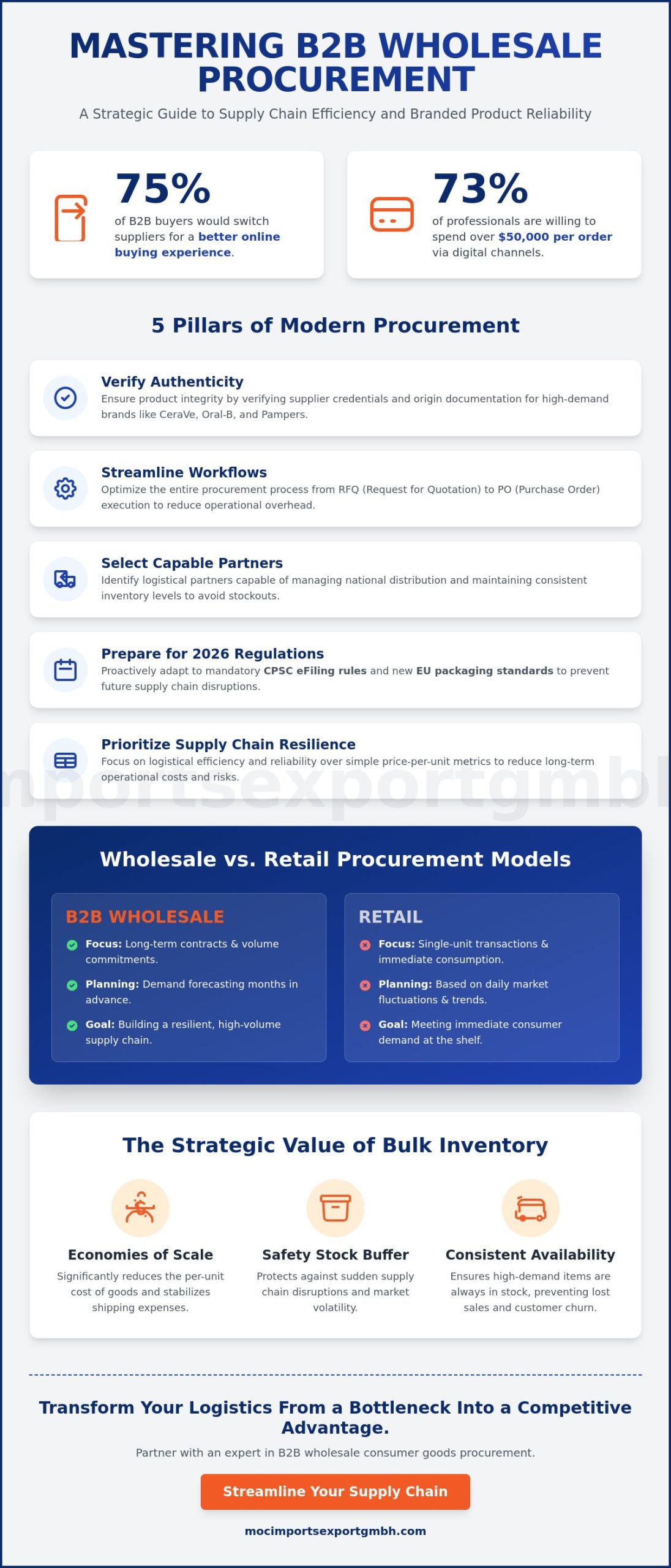
75% of B2B buyers report they would switch to a supplier that offers a better online buying experience. With 73% of professionals now willing to spend over $50,000 per order through digital channels, the demand for efficiency has never been higher. You know that B2B wholesale consumer goods procurement is becoming more complex as global trade regulations tighten and buyer expectations shift. Sourcing authentic brands like CeraVe or Oral-B in bulk requires a systematic approach to avoid disruptions and ensure product reliability.
Securing a dependable flow of inventory shouldn’t be a constant struggle against logistical hurdles or international shipping complexities. This article demonstrates how to master the complexities of bulk procurement by prioritizing supply chain efficiency and branded product reliability. You’ll learn how to streamline your procurement workflow, reduce operational overhead, and navigate critical 2026 updates like the new CPSC eFiling rules and EU packaging standards. We provide the roadmap to transform your logistics from a bottleneck into a competitive advantage through structured, professional inventory management.
Key Takeaways
- Verify supplier credentials and origin documentation to ensure the authenticity of high-demand brands like CeraVe, Oral-B, and Pampers.
- Streamline your internal workflows from RFQ to PO execution to optimize the B2B wholesale consumer goods procurement process.
- Identify essential criteria for selecting logistical partners capable of managing national distribution and maintaining consistent inventory levels.
- Prepare for 2026 regulatory changes, including mandatory CPSC eFiling and new EU packaging standards, to prevent supply chain disruptions.
- Prioritize supply chain resilience and logistical efficiency over simple price-per-unit metrics to reduce long-term operational overhead.
Fundamentals of B2B Wholesale Consumer Goods Procurement
B2B wholesale consumer goods procurement is a specialized logistical function. It focuses on the acquisition of high-turnover products intended for end-user consumption. Unlike general industrial procurement, which often deals with raw materials or heavy machinery, consumer packaged goods (CPG) procurement requires a high degree of precision regarding brand authenticity and expiration dates. Professional buyers must manage large volumes while ensuring every unit meets the specific quality standards of the manufacturer. This process is not just about purchasing; it’s about building a resilient supply chain that can withstand market fluctuations.
The Fundamentals of Wholesaling dictate that a distributor acts as a critical intermediary. They bridge the gap between global manufacturers and local retailers. This relationship is built on reliability. A wholesaler manages the complexities of international shipping and warehousing, allowing retailers to focus on their core operations. In the context of B2B wholesale consumer goods procurement, this means providing immediate access to established brands without the lead times associated with direct-from-factory orders. Efficiency in this sector is measured by how quickly a partner can move inventory from a central hub to a retail shelf.
The Value of Bulk Inventory in Retail
Bulk ordering is the primary method for maintaining healthy retail margins. High-volume orders allow businesses to achieve significant economies of scale. This reduces the per-unit cost of goods and stabilizes shipping expenses by maximizing container space. For high-demand items like laundry detergents or shelf-stable drinks, consistent availability is mandatory. If a shelf goes empty, the customer often switches brands or retailers. Bulk procurement ensures a safety stock that protects against sudden supply chain disruptions. It’s a strategic buffer that keeps the business operational during market volatility.
Wholesale vs. Retail Procurement Models
Procuring for wholesale differs significantly from retail purchasing. Retail models focus on single-unit transactions and immediate consumption. In contrast, B2B models rely on long-term contract negotiations and structured pricing tiers. Pricing is often tied to volume commitments rather than daily market fluctuations. Lead times are also more critical in the B2B space. Professional buyers must forecast demand months in advance to manage repeat order cycles for consumable products effectively. This disciplined approach ensures that inventory levels remain optimized for high-turnover items. Managing these cycles requires a systematic workflow that prioritizes logistical speed and accurate documentation over emotional brand narratives.
Sourcing Branded CPG: Authenticity and Volume Requirements
Sourcing reputable brands like Oral-B, Pampers, and CeraVe requires more than just capital. It demands a rigorous verification process to ensure product authenticity. In the global wholesale market, the risk of counterfeit goods is a persistent reality. Professional buyers must prioritize supplier credentials over the lowest possible unit price. A single shipment of non-authentic goods can permanently damage a retailer’s reputation and lead to legal complications. Successful B2B wholesale consumer goods procurement relies on the ability to secure high volumes while maintaining absolute product integrity through every stage of the supply chain.
Brand reputation directly influences retail procurement decisions. Consumers expect consistency in personal care and household items. While prestige drives sales, professional buyers also monitor environmental standards and compliance. Adhering to guidelines such as the EPA’s Comprehensive Procurement Guidelines is increasingly relevant for corporate social responsibility and regulatory compliance in the CPG sector. This focus on standard-compliant sourcing reduces long term risks and ensures that inventory meets both consumer expectations and government regulations. US retailers navigating these shifting trade dynamics can benefit from reviewing dedicated wholesale consumer goods sourcing strategies for the USA market, particularly as tariff increases and de minimis exemption changes reshape procurement economics.
Critical Categories for Wholesale Procurement
Personal care and oral hygiene items are essential high-turnover categories. Sourcing Oral-B toothbrush heads bulk allows retailers to maintain consistent stock of a market-leading brand. For household cleaning, logistical efficiency is found in larger formats. Sourcing 5 gallon laundry detergent from brands like Gain or Tide reduces the frequency of reorders and optimizes pallet space. Baby products, including Pampers ZZZ Overnight Diapers and Enfamil formula, require strict batch tracking and climate-controlled logistics to ensure safety and efficacy.
Ensuring Product Authenticity
Professional import and export firms serve as the primary line of defense in quality control. They verify manufacturer authorization and review product origin documentation before any transaction occurs. Common red flags in the wholesale market include prices that fall significantly below market averages, missing lot numbers, or discrepancies in packaging materials. International trade compliance requires a complete paper trail, including the Bill of Lading and Certificates of Analysis where applicable. This systematic approach eliminates ambiguity and confirms that the goods meet the manufacturer’s original specifications. If you require assistance with verifying documentation for a specific order, you can consult with our logistics experts to ensure your procurement process remains secure.
Evaluating Supply Chain Partners for National Distribution
Selecting a supply chain partner requires looking beyond digital interfaces. While software integration is useful, the physical movement of goods remains the core of B2B wholesale consumer goods procurement. A reliable partner must demonstrate a clear path for national distribution within the US. This involves more than just having a functional website; it requires established relationships with freight carriers and a deep understanding of customs procedures. German-based logistical standards, known for precision and systematic organization, provide a significant advantage in global trade by minimizing errors and ensuring timely delivery. Applying a structured professional B2B vetting checklist when choosing a wholesale distributor ensures you evaluate partners on criteria that extend well beyond price, including warehouse management systems, communication protocols, and regulatory compliance.
The current environment necessitates a partner who understands the broader context of trade. Reports on the Government’s Role in CPG Supply Chains highlight that policy and infrastructure are inseparable from business success. Evaluating a distributor’s financial stability and inventory reliability is critical. You need a partner that holds physical stock in multi-location fulfillment networks rather than one that merely acts as a middleman without assets. This physical presence ensures that high-volume orders are actually available when you place them.
Logistical Facilitation and Infrastructure
Infrastructure is the backbone of bulk procurement. A partner must offer robust warehouse management and specialized storage for sensitive items like baby products or skin care. Expert import/export knowledge is essential for facilitating international trade without delays. The transition from an international port to a national doorstep is where most disruptions occur. A systematic approach to drayage, customs clearance, and final-mile delivery ensures that high-volume orders arrive intact and on schedule.
Communication and Professional Reliability
Direct communication is a requirement, not a luxury. Procurement professionals don’t have time for automated chatbots when supply chain disruptions occur. You need a dedicated point of contact who provides literal, precise information. Professionalism in handling large-scale commercial contracts means providing clear documentation and adhering to agreed-upon lead times. Evaluating a partner’s responsiveness during a crisis reveals their true operational capacity. A dependable partner acts as a systematic extension of your own business, prioritizing clarity and procedural simplicity in every transaction. This level of organized competence is what separates a logistical partner from a simple vendor.
Optimizing the Procurement Lifecycle for High-Turnover Inventory
Efficiency in the procurement lifecycle directly impacts retail profitability. For B2B wholesale consumer goods procurement, the process must move from initial inquiry to final delivery without friction. The cycle begins with a Request for Quote (RFQ) that defines exact SKU requirements and volume needs. Vague specifications lead to delays. Once a quote is validated, the Purchase Order (PO) execution must happen quickly to secure stock in a fast-moving market. Professional buyers integrate this procurement data with internal ERP systems to maintain real-time visibility over incoming shipments and current floor stock.
Current data indicates a significant shift in buyer behavior. As of June 2026, 80% of B2B interactions occur through digital channels. This digitalization allows for faster order processing and more accurate forecasting. However, the physical reality of CPG inventory management remains. High-turnover items require a lifecycle that accounts for rapid depletion. A streamlined workflow ensures that replenishment happens before stockouts occur, protecting the retailer’s revenue and customer loyalty. If your current lifecycle lacks this speed, you can request a consultation to optimize your procurement workflow.
Structuring the Order Process
A structured order process minimizes errors in bulk transactions. Clear product specifications are mandatory, especially when dealing with international brands. Negotiating terms for recurring shipments of household essentials provides price stability and guaranteed allocation. This is particularly important for high-volume consumables. Upon arrival, implementation of standardized quality checks is essential. Verifying pallet integrity and batch numbers ensures that the received goods match the PO exactly. This disciplined approach prevents inventory discrepancies and simplifies the reconciliation process.
Inventory Strategy for Consumables
Managing high-demand personal care and household items requires a precise inventory strategy. Calculating safety stock levels protects against supply chain volatility and sudden demand spikes. Storage optimization is also critical for bulk formats. Items like cleaning supplies and degreasers often require specialized pallet configurations to maximize warehouse space. Data-driven procurement planning reduces deadstock by aligning order frequency with actual turnover rates. This ensures that capital isn’t tied up in slow-moving inventory, allowing for better cash flow management across all product categories.
Strategic Bulk Procurement with MOC Imports Export GmbH
MOC Imports Export GmbH acts as a systematic bridge for professional buyers. Since 2013, the company has specialized in the supply of high-quality, original consumer goods. B2B wholesale consumer goods procurement through a German-based partner offers US retailers a level of organizational precision that is often missing in fragmented markets. This partnership ensures that the transition from manufacturing to retail distribution follows a disciplined, logical hierarchy. By focusing on business utility, MOC eliminates the common pain points of sourcing branded items across international borders. The brand functions as a dependable partner that prioritizes the operational needs of its professional clientele.
The company manages a diverse inventory across Beauty, Personal Care, and Household Products. This includes direct access to global brands with confirmed authenticity. MOC actively simplifies how to source wholesale products for resale by providing structured data and literal product classifications. This approach is essential as the global wholesale market scales toward an expected $63.7 billion in 2026. Buyers can move from information gathering to action without navigating unnecessary distractions or decorative prose. Every transaction is designed for speed and clarity.
Our Expertise in Branded Sourcing
- Consistent access to top-tier brands including Oral-B, CeraVe, and Pampers.
- Specific high-turnover items such as the Oral-B iO5 electric toothbrush or CeraVe Resurfacing Retinol Serum.
- Verification processes that ensure every unit meets the strict quality standards of the original manufacturer.
- Compliance with the July 8, 2026, CPSC eFiling requirements for imported consumer products.
For national US business clients, this reliability is a critical asset. It removes the uncertainty of sourcing from unverified third parties. MOC provides the necessary documentation to satisfy international trade compliance and retail auditing requirements. This commitment to authenticity ensures that your retail reputation remains protected while maintaining consistent shelf availability for high-demand items.
Efficient Logistical Solutions
Logistical efficiency is the core benefit of the MOC partnership. The company specializes in bulk formats designed for industrial and high-volume retail use, such as 5-gallon cleaning supplies from Gain and Tide. These formats reduce shipping frequency and lower operational overhead. MOC manages the complexities of international trade, including the new sustainability requirements under the EU Packaging and Packaging Waste Regulation (PPWR) effective August 12, 2026. This direct support for B2B wholesale consumer goods procurement ensures that your supply chain remains resilient, agile, and fully compliant with evolving global standards. The result is a streamlined workflow that reduces costs and maximizes inventory turnover.
Advancing Your Wholesale Procurement Strategy
The landscape of global trade demands a systematic approach to inventory management. You’ve identified that brand authenticity and supply chain resilience are the foundations of successful retail operations. Establishing a reliable process for B2B wholesale consumer goods procurement involves more than just price negotiation. It requires a partner capable of navigating complex international regulations and ensuring national distribution without delays. Professional buyers benefit from direct access to authentic stock from brands like Oral-B, CeraVe, and Pampers.
MOC Imports Export GmbH provides the logistical precision necessary to scale your business. We specialize in German-standard facilitation and bulk formats that reduce operational overhead. Whether you’re managing personal care lines or household essentials, our multi-location fulfillment network ensures consistent inventory availability. Don’t let supply chain disruptions or documentation hurdles slow your growth. Efficient procurement is a logistical partnership that prioritizes reliability over simple unit costs.
Contact MOC Imports Export GmbH for your wholesale procurement needs to secure a dependable logistical partner. We look forward to streamlining your bulk buying process.
Frequently Asked Questions
What are the key benefits of B2B wholesale procurement for retailers?
B2B wholesale procurement allows retailers to achieve significant economies of scale by purchasing high volumes at lower per-unit costs. This systematic approach ensures consistent shelf availability for high-demand items like personal care and household staples. By consolidating orders, businesses also reduce per-unit shipping and handling expenses. Maintaining a safety stock through bulk acquisition protects your operations against sudden market fluctuations and supply chain disruptions.
How can I ensure the authenticity of branded consumer goods in bulk?
Authenticity is verified through a rigorous review of manufacturer authorization and product origin documentation. Professional buyers should inspect lot numbers and batch codes to ensure they match the manufacturer’s original specifications. Discrepancies in packaging or prices significantly below market averages are primary red flags. Working with a registered logistical partner that provides a complete paper trail, including Bills of Lading, eliminates the risk of counterfeit products in your supply chain.
What is the typical lead time for international wholesale shipments?
Lead times vary based on the point of origin and the final destination within the national distribution network. Factors such as customs clearance and the new 2026 CPSC eFiling requirements can influence the timeline for imported goods. A structured procurement workflow minimizes delays by ensuring all documentation is accurate before the shipment reaches the port. Reliable partners provide precise estimates based on current carrier capacity and port congestion levels to help you plan inventory cycles.
Why is 5-gallon packaging preferred for commercial cleaning supplies?
5-gallon packaging is preferred for commercial cleaning supplies because it optimizes pallet space and reduces the frequency of reorders. This format is highly efficient for high-turnover environments like hospitality or professional cleaning services. Sourcing brands like Gain or Tide in these larger volumes lowers the total cost of ownership by decreasing packaging waste and shipping weight. It allows for more stable inventory management while maintaining the efficacy of the original branded formula.
What documentation is required for B2B consumer goods procurement?
Standard documentation for B2B wholesale consumer goods procurement includes a Request for Quote (RFQ), a formal Purchase Order (PO), and the Bill of Lading. For sensitive categories like baby formula or skincare, a Certificate of Analysis may be required to verify quality standards. International transactions also necessitate commercial invoices and specific customs documentation. Accurate record-keeping is mandatory for meeting the new 2026 regulatory standards for imported consumer products in the US and EU markets.
How does MOC Imports Export GmbH facilitate national US distribution?
MOC facilitates national US distribution through a systematic fulfillment network and established relationships with reliable freight carriers. We manage the entire logistical process from international port arrival to the final retail doorstep. By utilizing German-standard logistical facilitation, we minimize errors in drayage and customs clearance. This organized approach ensures that high-volume shipments of branded consumer goods arrive at your facility intact and according to the agreed-upon delivery schedule.
Can I place recurring bulk orders for high-turnover items?
Recurring bulk orders are a standard feature of a professional procurement strategy for high-turnover inventory. Implementing a scheduled replenishment cycle provides price stability and guaranteed stock allocation for essential brands. This proactive method prevents stockouts of critical items such as diapers or oral care products. Retailers use these recurring contracts to align their supply chain with actual consumer demand data, which significantly reduces the risk of deadstock or emergency reorders.
What brands are available for wholesale procurement through MOC?
MOC provides direct access to a curated selection of top-tier global brands. Our inventory includes oral care products from Oral-B and Philips Sonicare, as well as skincare items from CeraVe and La Roche-Posay. We also supply household essentials from Gain, Tide, and Dawn. For food and beverage retailers, we offer brands such as Hershey’s, Kit Kat, and Lavazza. All products are sourced through authorized channels to ensure absolute authenticity and quality.
