
B2B Sourcing Guides
European FMCG Wholesale Guide for US Retailers 2026

Jul
The European FMCG market is projected to reach USD 2512.21 billion by 2034, yet many US retailers still struggle to bypass the logistical bottlenecks of transatlantic trade. Sourcing from European FMCG wholesale suppliers shouldn’t be a gamble with your supply chain reliability or product authenticity. You likely agree that managing international delays and high minimum order requirements often offsets the benefits of global sourcing.
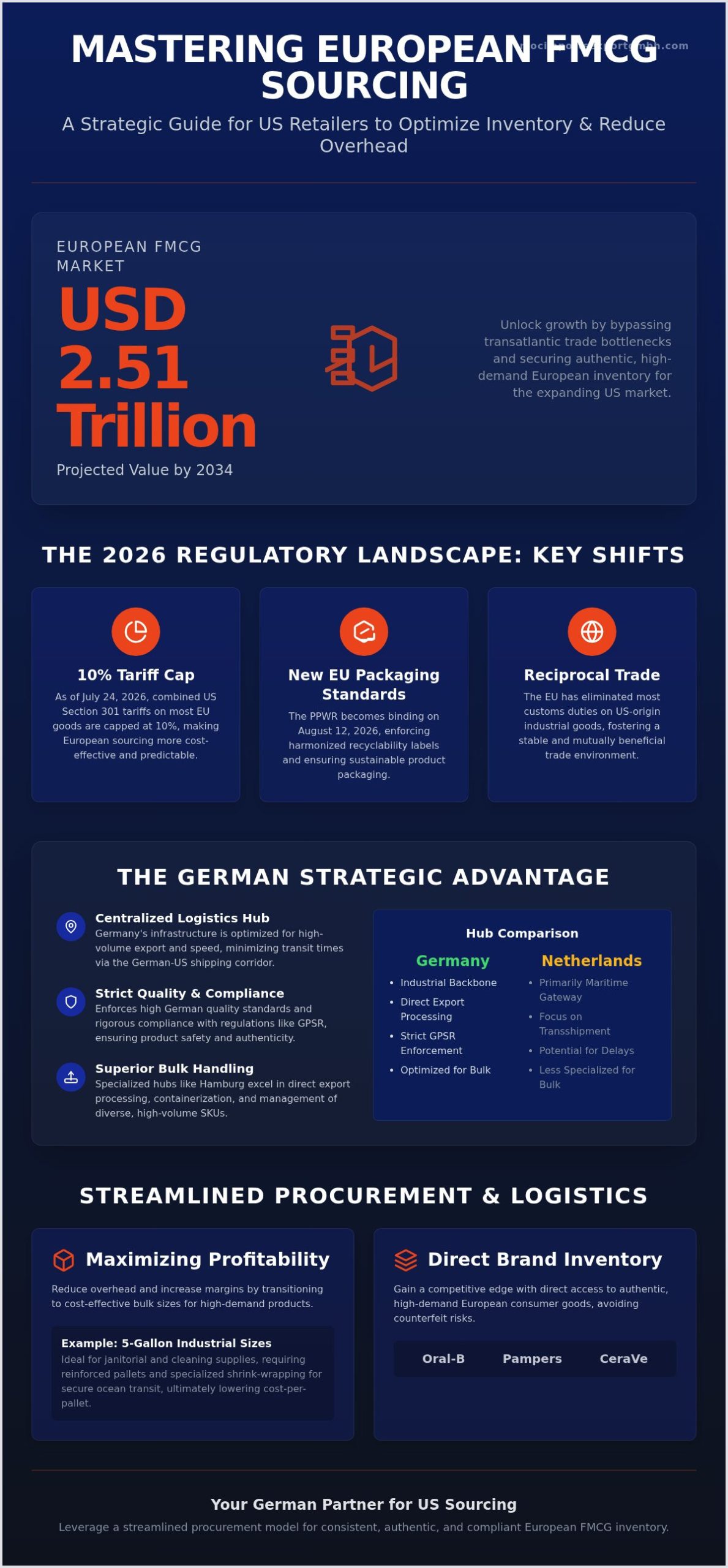
This guide will show you how to master the complexities of sourcing branded consumer goods from Europe to optimize your inventory and reduce overhead. We’ll provide a clear strategy for securing authentic German inventory while streamlining bulk procurement for high-demand cleaning and personal care items. This overview covers the essential regulatory shifts for 2026, including new EU packaging standards effective August 12 and the 10% cap on Section 301 duties, ensuring your procurement process remains efficient and profitable.
Key Takeaways
- Identify the 2026 landscape for European FMCG wholesale suppliers to secure consistent branded inventory.
- Optimize lead times by leveraging the efficiency of the German-US shipping corridor for bulk consumer goods.
- Establish rigorous vetting protocols to ensure product authenticity and maintain US retail compliance standards.
- Reduce overhead by transitioning to 5-gallon industrial bulk sizes for high-demand cleaning and janitorial supplies.
- Access a streamlined procurement model for direct inventory from brands like Oral-B, Pampers, and CeraVe.
The Landscape of European FMCG Wholesale Suppliers in 2026
US retailers face a shifting trade environment in 2026. The term Fast-Moving Consumer Goods (FMCG) describes high-turnover products sold at low cost. In the global B2B sector, these items represent the backbone of daily retail operations. Professional procurement teams now prioritize European FMCG wholesale suppliers to maintain inventory levels for essential categories like personal care, household cleaning, and baby products. The European FMCG market is expanding rapidly; projections reach USD 2512.21 billion by 2034.
The 2026 landscape is defined by regulatory clarity. As of July 24, 2026, combined US tariffs on EU goods under Section 301 generally don’t exceed 10%. This makes European sourcing a viable alternative to more volatile markets. Retailers are shifting toward European partners to secure authentic branded goods. This move avoids the risks of counterfeit products that often plague secondary markets.
Understanding Global FMCG Market Dynamics
International trade regulations directly impact consumer goods availability. For US buyers, the primary challenge is stabilizing inventory for high-turnover items. European sourcing provides a buffer against supply chain delays. Strategic partnerships with European FMCG wholesale suppliers allow US retailers to bypass traditional distribution hurdles. Data from July 2026 confirms that the EU has eliminated customs duties on most US-origin industrial goods. This fosters a reciprocal trade environment. Such stability is critical for retailers stocking fast-moving brands like Oral-B, Pampers, and CeraVe.
Why Sourcing from Germany Offers a Strategic Advantage
Germany serves as a centralized hub for European logistics. Its export infrastructure is optimized for volume and speed. German-based facilitators like MOC Imports Export GmbH act as a bridge for US buyers seeking direct access to European inventory. This model prioritizes procedural simplicity and strict quality control.
Professional buyers benefit from German quality standards, especially in sensitive categories. Sourcing skin care and laundry detergents from a German partner ensures compliance with the Packaging and Packaging Waste Regulation (PPWR) becoming binding on August 12, 2026. These standards guarantee that products meet harmonized recyclability labels. Reliability in the supply chain isn’t a luxury. It’s a business necessity for 2026 operations.
Strategic Logistics: Navigating European Distribution Hubs
Efficient logistics define the success of transatlantic trade. For US retailers, the German-US shipping corridor offers a streamlined path for bulk consumer goods. European FMCG wholesale suppliers located in Germany leverage sophisticated infrastructure to minimize transit times. This efficiency is critical when handling high-turnover inventory. A consolidated supply chain allows multi-category retailers to manage diverse SKUs under a single logistical umbrella. By centralizing procurement, businesses reduce the administrative burden of tracking multiple international shipments.
Hub Comparison: Germany vs. The Netherlands
While the Netherlands is a major maritime gateway, Germany provides a superior industrial backbone for bulk handling and containerization. German hubs like Hamburg and the Rhine-Ruhr region specialize in direct export processing for manufactured goods. Compliance with the General Product Safety Regulation (GPSR) is strictly enforced at these points, ensuring all US-bound exports meet safety and traceability standards. MOC facilitates these transitions by managing the complex documentation required for international trade. This systematic approach prevents the administrative delays often found in less organized corridors.
Optimizing Shipping for High-Volume SKU Categories
Bulk procurement of 5-gallon cleaning supplies presents unique challenges. These containers require reinforced pallet bases and specialized shrink-wrapping to withstand the rigors of ocean transit. Fragile items like Oral-B toothbrush heads are often positioned in top-tier loading zones to avoid crushing. By optimizing the mix of heavy and light SKUs, retailers significantly lower their cost-per-pallet. You can consult with a logistical partner to refine these loading plans and reduce overhead.
Lead times from a European warehouse to US national distribution centers depend on the port of entry and customs clearance speed. In 2026, the European FMCG logistics market is expected to reach USD 23.34 billion. This growth is driven by improvements in intermodal transport, combining road and rail for more reliable inland movement. Using established German export standards helps retailers secure a predictable flow of goods. This predictability is essential for maintaining shelf availability in the competitive US market. Short, declarative communication ensures that every partner in the chain understands their role, keeping the process moving without unnecessary distractions.
Vetting Reliability in European FMCG Distribution
Professional buyers cannot rely on generic trust when selecting European FMCG wholesale suppliers. Verification is a technical requirement for US retail compliance. Authenticity ensures that products like CeraVe or La Roche-Posay meet the safety standards expected by US consumers. Failure to verify leads to legal liability and inventory rejection at customs. A systematic vetting process separates professional facilitators from unreliable middlemen. This section outlines the technical framework for ensuring product and supplier integrity.
Product Authenticity Verification Framework
Genuine European packaging for global brands often features distinct multilingual labeling and specific security seals. When managing CeraVe wholesale orders, batch number verification is the primary defense against counterfeit goods. These numbers allow for precise tracking through the manufacturer’s supply chain. US retailers must ensure that all imported skin care items comply with local safety standards. This includes verifying that formulations match the registered product profiles in the target market. Batch tracking is not optional. It’s the only way to guarantee a safe and compliant shelf presence.
Evaluating Supplier Infrastructure and Capacity
A supplier’s logistical capability is as important as their product list. Assessing warehouse capacity ensures the partner can handle high-volume inventory without bottlenecking. Efficient suppliers utilize advanced logistics and multimodal transport to maintain a consistent flow of goods. This systematic approach reduces the risk of stockouts. Financial stability is another critical factor. A supplier with a proven track record in international trade provides the necessary security for large-scale capital investments. Retailers need partners who control their own inventory rather than acting as unverified brokers.
Reliable partners provide a full documentation trail for every transaction. This includes detailed invoices, certificates of origin, and batch tracking reports. Red flags include a lack of physical warehouse documentation or vague responses regarding stock locations. If a supplier cannot provide real-time inventory data, they likely don’t control the stock they’re selling. Direct access to data ensures that procurement decisions are based on facts. Efficient communication is the hallmark of a professional facilitator. It allows for rapid adjustments in a fast-paced market. Every document must serve a specific purpose in the procurement process, ensuring no ambiguity in product classifications or origin.
Maximizing Profitability with Bulk FMCG Procurement
Profitability in the 2026 retail market depends on volume and logistical efficiency. Sourcing from European FMCG wholesale suppliers allows US businesses to transition from retail-ready units to industrial-scale packaging. This shift significantly reduces the cost-per-unit. Bulk procurement also provides a strategic buffer against domestic US supply shortages. When local distributors face stockouts, direct access to European inventory ensures your shelves remain stocked. This systematic approach to inventory management prioritizes long-term stability over short-term gains.
The ROI of Industrial-Scale Cleaning Supplies
Industrial-scale cleaning products offer a higher return on investment compared to standard retail sizes. For example, 5-gallon Dawn dish soap serves as a primary staple for commercial and janitorial facilities. These large-format containers minimize packaging waste and lower the frequency of reordering. Managing wholesale laundry detergents in 5-gallon pails also optimizes pallet density. Storage costs are often offset by the drastic reduction in unit price. A clear cost-per-unit analysis usually favors bulk sizes for high-consumption environments. This efficiency is critical for maintaining healthy margins in competitive sectors.
High-Turnover SKU Management: Oral Care and Baby Products
Managing high-turnover categories requires a balance between variety and volume. Products like Oral-B toothbrush heads bulk packs are essential for professional buyers. These items have a high turnover rate and consistent demand. Similarly, stocking essential baby products like Pampers ZZZ overnight diapers in bulk ensures you capture steady consumer spending. Inventory turnover strategies should focus on these essential SKUs to maximize cash flow. Procurement teams must identify which brands drive the most traffic. Concentrating bulk orders on these specific brands streamlines the logistics process. It also simplifies warehouse operations by reducing the number of individual SKU locations.
Efficiency in procurement isn’t just about finding the lowest price. It’s about securing a reliable supply chain that supports your operational needs. By leveraging German export standards, you gain access to a disciplined logistical network. This reliability prevents the hidden costs of delayed shipments and inventory gaps. Professional retailers use these bulk strategies to secure a competitive edge. If you’re ready to optimize your inventory, you can request a bulk quote to see how European sourcing fits your business model. Direct procurement from established German partners ensures that your business remains agile and profitable throughout 2026.
MOC Imports Export GmbH: Your German Partner for US Sourcing
MOC Imports Export GmbH operates as a systematic logistical bridge for professional US retailers. We function as an efficient facilitator between European manufacturers and the North American market. As one of the most reliable European FMCG wholesale suppliers, we prioritize clarity and business utility in every transaction. Our model eliminates the ambiguity of unverified brokers by providing direct access to authentic branded inventory. We manage the entire German-to-US logistical corridor, ensuring that bulk orders reach national distribution centers without unnecessary delays. This organized competence allows your business to focus on retail operations while we handle the complexities of the supply chain.
Reliability is the core of our B2B environment. We provide consistent access to high-demand brands like Oral-B, CeraVe, Pampers, and Dawn. Our operations are grounded in German export standards, which are among the most disciplined globally. This expertise ensures that all documentation, from certificates of origin to batch tracking, meets US retail compliance requirements. We don’t just supply products; we secure your inventory pipeline against domestic shortages and logistical bottlenecks.
A Specialized Portfolio for Professional Buyers
Our inventory is curated for commercial and retail environments that require high-volume turnover. We specialize in cleaning and janitorial supplies, including 5-gallon industrial sizes of Gain and Dawn. For the personal care sector, we offer a comprehensive range of oral care products and baby care essentials like Pampers ZZZ overnight diapers. Beyond household goods, our portfolio includes bulk snacks from The Hershey Company. This diverse selection allows retailers to consolidate their procurement under a single, reliable partner. Consolidation reduces administrative overhead and simplifies the tracking of multi-category shipments.
Streamlining Your Wholesale Procurement Process
Initiating a bulk order with MOC is a direct and transparent process. We provide real-time inventory data to ensure that your procurement decisions are based on current stock levels. By acting as a single partner for diverse FMCG categories, we help you scale your sourcing without increasing logistical complexity. Professional retailers looking to optimize their 2026 inventory can transition from information gathering to action immediately. Our team handles the international logistics, customs clearance, and final national delivery. This comprehensive support ensures that your bulk procurement remains efficient and profitable. To begin your procurement transition, you can contact our logistical team for a detailed quote tailored to your volume requirements.
Securing Your Competitive Edge in 2026 FMCG Procurement
Transatlantic sourcing requires a systematic approach to avoid supply chain disruptions. You’ve learned how leveraging German-based reliability and specialized logistical hubs stabilizes inventory for high-turnover categories. Transitioning to 5-gallon bulk supplies for cleaning and janitorial needs directly reduces overhead while maintaining the quality standards of authentic branded goods. This shift from retail packaging to industrial sizes is a proven strategy for maximizing long-term profitability in a competitive market.
Partnering with experienced European FMCG wholesale suppliers ensures that your procurement remains compliant with evolving trade regulations. We focus on providing direct access to authentic personal care and household brands like Oral-B, CeraVe, and Dawn. This systematic model eliminates the risks associated with counterfeit products and unverified brokers. By centralizing your sourcing with a professional facilitator, you secure a predictable flow of inventory for your commercial or retail environment.
Professional procurement is about more than just finding products; it’s about building a dependable supply chain. We’re ready to act as your bridge to the European market. Explore our bulk FMCG inventory and secure your supply chain today. We look forward to optimizing your business operations.
Frequently Asked Questions
What are the benefits of sourcing FMCG products from European suppliers for the US market?
Sourcing from European FMCG wholesale suppliers provides US retailers with access to high-quality inventory and global brands often subject to domestic shortages. European manufacturing standards ensure product consistency and reliability for sensitive items like skincare and oral care. This geographic diversification stabilizes your supply chain against regional market fluctuations. It also allows for the procurement of specific industrial sizes not always available through standard US distributors.
How do I verify the authenticity of branded products like CeraVe when buying wholesale?
Authenticity is verified through a rigorous documentation trail including batch numbers and certificates of origin. Professional distributors maintain clear records that allow for product traceability back to the manufacturer. You should avoid suppliers who cannot provide verifiable batch data or physical warehouse confirmation for their stock. Direct access to these data points ensures that your inventory meets the high standards required for US retail compliance.
What are the most common logistics challenges when importing bulk cleaning supplies from Germany?
Primary logistics challenges involve managing the weight and stability of large-format liquids during ocean transit. High-volume items like 5-gallon pails require specialized palletization and reinforced packaging to prevent leakage or crushing. Strategic loading plans are essential to balance heavy containers with lighter SKUs to optimize shipping costs. Managing these variables requires a systematic approach to ensure that bulk cleaning supplies arrive in commercial-ready condition.
Why is Germany considered a primary hub for FMCG wholesale distribution?
Germany is a primary hub due to its centralized European location and highly efficient export infrastructure. The country’s logistics network is optimized for high-volume trade and strict industrial quality control. This disciplined environment ensures that international transactions are processed with the procedural precision required for large-scale distribution. German export standards provide a level of reliability that simplifies the procurement process for professional US buyers.
Does MOC Imports Export GmbH provide national shipping within the United States?
MOC Imports Export GmbH provides comprehensive national distribution coverage within the United States. We manage the entire logistical chain from our German operations to your US national warehouse. This end-to-end support simplifies the import process by providing a single point of contact for international freight and final delivery. Our focus remains on the efficiency of the transaction and the reliability of the supply chain.
What categories of consumer goods are most profitable for US retailers to source from Europe?
High-turnover categories such as personal care, janitorial supplies, and baby products offer the highest profitability for US retailers. Branded items from Oral-B, CeraVe, and Dawn consistently drive consumer demand. Sourcing these through European FMCG wholesale suppliers in bulk formats, particularly 5-gallon industrial sizes, significantly lowers the cost-per-unit. This approach maximizes retail margins while ensuring a steady supply of essential, fast-moving consumer goods.
How can I calculate the cost-benefit of 5-gallon bulk products versus retail packaging?
Calculation requires comparing the total volume price of the 5-gallon container against the equivalent volume in standard retail units. You must also factor in the reduction in packaging waste and the lower administrative costs of fewer reorders. Industrial sizes typically provide a lower unit price that offsets the storage requirements for large-format pails. Professional buyers use this data to justify the transition to bulk procurement and optimize their inventory overhead.
Are European-sourced branded products compliant with US retail standards?
Branded products from major global manufacturers are generally designed to meet international safety and quality standards. Retailers must verify that specific formulations and labels comply with US-specific retail and safety requirements. Working with a professional facilitator ensures that the necessary documentation for customs and safety compliance is available. This systematic verification process prevents inventory rejection at the border and ensures your business maintains a compliant retail shelf presence.
