

Uncategorized
How to Compare Sam’s Club Bulk Buying With Wholesale Costs

28
Oct
Oct
The larger pack can be the more expensive choice for a small business. Comparing Sam’s Club bulk buying with a wholesale distributor means weighing unit cost against pack size, cash tied up in stock, and how quickly products sell. There’s no fixed quantity threshold for a bulk purchase. The practical test is whether the order fits your demand and operations.
Bulk buying can lower the cost per item, but it can also leave you with excess inventory or less cash for other business needs. A wholesale distributor may be a better fit when order quantities, product formats, or shelf space matter as much as the headline price. The right choice depends on each item’s economics, not a blanket rule that one channel is always cheaper.
This guide explains how to compare unit costs and pack economics, protect margins, plan purchase orders, and assess an ongoing supplier relationship. Use this practical framework to decide when a warehouse-club purchase makes sense and when wholesale ordering better supports your business.
Key Takeaways
- Compare the cost per usable unit, not just the package total, and factor in how quickly your business can sell or use the inventory.
- Account for upfront cash needs, storage, and the risk of excess stock when assessing a bulk order.
- Use purchase-order frequency, minimum quantities, shipping terms, and delivery reliability to assess a wholesale relationship.
- Warehouse-club multipacks may offer value, but their pack size and format must fit your shelves and customer demand.
- Choose the purchasing channel that best supports your margins and replenishment needs, rather than assuming one option is always cheaper.
Competitive wholesale pricing and margin considerations
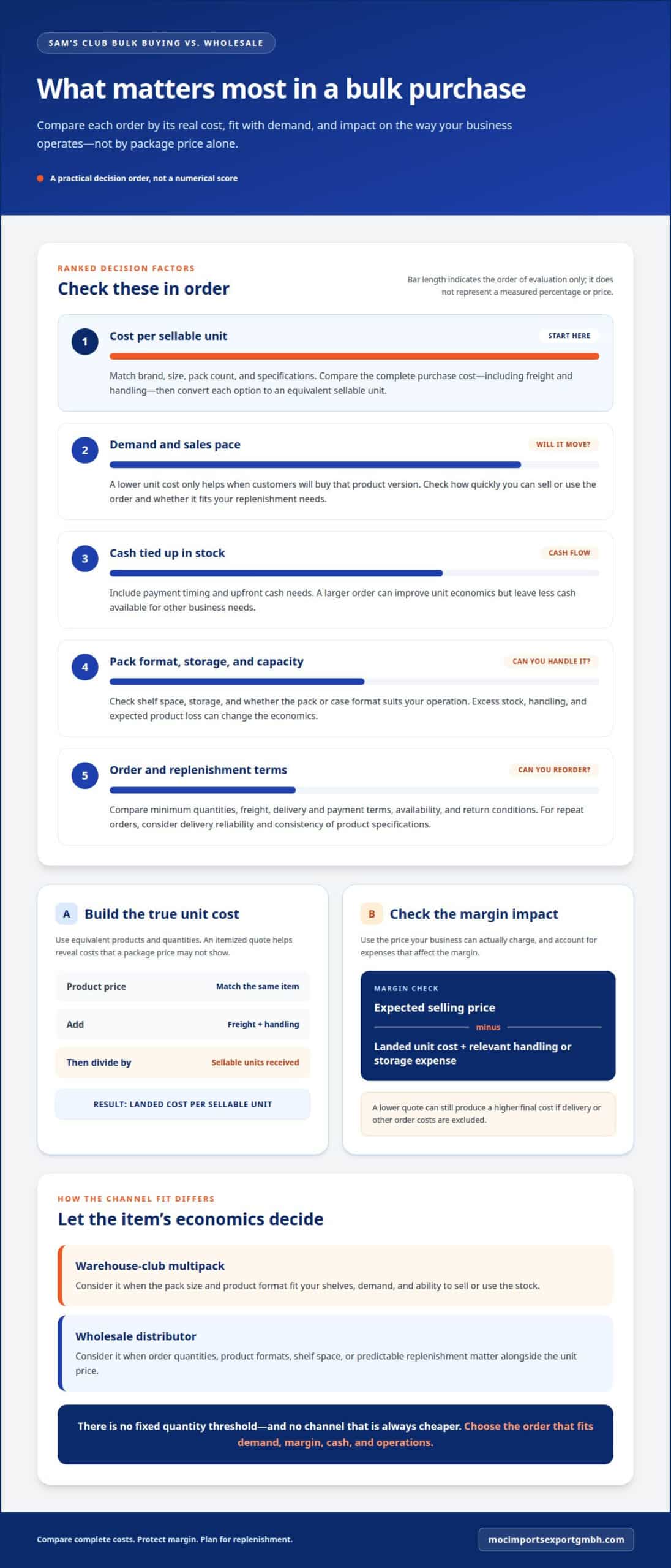
Compare the full cost of each purchase, not just its package price. For Sam’s Club bulk buying versus a wholesale distributor, the useful measure is the cost per sellable unit after freight, handling, and inventory effects.
-
Compare Product Pricing and Differentiation
Match the brand, size, pack count, and product specifications before comparing prices. Account for the costs and pricing structure of each channel, including any applicable fees or distributor markup. Consider these alongside the product’s features, packaging, and customer appeal. A lower unit cost matters only if customers will buy that version.
-
Compare Local Distributor Quotes
Request itemized quotes from local distributors using the same product description and order quantity you would use at Sam’s Club. Search for distributors by product category and location, then compare unit price, freight, minimum order, delivery terms, and payment conditions. Put each quote beside the Sam’s Club pack price and calculate a landed unit cost. A quote that excludes delivery can look cheaper while producing a higher final cost.
- Calculate your margin using the price your business can actually charge. Subtract the landed unit cost from the expected selling price, then include any handling or storage expense that affects the margin. For example, compare a warehouse multipack with a distributor case only after converting both into equivalent sale units. Wholesale pricing may be lower than individual-item pricing, but pack size and channel markups can change the result.
- Assess truckload pricing by dividing the complete delivered order cost by the sellable units received. Include freight, unloading, storage, and expected product loss. A truckload can reduce per-unit transport costs, but it also commits more cash and space. Compare its total cost with a smaller order, then weigh the discount against your sales pace and inventory capacity.
Treat purchase limits, returns, and product availability as transaction-specific factors. Compare the quantity offered and applicable return terms for the item and purchasing channel. Don’t build a margin forecast around stock that may not be available when you need to replenish.
- Record each purchase consistently in your bookkeeping. Keep the invoice or receipt, item quantities, unit costs, and any tax shown together. Separate inventory purchase records from sales records, and track sales tax collected from customers in the appropriate account. For tax reporting, follow the recordkeeping requirements for your business and jurisdiction rather than treating a club receipt as a complete margin analysis.
Choose the lower-cost channel only when its pack format, customer demand, and replenishment terms protect your margin. Comparing matched products and complete order costs makes each purchasing decision easier to support.
Purchase orders and ongoing retailer relationships
Build a purchasing routine that fits your cash flow, inventory turnover, and replenishment needs. A consistent process helps you compare warehouse-club purchases with a distributor relationship beyond the first order.
-
Compare Payment Terms and Credit Options
Compare the payment method, due date, credit availability, and any applicable account conditions before ordering. Purchasing terms can differ between Sam’s Club and wholesale distributors, so record the actual terms for each channel instead of assuming bulk orders receive credit. Include payment timing in your cash-flow plan: an attractive unit cost may still strain operations if the full order must be paid upfront.
-
Check Distributor Order Requirements
Ask distributors about minimum order quantities, case-pack rules, product assortment requirements, and the reorder process. Compare those requirements with your sales pace and storage capacity before committing. Minimums can vary by product or supplier, so assess each quote individually. A distributor may place bulk orders on a retailer’s behalf, allowing a smaller purchase quantity at a fair price.
- Standardize purchase orders with product descriptions, pack sizes, quantities, delivery instructions, and requested dates. Use the same fields for Sam’s Club and distributor purchases. This makes invoice matching easier and helps identify substitutions or quantity differences when goods arrive. Keep order documents with receipts and receiving records so you can reconcile stock counts and supplier invoices efficiently.
- Set reorder points based on sales pace and available inventory. Wholesale bulk buying can reduce how often you order, but larger orders also tie up cash and storage space. Compare the time saved through fewer purchase orders with the cost of holding stock. For fast-moving items, predictable replenishment may matter more than placing the largest possible order.
For repeat orders, track delivery performance, communication, and consistency of product specifications. Sam’s Club purchases large volumes, so suppliers serving the retailer need reliable production capacity and consistent lead times. For a small business, the same principle applies to planning: choose order quantities and schedules your operation can receive, store, and sell.
- Treat tax-exempt purchasing and resale-certificate handling separately from membership and payment terms. Keep relevant transaction records and tax details with each purchase, and follow the requirements for your business and jurisdiction. Membership alone does not replace documentation of the tax treatment of inventory purchases.
Use a simple supplier scorecard for price, order minimums, payment terms, delivery record, and ordering process. These are practical factors to compare in an ongoing wholesale relationship. If your business is planning recurring bulk orders, discuss your wholesale purchasing requirements as a next step.
Warehouse-club pack economics compared with standard retail items
Compare pack size, usable units, and purchase quantity before choosing a warehouse-club format. A lower shelf price per unit creates value only when the pack suits your sales pattern and storage capacity.
- Convert each package into the same sellable unit. For example, compare the cost per bottle, serving, or individually packaged item, rather than comparing a case price with the price of one retail item. Record the pack count and quantity per pack for Sam’s Club and the standard retail equivalent. This shows whether the larger package offers a genuine unit-cost advantage or simply contains more product.
- Match package formats to your customers and shelves. Warehouse clubs often sell bulk packages that may not fit small convenience-store shelves. A multipack can suit a business that sells the entire bundle, but it may require repacking or different shelf space if customers buy single items. Check product dimensions, outer packaging, and individual-unit format before setting a retail price.
- Estimate how much of each pack your business can sell before replenishment. A warehouse-club case can reduce repeat trips, while slow-moving stock takes up space and ties up working capital. Use sales records for the same item or a comparable product to set the order quantity. For a new line, start with a quantity that fits your storage and expected demand instead of relying only on the advertised pack value.
- Compare the complete fulfillment cost for Sam’s Club and a distributor. Include the item total, transportation, receiving effort, and time spent collecting or processing the order. Delivery fees, shipping costs, and pickup options depend on the order and purchasing channel. Compare the terms for each specific purchase, then include the selected option in your unit-cost calculation.
- Use bulk-saving figures as context, not as a business forecast. Individual consumers can save 25% to 35% by buying in bulk at wholesale outlets such as Sam’s Club and Costco. That range describes consumer savings, so calculate your own business result from matched products, order quantities, and selling formats.
- Review pack economics after sales, not just before ordering. Compare units received with units sold, damaged, or left in stock, then adjust the next order quantity. If a standard retail item sells steadily but its club multipack moves slowly, a smaller format may preserve shelf space and cash. If a bulk package sells through efficiently, its quantity can reduce the number of replenishment decisions.
Wholesale prices may be lower than individual-item prices. Compare matched units and quantities to determine whether that advantage suits your sales pattern and storage capacity.
Bulk buying versus wholesale
Choose a purchasing channel by comparing order size, buying process, and stock requirements. Bulk buying describes the quantity; wholesale describes a purchasing channel or transaction type.
- Define the quantity your business needs before comparing channels. There’s no specific quantity threshold for a bulk purchase; it generally means buying more than a local store would carry. For example, ordering several cases may count as bulk buying, whether you purchase from Sam’s Club or a distributor. Record expected sales and available storage first, then set an order quantity that fits both.
- Compare prices for identical products and pack formats. Consider the pricing structures of each channel, including applicable fees or distributor markup on the manufacturer’s price. Buying through a wholesaler may cost more than buying directly from the manufacturer, but the final result depends on unit costs and order terms. Don’t assume either channel always wins.
- Assess whether a wholesale distributor can meet your required quantity. Wholesalers can place bulk orders on retailers’ behalf, allowing retailers to buy smaller quantities at a fair price. This can help when a club pack exceeds your shelf space or customer demand. Compare the distributor’s minimum order and case sizes with your forecast, then calculate how much stock each option may leave unsold.
- Account for cash and storage before committing to a large purchase. Bulk orders require more upfront investment and can reduce cash available for other business needs. They can also leave excess inventory if customer demand falls short of the order quantity. For a product with uncertain sales, a smaller distributor order may reduce inventory exposure, even if its unit price is higher.
- Decide whether Sam’s Club inventory fits your resale plan. A small business can purchase goods there for resale, but the purchase itself doesn’t resolve tax or recordkeeping responsibilities. Keep transaction records and treat purchased goods as inventory in your business accounts. Compare this option with distributor ordering based on product format, quantity, replenishment needs, and your business’s documentation practices.
- Choose a channel that fits the item instead of following a blanket purchasing rule. A warehouse-club package may work for a fast-moving product when you have enough shelf or backroom capacity. A distributor may suit a product that needs a smaller order or a more tailored assortment. Compare both against the same sales forecast, available cash, and storage plan, then review the result after the order sells through.
Check each distributor’s minimum order and case sizes against your sales forecast, storage capacity, and available cash before purchasing. Choose order terms and product formats that fit your replenishment needs and limit unsold stock.
What are Sam’s Club membership fees and business benefits in 2026?
- Include the membership cost in your purchasing plan. A membership fee affects the effective cost of Sam’s Club inventory, even when individual items appear competitively priced. Divide the fee by the number of business purchases you expect to make, then add that share to each order’s cost. Use your own buying schedule, not an assumed visit frequency.
Sam’s Club serves small businesses and individual members who buy in bulk. Membership can suit businesses that regularly use its bulk formats, but may be less valuable when purchases are occasional or pack sizes exceed demand.
- Compare membership value with your planned product mix. List the items your business expects to purchase, their pack formats, and likely reorder frequency. Then identify which purchases you would make at Sam’s Club and which need different quantities or formats. A membership’s value depends on products you can use, not the total number of items available to members.
- Calculate a break-even point using your own orders. Add the membership fee to the cost of planned purchases, then compare that total with your alternative purchasing plan. Include transportation, receiving time, and storage needs in both calculations. For example, a business buying only one suitable item shouldn’t count unrelated club purchases as membership value.
Don’t treat a lower shelf price as the full benefit. An order can require additional cash and storage, while slow sales can leave inventory unused. Include these operating effects when comparing membership with a distributor’s order terms.
- Separate member benefits from business outcomes. The practical benefits are access to bulk purchasing and another purchasing option for small businesses. They create value only when the products, pack sizes, and purchase schedule align with actual demand. Record each Sam’s Club purchase, then compare its cost and sell-through with distributor orders in your inventory records.
- Review membership value at renewal using completed purchase records. Total the business purchases made through Sam’s Club, identify which items met your needs, and assess whether order quantities matched sales. Compare that pattern with distributor purchases, including their minimums and delivery terms. This review turns membership from a general overhead into a measurable procurement decision.
For a wholesale purchasing discussion focused on your product requirements, contact the wholesale team.
Include the membership fee in the effective cost of planned purchases and compare that total with your alternative purchasing plan. The business benefits are access to bulk purchasing and an option for small businesses, especially when available products and pack sizes match demand.
MOC Import Export GmbH: Oral-B Pro Cross Action Electric Toothbrush Heads – Pack of 8 (White)
MOC Import Export GmbH is a practical next step when your purchasing review points toward wholesale ordering for familiar consumer goods. Its Oral-B Pro Cross Action Electric Toothbrush Heads – Pack of 8 (White) gives buyers a defined pack format to assess against their sales needs, storage capacity, and reorder plans.
Compare the pack with your current product requirements and expected demand before adding it to a purchase order. This approach keeps the decision tied to your business’s inventory plan rather than bulk size alone. MOC Import Export GmbH also offers Pampers ZZZ Overnight Diapers, Size 5 (27+ lbs), 88 Count; Oral-B iO5 Electric Toothbrushes for Adults Black; and Gain Original Liquid Laundry Detergent – 5 Gallon.
For wholesale purchasing inquiries, contact MOC Import Export GmbH.
Turn the Comparison Into a Sourcing Plan
Make your next purchasing decision a working plan, not a one-time price comparison. Choose an item with steady demand, document the quantity your operation can manage, and set a review point for sales, stock, and reorder needs. This gives future decisions a consistent basis and helps your team adjust purchasing as demand changes.
Comparing Sam’s Club bulk buying with a wholesale distributor for a small business is useful when it leads to a clear procurement choice. Identify which products suit club packs and where wholesale ordering better fits your purchasing pattern. Then align your purchase orders with your inventory plan.
MOC Import Export GmbH offers wholesale consumer goods for business buyers. If you’re ready to discuss sourcing requirements and product needs, contact MOC Import Export GmbH to discuss sourcing. A clear plan is a practical foundation for your next order.
Frequently Asked Questions
What are the benefits of bulk ordering?
Bulk ordering can simplify replenishment when a business regularly uses the same products. For example, a café that repeatedly stocks coffee can plan larger, scheduled purchases instead of treating each restock as a separate decision. Consolidated purchasing can also make quantities easier to forecast across locations or departments. The benefit depends on predictable demand and a product format that staff can receive, store, and distribute efficiently.
What are the risks of bulk purchasing?
Bulk purchasing can reduce flexibility if customer preferences or operating needs change after an order arrives. A business may be left with products that no longer fit its assortment or have limited room to respond to a new customer request. Before ordering, consider how easily goods can be allocated across departments, locations, or sales channels. A purchase plan that allows alternatives can help limit the impact of changing demand.
What is bulk/wholesale buying?
Bulk buying describes purchasing a larger quantity; wholesale buying describes sourcing goods through a commercial supply channel, often for business use or resale. The terms can overlap, but they aren’t interchangeable. A retailer might buy a large package from a warehouse club, making it a bulk purchase, or source cases through a distributor. Classify each purchase by both its quantity and supplier, then record those details consistently in your procurement records.
Which products are cheaper at Sam’s Club versus wholesale distributors for small businesses?
Neither channel is always cheaper. Compare matched products and pack sizes using the complete landed cost, including freight, handling, and inventory effects.
