

B2B Sourcing Guides
Janitorial Supplies: A Professional Reference for Bulk Procurement 2026

13
Jun
Jun
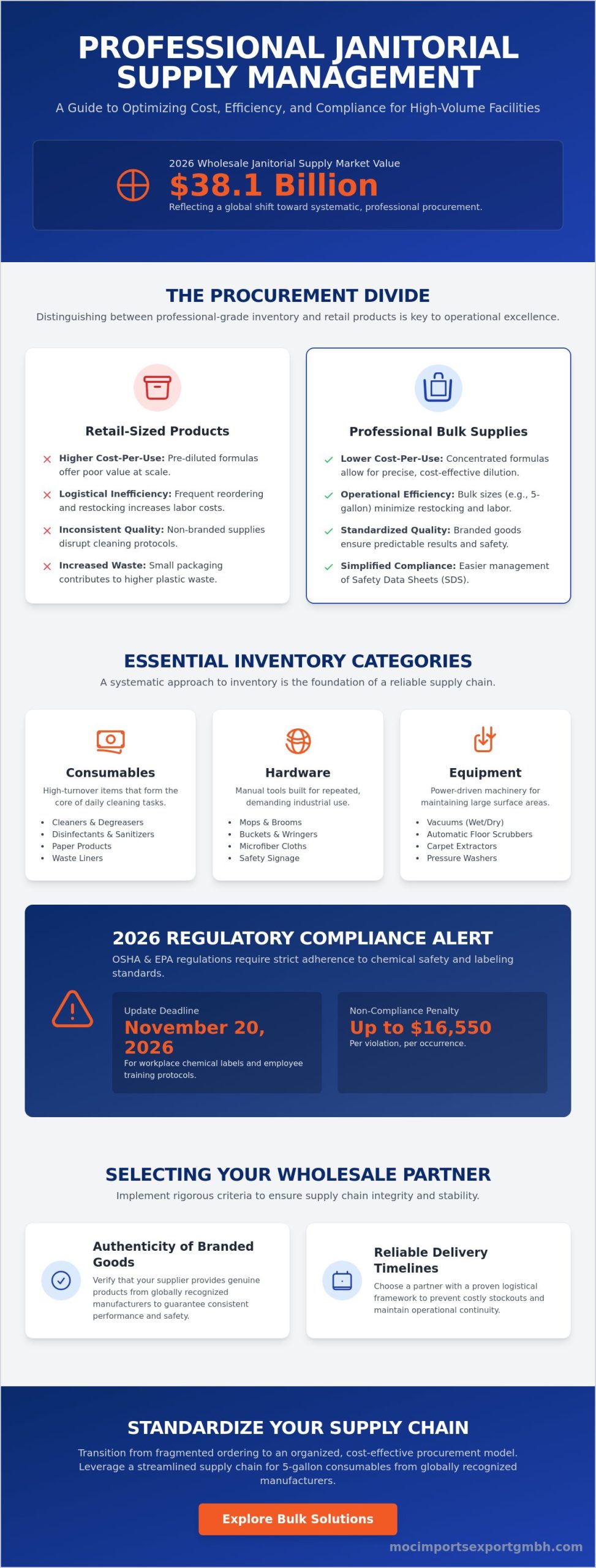
The wholesale market for janitorial supplies reached $38.1 billion in 2026, reflecting the massive scale of modern facility maintenance. Despite this volume, many managers continue to struggle with storage inefficiencies and the rapid turnover of retail-sized products. It’s difficult to maintain high standards when inconsistent quality from non-branded suppliers disrupts your protocols and increases operational friction.
Professional facility management requires a systematic approach to inventory rather than reactive purchasing. This reference offers a pragmatic overview of essential janitorial categories and professional procurement strategies for high-volume environments. You’ll learn how to standardize your cleaning protocols and reduce overhead through a reliable supply chain for branded consumables. We also cover critical 2026 regulatory updates, including the November 20 deadline for updated workplace labels and employee training. This guide provides the logistical clarity needed to transition from fragmented ordering to an organized, cost-effective procurement model that prioritizes business utility and compliance.
Key Takeaways
- Distinguish between retail products and professional-grade inventory to maintain consistent hygiene standards across high-volume facilities.
- Identify essential inventory categories, including degreasers, disinfectants, and specialized laundry supplies, tailored for healthcare and hospitality sectors.
- Evaluate the cost-per-use benefits of sourcing janitorial supplies in bulk containers to reduce logistical frequency and operational overhead.
- Implement rigorous selection criteria for wholesale partners to ensure the authenticity of branded goods and reliable delivery timelines.
- Standardize cleaning protocols by leveraging a streamlined supply chain for 5-gallon consumables from globally recognized manufacturers.
Defining Janitorial Supplies in a Professional Context
Janitorial supplies constitute the complete inventory of consumables and durable equipment required to maintain facility hygiene. In a professional environment, these items are not merely cleaning aids; they are critical components of an operational strategy. The wholesale market for these goods reached $38.1 billion in 2026, driven by a global shift toward systematic procurement. Professional facility managers prioritize supply chain stability and product consistency over the occasional convenience of retail shopping. This approach ensures that hygiene standards remain uniform across large-scale operations.
Standardized inventory is essential for maintaining health and safety compliance. By 2026, regulatory pressures from OSHA and the EPA have intensified. Facilities now face strict deadlines, including the November 20, 2026, requirement to update workplace labels and employee training for chemical substances. Using a professional-grade supply chain simplifies the management of Safety Data Sheets (SDS) and ensures that all products meet current legal benchmarks. This reduces the risk of serious violations, which can carry penalties of up to $16,550 per occurrence.
The Core Components of Facility Maintenance
Effective maintenance relies on a clear hierarchy of materials. Commercial cleaning operations typically segment their needs into three functional groups:
- Consumables: High-turnover items including cleaners and degreasers, paper products, and waste liners.
- Hardware: Manual tools such as mops, brooms, and microfiber cloths built for repeated industrial use.
- Equipment: Power-driven machinery like vacuums and floor scrubbers designed for high-traffic square footage.
Professional vs. Residential Grade Supplies
The difference between retail products and professional janitorial supplies is defined by chemical potency and structural integrity. Professional chemicals often feature higher concentration levels. This allows for precise dilution ratios, significantly lowering the cost per use compared to pre-diluted consumer alternatives. Durability is also a primary factor; hardware must survive multi-shift usage in demanding environments that would quickly degrade residential-grade tools. In such high-demand settings, maintaining the building’s physical structure with professional insulation is just as critical; for example, you can explore Schallschutz to see how specialized technical solutions support facility safety and noise reduction.
Packaging also differs. Professional inventory utilizes industrial formats like 5-gallon containers and bulk cases. These sizes are designed for industrial dispensing systems that minimize product waste and reduce labor frequency. Moving to high-volume procurement in 2026 is a pragmatic response to rising labor costs and the need for logistical efficiency in modern facility management.
Essential Categories for Janitorial Inventory Management
Professional facility management depends on organized inventory. Standardizing janitorial supplies across diverse departments prevents stockouts and ensures chemical compatibility. According to ISSA, the worldwide cleaning industry association, establishing clear categories is the first step toward operational efficiency. This classification allows for better tracking of consumption rates and more accurate forecasting for bulk orders. It also ensures that staff members use the correct products for specific surfaces, reducing the risk of property damage or safety hazards.
By 2026, the focus has shifted toward high-performance, branded consumables that offer predictable results. Managing these categories requires a deep understanding of your facility’s specific needs, from the volume of waste generated to the frequency of floor maintenance. A logical hierarchy of supplies simplifies training and ensures that every cleaning task is supported by the right tools and chemicals. This systematic approach is the foundation of a reliable supply chain.
High-Volume Liquid Consumables
In heavy-use environments like commercial kitchens and healthcare facilities, retail-sized bottles are inefficient. They increase plastic waste and require frequent restocking, which drives up labor costs. Switching to 5-gallon containers optimizes storage and simplifies dispensing. Integrating Dawn Original Manual Pot & Pan Liquid Dish Soap into commercial kitchens provides a reliable, high-performance solution for manual warewashing. Similarly, standardizing laundry protocols with wholesale laundry detergents ensures consistent results across large hospitality or medical linen loads. These high-volume formats reduce the frequency of logistical interventions and lower the overall cost-per-use.
Surface and Floor Care Systems
Floor maintenance is often the most labor-intensive part of facility care. Effective systems require a mix of specialized chemicals and durable hardware. Selecting the right cleaners and degreasers for industrial surfaces prevents long-term damage and maintains safety in high-traffic zones. These areas also demand the utility of professional vacuums and floor cleaning products to handle daily debris efficiently. Beyond chemicals, managing the disposable inventory for restrooms and breakrooms is vital. This includes waste liners and receptacles designed for specific debris types, alongside personal hygiene products like hand soaps and sanitizers for public-facing areas. If you need help determining the right inventory mix for your facility, consult with our logistics team to build a structured procurement plan.
Bulk Procurement Logic: Efficiency and Cost Analysis
The financial logic behind bulk procurement of janitorial supplies centers on minimizing the cost-per-use while reducing logistical frequency. Retail packaging is designed for consumer aesthetics, not industrial volume. Professional facility managers utilize data-driven insights from ISSA, The Worldwide Cleaning Industry Association to benchmark their consumption rates against industry standards. By moving from small-format bottles to industrial containers, organizations significantly decrease packaging waste and the labor hours spent on frequent restocking. This transition is essential for facilities aiming to scale their hygiene protocols without increasing their operational footprint.
Standardized branding across a facility also enhances operational safety. When a facility uses consistent products, staff training becomes simpler and more effective. Consistent labeling reduces the likelihood of chemical cross-contamination or improper application. High inventory turnover rates in professional settings demand a supply chain that can handle rapid depletion without administrative friction. Managing stock levels for a workforce that operates across multiple shifts requires a predictable flow of branded consumables to maintain service continuity. It’s a pragmatic shift that prioritizes business utility over retail convenience.
The 5-Gallon Efficiency Model
Transitioning to a 5-gallon format offers a clear mathematical advantage. A single 5-gallon bucket contains approximately 640 fluid ounces, replacing more than six standard 100oz retail bottles. This volume consolidation reduces the number of units handled by logistics staff and minimizes storage square footage. Implementing wholesale laundry detergent 5 gallon buckets allows for the use of automated dispensing pumps, which eliminate the variability of manual pouring. These strategies ensure that chemical application remains precise, further driving down the total cost of ownership. Large-scale liquid inventory is best managed through rack-mounted gravity systems or centralized pump stations to maximize floor space and improve accessibility.
Reducing Procurement Friction
Consolidating janitorial supplies under a single logistical partner reduces administrative overhead. Managing dozens of individual invoices and delivery schedules creates unnecessary complexity. Effective wholesale consumer goods sourcing provides a stable foundation for inventory management. Facilities can automate reorder points for essential consumables, ensuring that stock levels remain optimal without manual oversight. This systematic approach transforms procurement from a reactive task into a streamlined, predictable business process. By 2026, the global janitorial services market is projected to reach $228.64 billion, making procurement efficiency a critical competitive advantage for service providers who don’t want to be slowed down by fragmented supply chains. Facilities that are ready to move beyond retail-plus thinking can find a detailed format and brand performance breakdown in this guide to wholesale cleaning supplies bulk procurement for 2026.
Selection Criteria for Professional Janitorial Suppliers
Selecting a wholesale partner for janitorial supplies requires a move beyond simple price comparisons. In the professional market, the priority is verifying the authenticity of branded goods to ensure performance consistency. Non-branded or counterfeit alternatives often lack the precise chemical concentrations required for industrial hygiene. This leads to increased product consumption and potential damage to facility surfaces. A reliable supplier acts as a systematic bridge between manufacturers and buyers, ensuring that every pallet delivered meets the expected brand specifications. This organized competence is the baseline for any long-term procurement partnership.
Evaluating a supplier also involves assessing their ability to provide a comprehensive product range. High-volume facilities don’t just need cleaning chemicals; they require a logistical partner capable of managing breakroom inventory, personal care items, and specialized consumables. Consolidating these needs under one vendor reduces administrative friction and simplifies the reconciliation of invoices. A partner’s understanding of import/export compliance is equally critical, particularly as new regulations like the EU Digital Product Passport (DPP) take effect in July 2026. These mandates require detailed data on ingredients and recyclability, making compliance expertise a non-negotiable selection criterion.
Brand Reliability and Performance
Professional facilities prioritize globally recognized brands like Tide, Gain, and Dawn because they offer predictable results. Consistent chemical formulations allow janitorial teams to maintain standardized cleaning protocols without constant adjustments. For example, the use of Dawn Dish Soap 5 Gallon Wholesale in food service environments ensures that grease removal performance remains identical across every shift. This reliability is vital for meeting health and safety benchmarks. When the formulation is a known variable, training staff on proper dilution and application becomes a straightforward, repeatable process.
Supplier Logistical Competence
Logistical competence is defined by shipping reliability and the ability to manage market fluctuations. You must analyze lead times and the supplier’s capacity for national delivery to avoid stockouts of essential items. A seasoned partner manages the complexities of international trade, including state-level restrictions like the PFAS regulations enacted in Maine and Minnesota in early 2026. Ensuring product availability during these regulatory shifts requires a supplier with a robust, transparent supply chain. This logistical reach protects your facility from the operational disruptions caused by fragmented or unreliable sourcing models. If you are currently facing inconsistencies in your supply chain, contact our wholesale team for a professional procurement assessment.
Standardizing Your Supply Chain with MOC Import Export GmbH
MOC Import Export GmbH serves as a systematic facilitator for organizations requiring a consistent supply of branded janitorial supplies. We eliminate the operational friction caused by fragmented sourcing models by providing a centralized, high-volume distribution hub. Our operations prioritize business utility and logistical clarity. This ensures that professional buyers can maintain standardized protocols without the distraction of supply chain instability. By acting as a direct bridge to globally recognized manufacturers, we guarantee product authenticity and performance across every category of facility maintenance. This organized competence allows for a rapid transition from information gathering to procurement action.
Our approach centers on the reliability of the supply chain and the ease of the transaction. We understand that in a professional wholesale environment, the focus must remain on the efficiency of the partnership. Staying competitive requires a partner who values your time and operational needs. We provide the logistical reach necessary to support large-scale facilities while maintaining a respectful distance and professional register typical of B2B environments.
Strategic Branded Inventory
Professional facility management extends beyond basic floor care to encompass breakroom hygiene and personal care. MOC Import Export GmbH provides access to high-demand products from established brands like Oral-B, Pampers, and CeraVe. This allows for comprehensive inventory management under a single partner. Our catalog includes professional 5-gallon volumes of Gain, Dawn, and Tide, which are essential for high-turnover laundry and dishwashing requirements in healthcare and hospitality sectors. Additionally, we maintain a reliable supply of disposable tableware to ensure that breakroom maintenance remains consistent with the rest of the facility’s hygiene standards. This breadth of inventory simplifies the procurement process by consolidating multiple supply lines into one predictable stream.
Professional Procurement Partnership
Our partnership model is defined by direct communication and a minimalist approach to transaction processing. We manage the complex logistics of international trade, including compliance with the latest chemical safety standards and import regulations. This expertise ensures that your supply chain remains resilient during market fluctuations and regulatory shifts. MOC Import Export GmbH acts as a dependable partner for B2B clients who value operational speed and procedural simplicity. We facilitate efficient national trade by leveraging a systematic distribution network designed for bulk volumes. For structured procurement of bulk janitorial and consumer goods, contact MOC Import Export GmbH to discuss your specific facility requirements.
Optimizing Facility Logistics for 2026
Transitioning to a systematic procurement model is a requirement for modern facility managers. Standardizing on professional-grade inventory ensures compliance with 2026 OSHA and EPA standards while reducing the volatility of retail-based sourcing. By prioritizing high-volume, branded consumables, businesses achieve predictable hygiene outcomes and significant operational savings through reduced packaging waste and labor hours. It’s a pragmatic shift that moves facility care from a reactive expense to a streamlined business process.
MOC Import Export GmbH provides the logistical framework necessary to execute these strategies at scale. As a wholesale specialist in branded consumer goods, we offer national US shipping and a robust inventory of 5-gallon bulk consumables. Our expertise in international compliance protects your facility from stockouts and regulatory risks. Securing a reliable stream of janitorial supplies is a necessary step toward operational excellence. Browse Professional Janitorial and Cleaning Supplies at MOC to finalize your 2026 procurement plan. Reliable logistics are the foundation of a well-maintained facility.
Frequently Asked Questions
What are the most essential janitorial supplies for a new commercial facility?
Essential inventory includes surface disinfectants, floor cleaners, high-capacity waste liners, and restroom consumables like hand soap and paper products. New facilities must also secure durable hardware, such as industrial vacuums and microfiber systems, to handle high-traffic square footage. It is critical to prioritize products that meet the 2026 OSHA Hazard Communication Standard deadlines to ensure immediate regulatory compliance for workplace safety.
How does buying janitorial supplies in bulk reduce operational costs?
Bulk procurement reduces the cost-per-use by eliminating the price premium associated with retail-sized packaging. It also decreases logistical frequency, which lowers shipping expenses and administrative processing time for individual orders. Organizations benefit from reduced packaging waste and fewer labor hours dedicated to frequent inventory replenishment, allowing maintenance teams to focus on core cleaning tasks rather than restocking. For a detailed breakdown of format efficiency and brand selection, review the business procurement guide for wholesale cleaning supplies bulk to align your purchasing strategy with industrial-scale volume requirements.
What is the difference between commercial and industrial cleaning supplies?
Commercial cleaning supplies are designed for offices, retail spaces, and public environments where general hygiene and aesthetics are the primary goals. Industrial supplies are formulated for manufacturing plants and warehouses, focusing on heavy-duty degreasing and machinery maintenance. Industrial products often feature higher chemical concentrations and require specialized PPE or more rigorous handling protocols compared to standard commercial alternatives.
Why should facilities prioritize branded cleaning chemicals over generic alternatives?
Branded janitorial supplies provide consistent chemical formulations that ensure predictable performance across every application. This reliability simplifies staff training and reduces the risk of surface damage caused by variable or lower-quality generic ingredients. Established brands also provide comprehensive Safety Data Sheets (SDS), which are vital for maintaining the updated 2026 workplace safety standards required by federal regulators.
How should 5-gallon cleaning buckets be stored and handled safely?
Store 5-gallon buckets in cool, dry areas, ideally on pallet racking or dedicated spill containment units to prevent floor damage. Use industrial dispensing pumps to eliminate the need for manual pouring, which prevents lifting injuries and chemical splashing. Ensure that all containers remain clearly labeled in accordance with the November 2026 OSHA workplace labeling requirements to maintain a safe and compliant storage environment.
What role does a wholesale importer play in the janitorial supply chain?
A wholesale importer acts as a systematic bridge between global manufacturers and professional buyers by managing complex international logistics and customs compliance. They provide the infrastructure for large-scale inventory warehousing, ensuring that B2B clients have a reliable, high-volume supply of branded janitorial supplies. This partnership allows facilities to bypass the complexities of global trade while maintaining a consistent stock of essential consumables.
Can janitorial supplies be standardized across multiple facility locations?
Standardization is achieved by utilizing a single logistical partner and a fixed list of core products for all sites. This approach ensures uniform hygiene standards and simplifies inventory tracking across a national footprint. It also allows for centralized procurement, which leverages higher purchasing volume for better logistical efficiency and results in more predictable operational overhead for the entire organization.
