
B2B Sourcing Guides
Wholesale Coffee Distributor Germany: A Strategic B2B Sourcing Guide
05
Aug
Aug
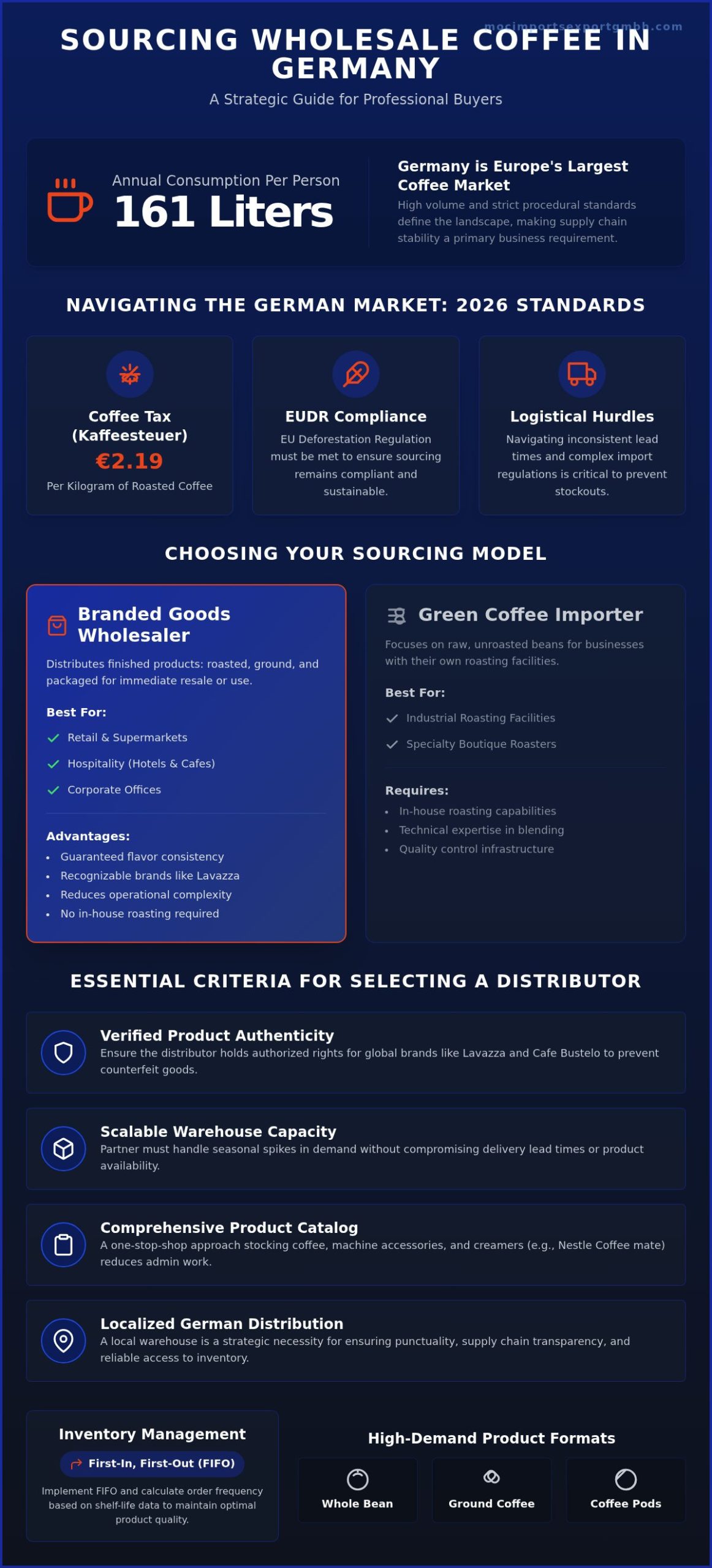
Germans consume an average of 161 liters of coffee per person every year. This high volume makes supply chain stability a primary business requirement. Selecting a professional wholesale coffee distributor Germany is the most efficient way to secure authentic brands like Lavazza and Cafe Bustelo. You need a partner that prevents stockouts and manages the specific logistical demands of the German market.
Bulk procurement often involves navigating inconsistent lead times and complex import regulations. These delays disrupt your operations and impact your bottom line. This guide provides a strategic framework for sourcing branded coffee products in bulk. You’ll discover how a localized distribution partner simplifies the transition from order to delivery.
We’ll examine the critical standards for 2026, including the €2.19 per kilogram coffee tax and the EU Deforestation Regulation (EUDR) compliance. This overview ensures your sourcing remains compliant and efficient. Use this information to build a reliable inventory of high-demand international coffee products and essential accessories like Coffee mate creamers.
Key Takeaways
- Distinguish between green coffee importers and branded goods wholesalers to ensure your supplier matches your specific retail or office requirements.
- Select a wholesale coffee distributor Germany based on verified product authenticity and the ability to scale inventory according to your seasonal demand.
- Analyze the cost-benefit of sourcing established global brands like Lavazza and Cafe Bustelo to guarantee flavor consistency and reduce operational complexity.
- Maintain product quality by implementing a First-In, First-Out (FIFO) inventory system and calculating order frequencies based on specific shelf-life data.
- Utilize a localized German distribution partner to simplify logistics and secure reliable access to essential coffee machine accessories and Nestle Coffee mate products.
Navigating the Landscape of Wholesale Coffee Distribution in Germany
The German coffee market is the largest in Europe. It operates on high volume and strict procedural standards. A wholesale coffee distributor Germany acts as the essential link between global manufacturers and the local market. This role involves more than simple transportation. It requires managing the Kaffeesteuer (coffee tax), ensuring EUDR compliance, and maintaining a consistent inventory of high-demand brands. Professional buyers prioritize distributors who can navigate these regulatory frameworks while maintaining steady stock levels.
Businesses across Germany rely on these distributors for specialized procurement. The primary sectors include:
- Retail: Supermarkets and convenience stores requiring shelf-ready packaging.
- Hospitality: Hotels and cafes needing bulk whole beans for professional equipment.
- Corporate Offices: Large-scale operations sourcing consistent supplies for staff consumption.
Reliability is the benchmark for success in this sector. German business culture values punctuality and supply chain transparency. A stockout in a retail environment or a corporate office leads to immediate operational friction. Consequently, selecting a partner with a localized German warehouse is a strategic necessity. This ensures that the history of coffee in Germany continues to be defined by high consumption and efficient trade.
Green Coffee vs. Branded Consumer Coffee
The market is divided into two distinct categories. Green coffee importers focus on raw, unroasted beans. These are typically sold to industrial roasting facilities or specialty boutique roasters. In contrast, branded consumer coffee wholesalers distribute finished products. These goods are roasted, ground, and packaged for immediate resale or use. This distinction is critical for B2B buyers who do not have in-house roasting capabilities.
Most retailers and corporate buyers prioritize branded options. Sourcing branded coffee in bulk eliminates the technical complexities of roasting. Brands like Lavazza and Cafe Bustelo offer standardized flavor profiles that consumers recognize. This consistency is vital for maintaining customer loyalty in retail environments and ensuring quality in office settings.
The German Market Demand for International Brands
Consumer behavior in Germany shows a strong preference for established global brands. This preference is rooted in a sophisticated culture of consumption where quality is expected. Buyers look for specific trust signals, such as recognizable logos and consistent quality certifications. A comprehensive wholesale catalog must include various formats to meet these needs:
- Whole Bean: Preferred by the growing specialty and home-brewing segments.
- Ground Coffee: The standard for high-volume filter machines and espresso bricks.
- Coffee Pods: Essential for modern office environments and single-serve retail.
Access to international brands provides a competitive edge. It allows businesses to meet diverse consumer tastes without managing multiple individual supplier relationships. Efficient distribution ensures these products are available exactly when the market demands them.
Essential Criteria for Selecting a Reliable Coffee Supply Chain Partner
Selecting a wholesale coffee distributor Germany requires a focus on operational capacity and brand integrity. High-volume procurement is only successful when your partner can verify product authenticity. You must ensure they hold authorized distribution rights for international brands like Lavazza and Cafe Bustelo. This prevents the entry of counterfeit goods into your retail or office environment. Scalability is equally critical. A distributor must possess the warehouse capacity to handle seasonal spikes in demand without compromising lead times.
Evaluate the breadth of the product catalog. Efficient sourcing involves consolidating multiple categories under one supplier. A distributor providing only whole beans creates unnecessary administrative work. Look for partners who also stock coffee machine accessories and creamers like Nestle Coffee mate. This one-stop-shop approach reduces logistical touchpoints and simplifies your accounts payable process.
When vetting a potential partner, prioritize these specific operational traits:
- Inventory Transparency: Real-time data on stock levels for high-demand SKUs.
- Lead Time Accuracy: Consistent delivery schedules that align with your inventory turnover.
- Brand Certification: Documentation proving the origin and authenticity of global coffee brands.
- Diverse Packaging Options: Availability of 12-count cases, 1kg bags, and individual espresso bricks.
Logistical Efficiency and National Coverage
A centralized German warehouse is essential for maintaining national distribution. It minimizes transport distances and ensures predictable shipping speeds. Rapid inventory turnover in retail depends on these localized logistics. Managing bulk weights, such as 1kg whole bean bags or cases of espresso bricks, requires specialized handling. Professional distributors utilize structured shipping protocols to prevent damage and maintain the integrity of the packaging. If you require a logistical partner to manage your bulk procurement, reach out to our distribution team for a consultation.
Compliance and Quality Standards in Food Wholesale
Adherence to German food and beverage regulations is non-negotiable. This includes managing the €2.19 per kilogram coffee tax and ensuring compliance with the EU Deforestation Regulation (EUDR), which became fully applicable to SMEs by June 30, 2026. These legal requirements are complex but necessary for market access. Proper storage conditions are also vital. Temperature-controlled environments prevent the degradation of volatile oils in the coffee, ensuring freshness upon delivery.
For businesses expanding their reach, understanding wholesale consumer goods sourcing strategies for US retailers can provide additional perspective on international trade. A comprehensive German coffee market analysis highlights that consumer demand is shifting toward high-quality, traceable products. This shift necessitates a partner who views compliance as a core business function rather than an afterthought.
Comparing Branded Wholesale vs. Direct Green Coffee Sourcing
Direct green coffee sourcing requires significant capital investment in roasting infrastructure and specialized labor. For many businesses, working with a wholesale coffee distributor Germany is a more pragmatic choice. This approach eliminates the technical risks associated with roasting, such as flavor inconsistency and high energy costs. Recent German coffee market trends indicate that while whole bean consumption is rising, the demand for standardized quality remains the primary driver for B2B buyers. The German market consumed approximately 456,000 tonnes of coffee in 2025; managing this volume through branded products reduces the operational burden on individual retailers.
Branded products arrive shelf-ready. This reduces the “last mile” complexity often found in bulk food logistics. While raw green beans require temperature-controlled silos and long-term storage, packaged ground coffee or whole bean bags use standardized pallet dimensions. This allows for more efficient warehouse space utilization and faster inventory turnover. Bricks of ground coffee, such as Cafe Bustelo 6 oz bricks, are vacuum-sealed to extend shelf life and prevent the oxidation that can ruin unsealed specialty batches.
Flavor consistency is another critical differentiator. Specialty batches of green coffee are subject to seasonal variations and harvest fluctuations. This makes it difficult for a non-specialist to maintain a uniform product for their clientele. Branded wholesale removes this variable. Global manufacturers utilize sophisticated blending techniques to ensure that a cup of Lavazza tastes the same regardless of when or where it was purchased.
The Retail Advantage of Branded Coffee
Recognizable labels like Lavazza act as immediate trust signals for consumers. Retailers benefit from the massive marketing budgets of these global entities without any direct cost. Stocking the Food and Beverages Coffee Category ensures that your inventory matches consumer expectations for quality and flavor. It’s a low-risk strategy compared to establishing a private label roasting operation. Branded products drive foot traffic because customers specifically seek out labels they already know and prefer.
Office and Facility Procurement Logic
Standardization is the priority in office and facility environments. Facilities managers favor products like Cafe Bustelo and Nestle Coffee mate because they provide a predictable experience for employees and guests. Sourcing these through a central distributor simplifies administrative tasks. You can manage your beverage inventory alongside wholesale cleaning supplies, consolidating your billing into a single monthly statement. This level of organization is essential for maintaining a systematic and efficient workplace. Consolidating your supply chain reduces the number of individual deliveries, further streamlining your facility logistics.
Strategic Inventory Management for Bulk Coffee Procurement
Inventory management for coffee requires a systematic approach to protect product quality and business margins. A reliable wholesale coffee distributor Germany provides the necessary volume, but the buyer must implement structured internal controls. The First-In, First-Out (FIFO) system is the standard for managing perishable consumer goods. It ensures that the oldest stock is sold or consumed first. This prevents the accumulation of expired inventory and maintains the flavor profile that consumers expect from premium brands.
Coffee prices are subject to global market volatility. Bulk ordering acts as a hedge against sudden price increases. By securing larger volumes when prices are stable, businesses protect their bottom line. Calculating optimal order frequencies involves balancing storage costs against demand forecasts. This data-driven approach ensures you maintain enough stock to prevent stockouts while avoiding over-investment in inventory. Units should be managed at the pallet or case level to maintain logistical efficiency.
Consolidating your supply chain is a proven method for reducing operational friction. Sourcing all beverage-related items from a single partner simplifies the procurement cycle. This strategy reduces the number of individual deliveries, which lowers the overall carbon footprint and minimizes warehouse disruption. A systematic approach to inventory ensures that your retail shelves or office breakrooms remain fully stocked without excess waste.
Maximizing Shelf Life and Freshness
Branded wholesale products often utilize nitrogen-flushed packaging to preserve aroma and flavor. This technology significantly extends shelf life compared to unsealed or locally roasted goods. To maintain this quality, store coffee in a cool, dry environment. Ideal storage temperatures remain below 20 degrees Celsius with low humidity. Monitoring “best before” dates is a daily operational task. High-volume inventory requires a clear labeling system to identify stock that needs immediate rotation. Vacuum-sealed espresso bricks and foil-lined whole bean bags provide the best protection against oxidation.
Leveraging Multi-Category Sourcing
Procurement efficiency increases when you consolidate orders. Sourcing coffee alongside snacks and drinks from one partner reduces total shipping expenses. This strategy also lowers administrative overhead. Managing one invoice is faster than processing several from different suppliers. For broader facility management, refer to our Wholesale Laundry Detergent 5 Gallon Bucket Guide for insights on bulk household goods. Streamlining your procurement process saves time and operational costs. Contact our wholesale specialists to discuss a consolidated delivery schedule for your business.
MOC Import Export GmbH: Efficient Branded Coffee Wholesale in Germany
MOC Import Export GmbH operates as a professional wholesale coffee distributor Germany. Our firm specializes in the systematic distribution of branded consumer goods. We provide a streamlined bridge between global manufacturers and professional buyers. This centralized approach reduces administrative friction for retailers and corporate offices. Our focus remains on logistical reliability and inventory consistency. We manage the complexities of the German supply chain so our clients can focus on their core operations.
Our German-based national distribution network offers a significant logistical advantage. We maintain a high-volume warehouse that facilitates rapid order fulfillment across the country. This localized presence allows us to handle specific administrative requirements with surgical precision. Business-to-business clients benefit from a partner that understands the nuances of the local market while providing access to international brands. Our team prioritizes business utility and procedural simplicity in every transaction.
The MOC digital procurement portal is designed for efficiency. It allows for 24/7 bulk ordering, providing real-time access to our extensive catalog. This platform’s optimized for quick decision-making, ensuring that the transition from information gathering to action is as fast as possible. We act as a dependable partner, offering authoritative support and structured information to simplify the bulk-buying process. Our goal’s to create a sense of organized competence that reassures every client.
Featured Brands and Product Categories
The MOC catalog features industry-standard labels known for quality and consistency. We stock Lavazza Top Class Filtro Whole Bean Coffee in 1 kg bags and Cafe Bustelo Espresso Ground cases. These products are essential for businesses that demand standardized flavor profiles. We also provide essential complements, such as Nestle Coffee mate French Vanilla liquid pump bottles. For a complete beverage solution, explore our Coffee Machine Accessories category. This allows for the simultaneous procurement of both consumables and necessary hardware.
Why Partner with a German Logistical Expert?
Partnering with a localized expert ensures reliable B2B trade facilitation. We provide professional customer service from our German headquarters, ensuring clear communication and no-nonsense support. Our team understands the operational needs of modern wholesale trade, from VAT compliance to bulk shipping protocols. We don’t complicate the ordering process with unnecessary prose. To streamline your procurement process, you can browse our full range of food and beverages. This systematic catalog includes everything from premium coffee to bulk snacks and drinks, allowing for total supply chain consolidation.
Optimizing Your German Coffee Supply Chain
Maintaining a stable beverage inventory is a primary requirement for retail and corporate operational success. Branded wholesale products provide the consistency and trust signals that modern consumers expect. Selecting an established wholesale coffee distributor Germany ensures your business stays compliant with shifting regulations while maintaining optimal stock levels. This strategic choice removes the technical burdens of roasting and significantly simplifies the procurement cycle. Operational efficiency remains the benchmark for every successful business transaction.
MOC Import Export GmbH provides the logistical reliability required for complex bulk procurement. We serve as an authorized reseller of brands like Lavazza and Cafe Bustelo, offering authentic products supported by our German-based logistical expertise. Our national delivery network ensures on-schedule arrival for all bulk orders, regardless of volume. This structured approach supports your specific inventory turnover goals and facility needs. We prioritize organized competence and clarity in every distribution partnership.
Streamline your coffee procurement with MOC Import Export GmbH to establish a professional supply chain today. Our team is ready to facilitate your next bulk sourcing project with precision and speed.
Frequently Asked Questions
What are the benefits of using a local wholesale coffee distributor in Germany?
Using a localized wholesale coffee distributor Germany ensures compliance with the €2.19 per kilogram roasted coffee tax. It also guarantees that all products meet the EU Deforestation Regulation (EUDR) standards applicable in 2026. Localized warehousing reduces lead times compared to cross-border shipping. This proximity allows for more responsive inventory management and reduces the risk of stockouts in high-demand environments.
How do I verify the authenticity of branded coffee products in bulk?
Authenticity is confirmed by verifying the distributor’s authorized reseller status. Professional buyers should request documentation that traces the supply chain back to global manufacturers like Lavazza or Cafe Bustelo. Authentic branded products arrive in standardized, factory-sealed packaging with clear batch numbers. This transparency is vital for maintaining retail trust and ensuring the flavor consistency expected by professional clients.
What is the typical shelf life for wholesale ground coffee?
Vacuum-sealed ground coffee has a typical shelf life of 12 to 18 months. Nitrogen-flushed packaging prevents oxidation, which is the primary cause of flavor loss. High-volume buyers should implement a FIFO system to ensure stock is rotated before these dates expire. Proper storage in a cool, dry warehouse environment is necessary to maintain the integrity of the seals and the volatile oils within the coffee.
Can I order coffee machine accessories and creamers from the same distributor?
Consolidating consumables and hardware under one supplier is highly efficient. Most professional distributors provide a full range of Nestle Coffee mate products and essential coffee machine accessories. This one-stop-shop approach reduces the number of invoices your accounting department must process. It also ensures that all beverage components, from the beans to the creamer, arrive in a single, coordinated shipment.
What are the shipping requirements for large bulk coffee orders in Germany?
Bulk shipments require adherence to German pallet standards and freight safety protocols. A wholesale coffee distributor Germany must organize deliveries using Euro-pallets for efficient warehouse integration. Shipping large volumes of 1kg bags or espresso bricks requires moisture-protected transport and secure wrapping to prevent damage. Professional logistical partners handle these complexities to ensure goods arrive in shelf-ready condition across the national network.
How does bulk coffee pricing compare to retail purchasing for businesses?
Bulk pricing offers a substantial discount over consumer retail rates by eliminating individual unit markups. Businesses benefit from lower per-unit costs when ordering by the case or pallet. This procurement method also reduces the administrative costs associated with frequent, small-scale orders. Securing large volumes helps stabilize your budget against fluctuations in the global coffee commodity market.
Is it better to source whole bean or ground coffee for office use?
Whole bean coffee is the preferred choice for facilities using modern bean-to-cup machines to ensure maximum freshness. Ground coffee is often more practical for high-capacity filter brewing in large corporate offices. Your decision should align with your existing machinery and the volume of consumption. Both formats offer consistent flavor profiles when sourced from established international brands that prioritize quality control.
