

B2B Sourcing Guides
Wholesale Household Goods Suppliers: A Professional Procurement Guide (2026)

28
May
May
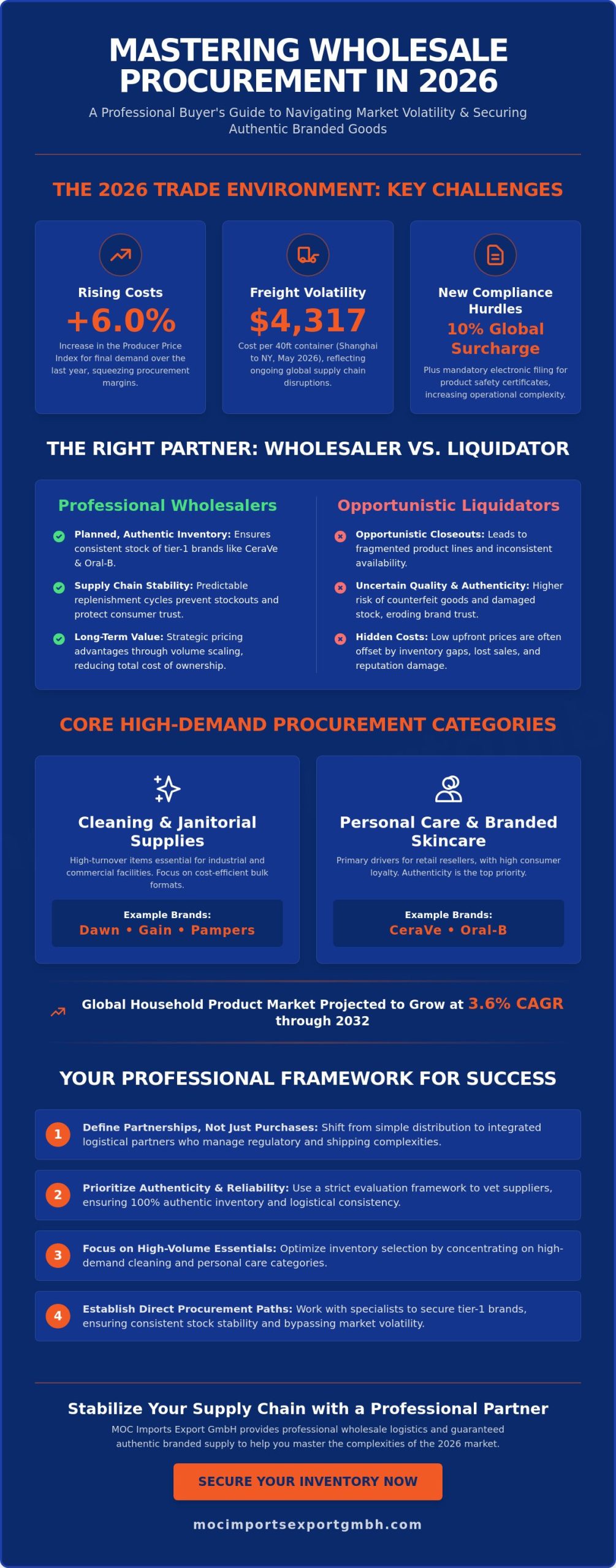
With the Producer Price Index for final demand climbing 6.0% over the last year, procurement margins are under unprecedented pressure. Finding reliable wholesale household goods suppliers is no longer just about the lowest price per unit. It’s about logistical survival. You likely recognize that securing authentic branded inventory is becoming increasingly difficult as global supply chains tighten. Between the suspension of the de minimis exemption and rising ocean freight rates, which hit $4,317 per 40ft container for Shanghai to New York in May 2026, the operational floor is shifting beneath professional buyers.
This guide provides a professional framework to master these complexities. You’ll learn how to evaluate distributors, secure 100% authentic inventory like Oral-B and CeraVe, and stabilize your supply chain against market volatility. We’ll examine logistical benchmarks, authenticity verification protocols, and cost-reduction strategies for bulk procurement. This systematic approach ensures your business remains competitive in a high-tariff environment while maintaining the inventory stability required for scale.
Key Takeaways
- Define the shift from simple distribution to integrated logistical partnerships in the 2026 trade environment.
- Use a professional framework to evaluate wholesale household goods suppliers based on logistical reliability and product authenticity.
- Identify high-volume categories including commercial cleaning agents and branded personal care essentials for optimal inventory selection.
- Manage 2026 compliance requirements including mandatory electronic filing for safety certificates and updated import surcharges.
- Establish direct procurement paths for tier-1 brands like Oral-B, Pampers, and CeraVe to ensure consistent stock stability.
Navigating the Market for Wholesale Household Goods Suppliers
Professional procurement in 2026 requires a precise definition of wholesale household goods suppliers. These entities are no longer passive intermediaries. They act as strategic logistical partners that manage complex regulatory hurdles, such as the mandatory electronic filing for product safety certificates effective July 8, 2026. For a foundational perspective on understanding the wholesale market, one must look at how these partners mitigate the impact of the 10% global import surcharge introduced in February 2026. Relying on simple distribution is insufficient. Modern trade demands an integrated approach where the supplier manages the transition from high-volume manufacturing to localized retail availability.
Efficiency dictates a move away from opportunistic liquidation. Professional buyers are prioritizing consistent, branded inventory to ensure product authenticity. Reliable access to tier-1 brands like CeraVe or Oral-B provides a level of quality control that liquidators cannot match. This shift stabilizes the retail environment. It replaces the “hit or miss” nature of closeouts with a systematic inventory flow. Import and export specialists facilitate this by navigating international shipping disruptions and volatile ocean freight rates, which rose to $2,712 per 40ft container in May 2026.
The Importance of Supply Chain Stability
Consistent inventory prevents retail stockouts and protects consumer trust. In March 2026, the inventories/sales ratio for merchant wholesalers was 1.21. This indicates a lean but active market where precision is vital. Global logistics disruptions directly impact domestic availability; therefore, a partner who can bypass these hurdles is essential. Supply chain stability in B2B procurement is the consistent, predictable arrival of inventory that aligns with forecasted demand and operational capacity.
Distinguishing Between Wholesalers and Liquidators
The reliability of stock is the primary differentiator between these two models. Professional wholesale household goods suppliers provide planned inventory. This allows for long-term shelf planning and marketing strategies. Liquidators rely on opportunistic closeouts, which leads to fragmented product lines and uncertain quality. Professional wholesale environments maintain strict quality control standards to protect the integrity of branded goods like Gain detergent or Pampers diapers. While liquidators might offer lower upfront costs for a single lot, direct wholesale partnerships offer long-term pricing advantages through volume scaling and predictable replenishment cycles. This systematic approach reduces the hidden costs associated with inventory gaps and counterfeit risks.
Core Categories in High-Demand Household Procurement
High-demand procurement centers on daily essentials. The global household product market reached $342.7 billion in 2025 and is projected to grow at a CAGR of 3.6% through 2032. Professional wholesale household goods suppliers prioritize these high-turnover items to maintain liquid inventory. This strategy aligns with data from the wholesale trade sector, which shows a significant rise in merchant wholesaler sales, reaching $772.2 billion in March 2026. Focusing on staple goods reduces the risks associated with shifting consumer trends.
Cleaning and Janitorial Supplies
Industrial and commercial facilities require specialized formats for cost efficiency. The 5-gallon bulk format for products like Dawn Original Manual Pot & Pan Liquid Dish Soap and Gain Original Liquid Laundry Detergent is a standard for professional procurement. These high-volume containers reduce packaging waste and lower the per-ounce cost. For a detailed breakdown of these logistics, consult our Wholesale Laundry Detergent 5 Gallon Bucket: A Business Procurement Guide. Sourcing these through established distributors ensures consistent chemical formulations and regulatory compliance.
Personal Care and Branded Skincare
Branded skincare and dental hygiene are primary drivers for retail resellers. Brands like CeraVe and Oral-B maintain high consumer loyalty and consistent demand. Sourcing authentic products like the Oral-B iO5 Electric Toothbrush or CeraVe Resurfacing Retinol Serum requires a vetted supply chain. Counterfeit risks in these categories make authenticity the top priority over marginal price differences. Review our CeraVe Wholesale Supplier Guide: Sourcing Authentic Skincare in Bulk for verification protocols. Reliable delivery of these items is essential for maintaining shelf presence in competitive markets.
Baby and Child Care Essentials
Baby essentials remain recession-proof. High-turnover items like Pampers ZZZ Overnight Diapers (Size 5, 88 Count) are critical for care facilities and retail stock. Specialized inventory, such as CeraVe Baby Eczema Relief Cream, caters to a growing niche of health-conscious parents. For businesses looking to scale, partnering with reliable wholesale household goods suppliers ensures these staple products remain in stock during peak demand cycles. Managing these products requires a focus on shelf-life and steady replenishment to avoid stockouts. If you need to stabilize your inventory with these high-demand brands, view our current wholesale availability.
Evaluating Supplier Reliability and Logistical Efficiency
Verification of product authenticity is the first step in a professional procurement framework. In the international branded market, the risk of counterfeit consumer packaged goods (CPG) is high. You need to ensure your wholesale household goods suppliers provide a transparent chain of custody for every shipment. Financial stability is also a critical metric. A supplier with weak capital reserves might fail to secure inventory during peak seasons or struggle with the rising ocean freight rates observed in May 2026. Professional reputation is built on consistency. Look for partners who maintain high communication standards. Fast-paced trade doesn’t allow for delayed email chains. You need direct, data-driven responses regarding stock levels and shipping status.
Lead time accuracy is another non-negotiable factor. When global shipping disruptions occur, a reliable export partner provides realistic windows rather than optimistic estimates. This allows you to plan your inventory cycles without the threat of unexpected stockouts. Your capital shouldn’t be tied up in transit due to a distributor’s poor logistical planning. Vetting a supplier involves reviewing their historical performance in handling high-volume transactions and their ability to navigate the complex regulatory environment of 2026.
The Logistics of Bulk Household Goods
Efficient distribution requires a choice between palletized shipping and full container-load (FCL) distribution. Pallets offer the flexibility needed for mid-sized operations, while FCL maximizes cost-per-unit savings for national distribution. Logistical efficiency in modern supply chain management focuses on minimizing touchpoints to reduce the risk of damage. Managing the “last mile” in national wholesale delivery requires a partner with a established network of local carriers. Logistical efficiency directly impacts retail margins by lowering the total cost of ownership for every unit in your warehouse.
Brand Authenticity and Quality Control
Unverified suppliers pose a significant threat to your business’s legal and financial standing. In the CPG sector, documentation is your primary defense. Professional wholesale household goods suppliers must provide General Certificates of Conformity (GCCs) and clear invoices that trace back to authorized manufacturers. This is vital when sourcing high-turnover items like dental care products. For instance, procurement of Oral-B Toothbrush Heads Bulk requires strict adherence to quality control protocols to ensure you aren’t receiving grey-market or counterfeit inventory. Quality control standards in a professional wholesale environment include regular batch inspections and climate-controlled storage to maintain the integrity of chemical products like detergents and skincare serums.
Strategic Sourcing for National and International Distribution
Strategic sourcing in 2026 requires navigating a volatile regulatory environment. With the 10% global surcharge effective February 24, 2026, and the suspension of the de minimis exemption, international procurement has become a high-stakes logistical operation. Professional wholesale household goods suppliers must act as compliance officers. They handle the documentation necessary to move large volumes across borders without incurring unnecessary delays or penalties. Strategic inventory positioning involves placing stock in regional hubs to mitigate rising ocean freight costs, which reached $4,082 for Shanghai to Genoa in May 2026. This approach ensures national distribution networks remain agile despite global disruptions.
The cost-benefit analysis of sourcing from German-based export specialists reveals significant advantages in administrative efficiency. These specialists manage the granular details of trade compliance, allowing resellers to focus on market expansion. By centralizing the procurement of European-market brands, businesses reduce the number of touchpoints in their supply chain. This systematic approach minimizes the risk of logistical bottlenecks that frequently occur during peak shipping seasons.
Compliance and Regulatory Standards
Importers must adapt to the mandatory electronic filing for product safety certificates starting July 8, 2026. This requires filing General Certificates of Conformity (GCCs) at the time of entry for consumer products. For household chemicals like Dawn or Gain Original Liquid Laundry Detergent, maintaining updated Safety Data Sheets (SDS) is mandatory for bulk transport. Labeling requirements also vary significantly; international consumer goods must meet specific language and ingredient disclosure standards to clear customs. German-based export specialists ensure all EU-sourced inventory, such as CeraVe or Oral-B, complies with both European export laws and US import regulations before the goods leave the warehouse.
Optimizing Procurement for High-Volume Resellers
Efficiency in high-volume trade relies on data-driven forecasting. The global wholesale market is projected to reach $63.7 billion in 2026, representing a 6% growth rate. Resellers must use this growth data to inform their volume-based pricing models. Purchasing in bulk, such as 5-gallon containers of Gain detergent or 88-count packs of Pampers ZZZ diapers, allows for better cost amortization across the supply chain. Digital procurement platforms now play a central role by providing real-time visibility into inventory levels and shipping milestones. This systematic approach reduces the operational pressure of “in-season buying” by securing stock well in advance. To stabilize your 2026 inventory through a systematic partner, contact MOC Imports Export GmbH for professional procurement support.
MOC Imports Export: Professional Wholesale Logistics and Branded Supply
MOC Imports Export GmbH operates as a systematic facilitator for B2B procurement, bridging the gap between high-volume manufacturers and professional retailers. While many wholesale household goods suppliers rely on generic variety, our operations focus on the logistical precision required to manage tier-1 branded inventory. We provide the organized competence necessary to navigate the 2026 trade landscape. Our role involves more than simple distribution. We ensure that every transaction follows a logical hierarchy of efficiency, from inventory verification to final delivery. This German-based approach prioritizes business utility, providing a grounded and reliable partnership for companies that value supply chain stability over opportunistic buying.
Reliability in international trade is defined by the ability to move goods across borders without administrative friction. We utilize industry-standard terminology and procedural simplicity to ensure clear communication with our professional clientele. By focusing on volume and logistical benefits, we reduce the complexities of bulk purchasing. Our shipping protocols are efficiency-driven, offering streamlined solutions for top-tier bulk products to maintain your operational speed.
Our Branded Product Portfolio
Our inventory is curated for high-demand commercial and retail environments. We specialize in high-volume formats that maximize shelf efficiency and reduce procurement costs. Our portfolio includes:
- Cleaning and Janitorial: Gain Original Liquid Laundry Detergent and Dawn Original Manual Pot & Pan Liquid Dish Soap, both available in 5-gallon bulk containers.
- Professional Dental Care: Oral-B iO5 Electric Toothbrushes for Adults and Oral-B Pro Cross Action Electric Toothbrush Heads (Pack of 8).
- Clinical Skincare: A comprehensive CeraVe range featuring Acne Control Gel (2% Salicylic Acid), Resurfacing Retinol Serum, and Baby Eczema Relief Cream.
- Baby Essentials: Pampers ZZZ Overnight Diapers, Size 5, in 88-count high-volume packs.
This focus on established brands ensures 100% product authenticity, a critical requirement for maintaining retail trust in an environment where unverified stock poses significant financial risks.
Streamlined B2B Ordering Process
The MOC procurement experience is designed for rapid decision-making. We avoid unnecessary narrative flair, opting instead for direct communication through professional German contact channels. Our system allows buyers to transition quickly from information gathering to action. This methodical flow mirrors the speed of modern wholesale trade, ensuring that critical data points regarding stock availability and lead times are highlighted immediately. We act as a dependable partner, simplifying the bulk-buying process through structured information and disciplined execution. To secure your 2026 inventory, view MOC Imports Export GmbH’s full wholesale household goods inventory and establish a stable path for your branded supply needs.
Optimizing Your 2026 Procurement Strategy
Professional procurement in the current trade environment requires more than identifying low-cost inventory. It demands a systematic approach to logistical reliability and strict adherence to brand authenticity. Successful retailers prioritize long-term stability by vetting wholesale household goods suppliers that can navigate the 2026 regulatory landscape, including mandatory electronic safety filings and shifting import surcharges. Focusing on high-demand categories like professional dental care and bulk detergents protects your margins from market volatility.
MOC Imports Export GmbH provides the German-based logistical precision needed to scale your operations. We offer direct access to authentic branded products from Oral-B, Gain, and CeraVe, ensuring your inventory remains consistent and compliant. Our national and international distribution capabilities simplify complex trade routes and reduce administrative friction. This organized framework allows you to focus on market growth while we manage the supply chain.
Partner with MOC Imports Export for Professional Bulk Procurement and establish a resilient inventory strategy today.
Frequently Asked Questions
What are the most profitable household goods to buy wholesale?
High-turnover consumables offer the most consistent profit margins for professional resellers. This includes branded oral care like Oral-B toothbrush heads, specialized skincare such as CeraVe serums, and bulk cleaning agents. These items have high repurchase rates and stable market value. Sourcing 5-gallon containers of Gain or Dawn also reduces per-ounce costs, which increases the margin for commercial-scale procurement.
How do I verify if a wholesale household goods supplier is legitimate?
Request a valid VAT identification number and proof of business registration in their home country. Legitimate wholesale household goods suppliers provide transparent documentation, including General Certificates of Conformity and verifiable manufacturer invoices. You should also confirm their physical warehouse location and check for a history of handling high-volume B2B transactions without unresolved legal disputes.
Can I order branded products like CeraVe or Oral-B in bulk for international export?
Yes, professional distributors manage the export of tier-1 brands by ensuring all international labeling and compliance standards are met. This includes preparing the necessary customs documentation for goods like Oral-B iO5 electric toothbrushes or CeraVe acne treatments. Effective export partners handle the administrative burden of cross-border trade to ensure inventory clears customs without delay.
What is the typical lead time for national bulk deliveries of cleaning supplies?
National delivery times typically range from three to seven business days for palletized shipments. This window depends on the distance between the distribution hub and the delivery point, as well as the current carrier capacity. Reliable partners provide real-time tracking and clear communication to prevent stockouts and allow for precise inventory planning.
Are there specific regulations for importing wholesale laundry detergent?
Importers must provide current Safety Data Sheets (SDS) for chemical products like Gain or Dawn Original. Effective July 8, 2026, you must also electronically file General Certificates of Conformity (GCC) with customs at the time of entry. These regulations ensure that all imported household chemicals meet the required safety and labeling standards for your specific market.
Do wholesale suppliers offer free shipping on high-volume household orders?
Many professional wholesale household goods suppliers offer free shipping on specific high-volume product tiers or pallet-sized orders. This incentive simplifies the cost-per-unit calculation and rewards buyers for scaling their procurement. You should review the specific terms of the distribution agreement to understand which bulk quantities qualify for subsidized freight costs.
What is the difference between a liquidator and a professional wholesale distributor?
Professional distributors provide consistent, replenishable inventory with a guaranteed chain of custody for branded goods. Liquidators sell opportunistic stock from closeouts or bankruptcies; this results in inconsistent availability and higher risks of damaged or expired goods. A professional partnership ensures long-term supply chain stability, while liquidation is best suited for one-time, high-risk purchases.
How do MOQs affect the unit price of household essentials?
Minimum Order Quantities (MOQs) are designed to amortize the fixed costs of logistics and administration over a larger number of units. Increasing your order volume typically leads to a lower unit price as the supplier’s overhead per item decreases. This is particularly effective when purchasing high-volume essentials like Pampers diapers or bulk dish soap, where scale directly impacts your bottom-line profitability.
