

Uncategorized
Dot Foods Redistributor vs. Direct Wholesale Consumer Goods Supplier
09
Oct
Oct
The best wholesale route may not be the one with the most familiar name. In the Dot Foods redistributor vs direct wholesale consumer goods supplier comparison, the right fit depends on what you buy and how your business manages orders, inventory, and supplier relationships.
It’s easy to focus first on product range or bulk purchasing. But the models work differently: Dot Foods redistributes products from multiple manufacturers in less-than-truckload quantities, while a wholesale supplier can serve businesses seeking branded consumer goods across categories. Those differences affect assortment planning and procurement workflows.
This article compares the two options by product fit, order structure, operational needs, and supplier relationship. You’ll see when redistribution may suit a food-focused assortment and when a broader wholesale supplier may better match purchasing needs across categories such as cleaning, personal care, baby products, food, and beverages. The goal is to make a practical sourcing decision based on your business requirements, not the label alone.
Key Takeaways
- Understand how redistribution differs from wholesale supply in product sourcing and order flow.
- Use the Dot Foods redistributor vs direct wholesale consumer goods supplier comparison to assess product fit, order structure, and buyer coordination.
- Decide whether your purchasing needs are food-focused or span multiple consumer goods categories.
- Consider how consolidation may affect purchasing tasks and inventory planning under different sourcing arrangements.
- See how MOC Import Export GmbH serves business buyers with wholesale and bulk consumer goods across several categories.
Dot Foods Redistributor vs. Wholesale Supplier: What Each Model Does
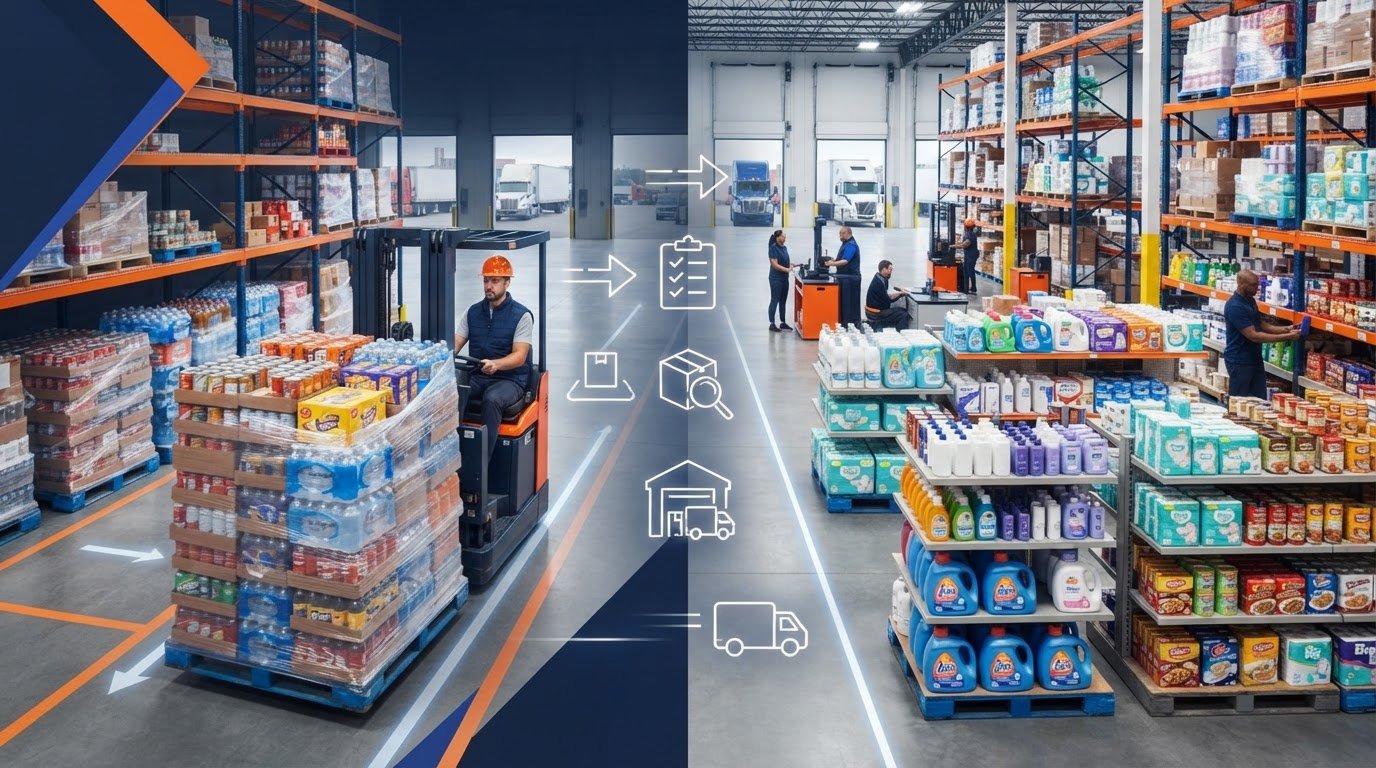
A redistributor buys products, holds inventory, and resells them to other businesses. It may bring products from different manufacturers together for distributor customers. A wholesale consumer goods supplier sells products in business-oriented quantities to retailers and other business buyers. Wholesale describes the sale of goods for resale or business use; redistribution describes an intermediary’s role in purchasing and reselling inventory within the supply chain.
These labels describe different functions, not a rule about where every product originates. A wholesale supplier may source through manufacturers, distributors, or other arrangements, so not every supplier bypasses intermediaries. Wholesaling provides useful background on the commercial role of wholesale trade. Dot Foods’ stated model is food-focused redistribution, while its assortment also includes non-food products.
In plain terms, redistribution moves products through an intermediary that consolidates inventory, while wholesale supply describes selling goods in bulk to business buyers.
How Dot Foods’ redistribution model works
Dot Foods describes a process of purchasing products, holding inventory, and supplying distributors. Consolidation lets a buyer access products from multiple manufacturers through a combined order rather than arranging a separate purchase from every source. This may simplify procurement when the products and order arrangement fit the buyer’s needs. These are Dot Foods’ stated capabilities, not a guarantee that every redistributor uses the same structure.
What a wholesale consumer goods supplier does
A wholesale supplier sells goods in quantities intended for business purchasing. The assortment, order structure, and sourcing path vary by supplier and product category. Some suppliers carry focused ranges; others serve buyers across several consumer goods categories. Evaluate what the supplier sells and how its ordering model fits your purchasing workflow instead of assuming all wholesalers operate alike.
MOC Imports Export GmbH is a wholesale and bulk import/export business, not a manufacturer. It serves business buyers across household, cleaning, personal care, baby, food, beverage, and pet supply categories. For example, a buyer sourcing cleaning products alongside personal care or baby goods may value access to a supplier with breadth across those categories. That breadth does not mean every order combines them.
- Redistribution: An intermediary purchases and holds products, then resells them to business customers.
- Wholesale supply: A supplier sells business quantities, with product range and order structure varying by supplier.
- Consolidation: Multiple products may be combined in an order, potentially reducing separate purchasing tasks.
- Supplier relationship: The relationship and sourcing path depend on the individual business model, not the label alone.
The Dot Foods redistributor vs direct wholesale consumer goods supplier decision starts with the role each model plays in your procurement chain. Identify whether you need a redistribution network for a food-focused assortment or a wholesale source for a broader consumer goods mix. Then compare product selection, ordering, and buyer coordination for the arrangements you are considering.
How Redistribution and Wholesale Supply Change Procurement
The sourcing model shapes the steps between choosing products and receiving stock. In redistribution, a company such as Dot Foods purchases and holds products, then consolidates items from different manufacturers for distributor orders. A wholesale supplier sells business quantities through its own purchasing and inventory process. The supplier may source through manufacturers or other channels, so “wholesale” alone doesn’t define a product’s origin.
Consolidation can simplify purchasing when one order replaces several separate buying tasks, provided the assortment and terms fit the buyer’s needs. It doesn’t automatically reduce total inventory or guarantee that products from different categories can be combined. Product eligibility, order structure, and minimums depend on the supplier’s stated terms.
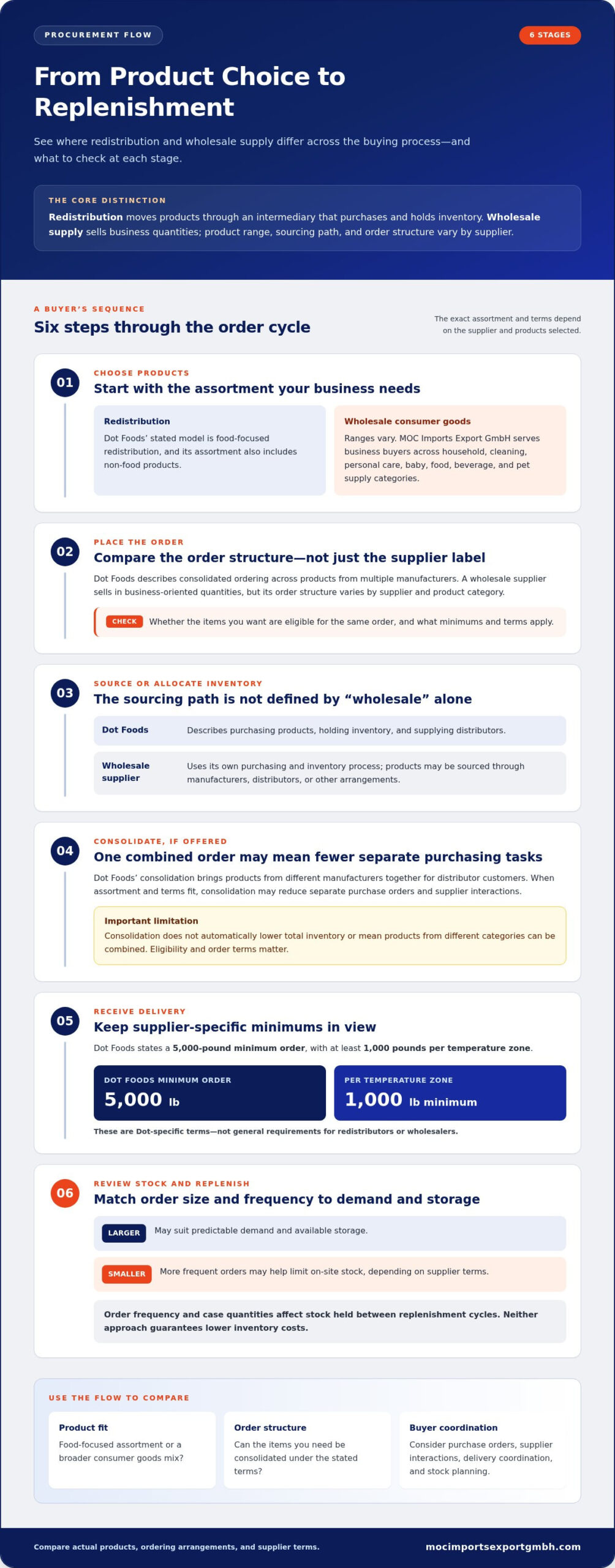
Procurement flow
Product selection → Order placement → Supplier sourcing or inventory allocation → Consolidation, if offered → Delivery receipt → Stock review and replenishment
Ordering, assortment, and supplier coordination
A consolidated order can reduce the number of purchase orders and supplier interactions involved in sourcing eligible products. Dot Foods states a 5,000-pound minimum order, with at least 1,000 pounds per temperature zone. These are Dot-specific terms, not standard requirements for redistributors or wholesalers generally.
Buying from multiple wholesale suppliers can provide access to category-specific assortments, but it may also mean separate ordering, delivery coordination, and invoice processes. A broad catalog can make product discovery easier, but category breadth doesn’t mean every category can be combined in one order. Compare the range you need with each supplier’s actual ordering structure.
Inventory and replenishment implications
Order frequency and case quantities affect how much stock a business must hold between replenishment cycles. Larger orders may suit predictable demand and available storage; smaller, more frequent orders may help limit on-site stock, depending on supplier terms. Neither approach guarantees lower inventory costs. The outcome depends on sales velocity, storage capacity, product shelf life where relevant, and reorder timing.
For cross-category buyers, plan replenishment by product group instead of assuming all items move at the same pace. Cleaning supplies, personal care products, and beverages may follow different demand patterns. Build a purchasing schedule around those differences and account for supplier-specific order constraints.
- Map the assortment: Separate core products from occasional purchases and note which categories matter most.
- Count coordination steps: Consider purchase orders, supplier contacts, receipts, and invoice handling.
- Match quantities to demand: Compare case sizes and order frequency with storage and expected stock movement.
- Review terms by supplier: Treat minimums, eligible products, and consolidation options as specific conditions, not model-wide rules.
When assessing the Dot Foods redistributor vs direct wholesale consumer goods supplier choice, compare the full procurement workflow, not just the number of products in a catalog. MOC Imports Export GmbH supplies wholesale and bulk consumer goods across categories including household, cleaning, personal care, baby, food, and beverages. Use your category mix and replenishment workflow to shape a practical sourcing plan.
Redistributor vs. Direct Wholesale Supplier: A Practical Comparison
The practical difference is not a universal price or speed advantage. It’s how each model fits your assortment and purchasing workflow. A redistributor can consolidate products across manufacturers for distributor buyers. A wholesale supplier sells business quantities, but its product range, sourcing channels, and order terms vary. “Direct” describes the buyer’s relationship with the supplier; it doesn’t guarantee that the supplier buys directly from manufacturers.
Comparison point
Redistributor: Purchases and resells products, often consolidating inventory from multiple sources. Dot Foods describes a food-focused redistribution model serving distributors.
Wholesale supplier: Sells products in bulk or business-oriented quantities. The supplier’s catalog and sourcing path depend on its own business model.
Product scope
Redistributor: Dot Foods states that its catalog includes food, beverages, non-food, and specialty items. Its product range is company-specific, not a standard definition of redistribution.
Wholesale supplier: May focus on one category or span consumer goods. Buyers should compare the actual assortment with their purchasing needs.
Order flow and coordination
Redistributor: Consolidated sourcing may reduce the number of separate purchasing touchpoints for eligible products.
Wholesale supplier: Buyers place orders within that supplier’s ordering structure. A broader catalog may help with assortment planning, but doesn’t automatically mean categories can be combined in one order.
Dot Foods reports more than 130,000 products from over 1,500 suppliers. Those figures describe Dot’s own network and catalog; they don’t establish what all redistributors offer. Compare the operational fit of each option, including purchase-order workload, product selection, delivery coordination, and stock planning. Neither model is inherently cheaper or faster for every buyer.
Where a redistributor may fit best
A redistributor may suit distributors sourcing food-industry products from multiple manufacturers who want a consolidated purchasing route. Fewer ordering touchpoints can be useful when the products fit the buyer’s needs and the ordering terms align with its workflow. Dot Foods’ stated capabilities and terms apply to Dot and shouldn’t be assumed to represent other redistributors.
Where a broader wholesale supplier may fit best
A broader consumer goods supplier may be relevant when procurement covers several categories, not only food. MOC Imports Export GmbH supplies wholesale and bulk products across household, cleaning, personal care, baby, food, beverage, and pet categories. For example, buyers can assess household cleaning products alongside personal care or baby goods. Category breadth alone doesn’t promise a combined order, specific minimum, or fulfillment arrangement.
Use the Dot Foods redistributor vs direct wholesale consumer goods supplier comparison to identify which model better matches your assortment and coordination needs. Then assess the actual product range and order flow instead of assuming the label determines the outcome.
How to Choose a Sourcing Model for Your Business
Choose a model by testing it against your actual purchasing workflow. A food-focused distributor and a buyer sourcing products across household, personal care, baby, and beverage categories may have different assortment and coordination needs. Use this four-step review to compare practical fit, not just the model’s name.
1. Match the sourcing model to your assortment
List priority categories, brands, and product formats before reviewing suppliers. Separate regular purchases from occasional needs, then estimate how much of your assortment is food-focused versus broader consumer goods. Foodservice or distributor buyers can assess whether Dot Foods’ stated food redistribution focus aligns with their product requirements. Buyers with cross-category plans should compare those plans with each supplier’s actual range. For example, a baby assortment can include products such as baby products, while other purchasing needs may sit in separate categories.
2. Compare the ordering process
Map how each option handles product selection, purchase orders, receipts, and invoicing. Note how many suppliers your team coordinates with and whether consolidation is available for the products you need. Don’t assume a supplier’s category breadth means every category can be combined in one order. Record supplier-specific minimums and order conditions from the supplier’s stated terms.
3. Check inventory against business scale
Relate order quantities and frequency to sales patterns, available storage, and staff capacity. A larger operation may have room for more stock, while a smaller buyer may need tighter replenishment planning. Neither scale determines the right model by itself. Review how quickly each product moves, how much space it occupies, and whether your reorder pattern can accommodate the supplier’s order structure.
4. Assess coordination and replenishment
Assign responsibility for ordering, receiving, storage, invoice processing, stock counts, and reorders. Then compare the expected workload under each model. A consolidated arrangement may reduce separate purchasing touchpoints, while category-focused suppliers may provide a closer match for specific product needs. The relevant measure is your team’s total coordination effort, not an assumed time or cost saving.
- Product fit: Does the assortment match your planned category mix and formats?
- Ordering: Can your team manage the order flow and supplier-specific terms?
- Inventory: Do order quantities and replenishment patterns fit demand and storage capacity?
- Coordination: Are responsibilities clear across purchasing, receiving, and reordering?
The Dot Foods redistributor vs direct wholesale consumer goods supplier decision becomes clearer once these four factors are written down. MOC Imports Export GmbH serves business buyers with wholesale and bulk consumer goods across multiple categories. Discuss your wholesale sourcing requirements in relation to your assortment and purchasing workflow.
MOC Imports Export GmbH as a Wholesale Consumer Goods Option
MOC Imports Export GmbH is a Germany-registered wholesale and bulk import/export company serving business customers nationally in the United States. Its consumer goods assortment spans household products, cleaning, personal care, baby products, food, beverages, and pet supplies. This breadth offers a sourcing option for buyers whose purchasing plans extend beyond a food-focused range. It doesn’t mean every category can be ordered together or follows the same terms.
When MOC’s wholesale assortment may suit your needs
Category range matters when you’re planning procurement across different consumer goods groups. For example, buyers can assess Oral-B products for oral care, Pampers for baby products, Dawn and Gain for cleaning, and CeraVe for personal care. These brands illustrate how a planned assortment may span categories. Compare your business’s actual needs with the product categories relevant to its purchasing plan.
Before selecting a wholesale partner, organize your requirements into a working list:
- Priority categories: Identify whether your purchasing is primarily food-focused or covers household, cleaning, personal care, baby, beverage, and other consumer goods.
- Brands and formats: Record the brands and product formats that match your assortment and purchasing workflow.
- Buying pattern: Note which items are recurring needs and which are occasional purchases.
This gives procurement teams a clearer basis for comparing a redistributor’s stated focus with a broader wholesale supplier’s categories. It also helps avoid treating a long product range as proof that all items share one order structure, minimum, or fulfillment arrangement.
Move from model comparison to a sourcing discussion
The decision comes down to assortment fit and the work required to purchase, receive, track, and replenish the goods. Buyers with food-industry distribution needs can consider whether Dot Foods’ redistribution model aligns with their requirements. Businesses sourcing branded consumer goods across several categories can assess whether a wholesale supplier’s range and ordering approach suit their procurement process. A practical sourcing plan reflects product priorities, demand patterns, storage, and the buyer’s capacity to coordinate orders.
For a structured evaluation, document your priority categories, products, and purchasing workflow before comparing sourcing arrangements. MOC Imports Export GmbH provides a wholesale and bulk import/export option for business buyers seeking consumer goods across multiple categories. Start with a clear outline of what your business buys and how it manages procurement.
Discuss your wholesale sourcing requirements with MOC Imports Export GmbH to identify how its consumer goods categories align with your business needs.
Put Your Sourcing Decision into Practice
The Dot Foods redistributor vs direct wholesale consumer goods supplier decision is an opportunity to make procurement more deliberate. Turn your comparison into a working brief: identify priority products, expected purchasing patterns, storage limits, and the coordination tasks your team needs to manage. This gives your business a practical reference point for evaluating sourcing arrangements as its needs change.
For buyers considering wholesale and bulk consumer goods supply across categories, MOC Imports Export GmbH offers a range that includes household, cleaning, personal care, baby products, food, beverages, and pet supplies. Branded examples include Oral-B, Pampers, Dawn, Gain, and CeraVe. Use your purchasing priorities to assess how this breadth relates to your business, without assuming different categories share one order structure.
Move forward with a clear view of your assortment and procurement workflow. Discuss your wholesale sourcing requirements with MOC Imports Export GmbH and take the next step toward a sourcing approach built around your business needs.
Frequently Asked Questions
What is the difference between Dot Foods and a wholesale supplier?
Dot Foods operates as a redistributor, while “wholesale supplier” describes a broader type of seller. For a buyer, the distinction matters when reviewing who handles product selection, order processing, and account coordination. Dot Foods describes a food-industry redistribution model. A business sourcing a mixed consumer goods assortment should compare its planned products with each supplier’s range and purchasing process instead of assuming the models serve identical needs.
Is Dot Foods a direct wholesale supplier?
Dot Foods describes itself as a redistributor that purchases products and supplies distributors and other customers. “Direct wholesale supplier” can mean different things in different purchasing conversations, and it doesn’t necessarily mean the seller buys directly from a manufacturer. To clarify the relationship, identify which company invoices your business, which products it supplies, and which party manages ordering and fulfillment for your account.
Can a wholesale supplier replace a food redistributor?
Sometimes, but only if the wholesale supplier’s range and purchasing arrangement meet the buyer’s food requirements. A restaurant distributor, for example, may need a particular food assortment and a consolidated supply route, while a general retailer might source food alongside household or personal care goods. Compare the actual products and operational responsibilities. If a supplier can’t meet a core category need, it may complement rather than replace another sourcing channel.
Which is better for small businesses, a redistributor or a wholesale supplier?
Neither is automatically better for a small business. A buyer with limited storage might prioritize order quantities and replenishment timing, while a business with a narrow product range may value category specialization. Consider who will manage purchasing, receiving, and stock records, especially if one employee handles several roles. A simple comparison using frequently purchased items can reveal which ordering process is manageable without assuming business size determines the answer.
How do I compare wholesale suppliers with Dot Foods?
Compare a representative basket of products your business regularly needs, then record whether each item fits the supplier’s assortment and ordering process. The Dot Foods redistributor vs direct wholesale consumer goods supplier comparison should also account for receiving steps and the records your team needs for reconciliation. Keep Dot Foods’ stated features separate from other suppliers’ terms. A like-for-like review helps reveal workflow differences without relying on broad claims.
Does direct wholesale always mean lower procurement costs?
No. “Direct” doesn’t guarantee a lower overall procurement cost because the label alone says little about the full work and inventory involved. Consider purchasing administration, the quantities your business must hold, receiving tasks, and the effort required to coordinate separate orders. An arrangement that appears simple at the ordering stage may require additional internal handling. Compare the complete process for the products you buy, not one claimed advantage in isolation.
